
Buying a home with a co-borrower can strengthen your mortgage application — but when that co-borrower is self-employed and carries student loan debt, the path to approval requires some extra preparation. FHA loans are often a popular choice for homebuyers because they offer more flexible credit and down payment standards compared to conventional financing. However, lenders still follow specific guidelines when evaluating co-borrowers who have non-traditional income and existing student obligations. Understanding the requirements for FHA loan with co-borrower who is self-employed and has student debt can make the difference between a smooth closing and an unexpected denial. This article walks you through what lenders look for, how income is calculated, and how student debt is treated in the approval process.
What Is an FHA Loan and Why Co-Borrowers Matter
An FHA loan is a government-backed mortgage insured by the Federal Housing Administration. Because the FHA provides insurance to lenders, these loans typically come with more accessible qualifying standards — including lower minimum credit scores and down payment requirements as low as 3.5%. This makes FHA financing a common choice for first-time homebuyers and those with limited savings.
A co-borrower is someone who applies for the mortgage alongside the primary borrower. Both parties share legal responsibility for repaying the loan, and both credit profiles, income sources, and debts are evaluated during underwriting. Adding a co-borrower can boost the overall application by combining incomes, which may help meet debt-to-income (DTI) ratio requirements.
However, when a co-borrower is self-employed and has student loans, lenders pay very close attention to how income is documented and how monthly debt obligations are calculated. These two factors — self-employment income and student debt — each carry their own set of FHA guidelines that borrowers should understand before applying.
FHA Credit and Down Payment Basics for Co-Borrowers
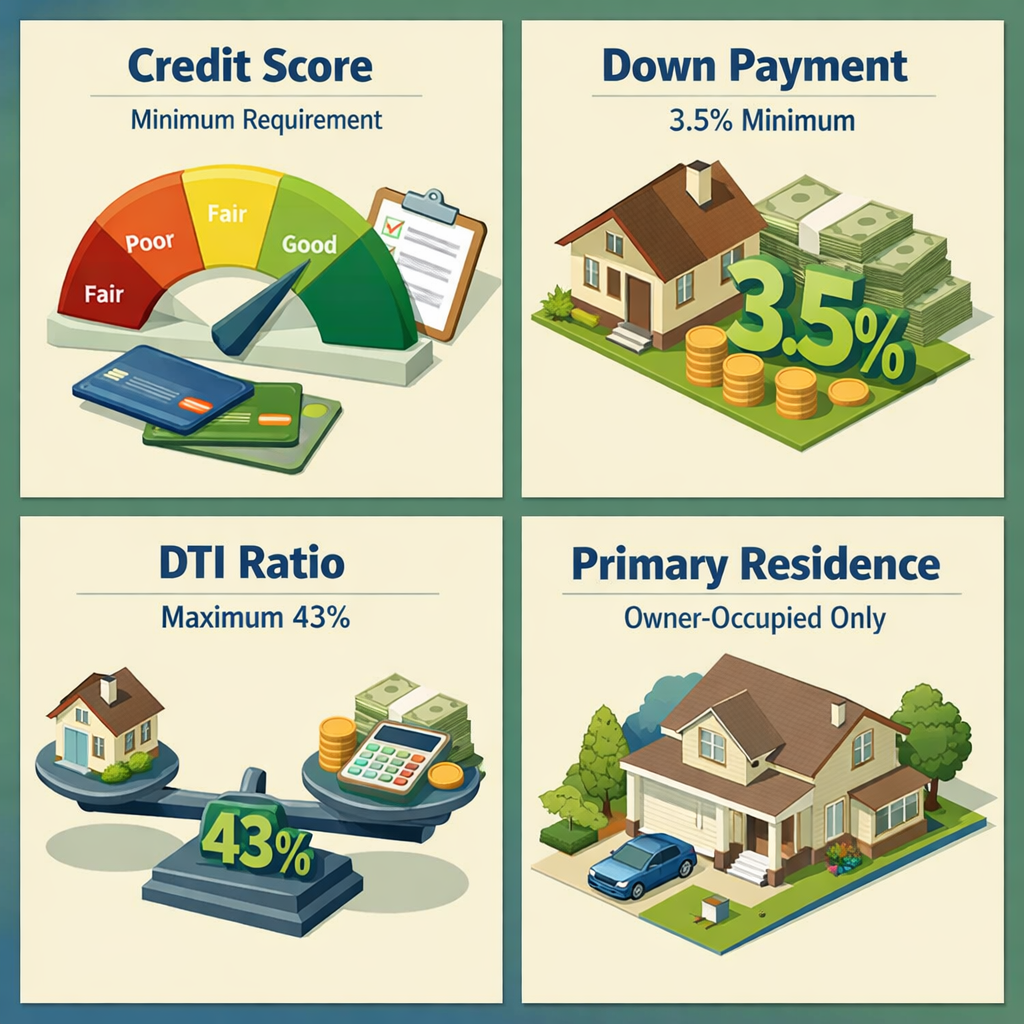
Before diving into the specifics of self-employment and student debt, it helps to understand the baseline FHA qualification standards that apply to all borrowers and co-borrowers.
- Minimum credit score: FHA guidelines generally require a minimum score of 580 to qualify for the 3.5% down payment option. Scores between 500 and 579 may still qualify but typically require a 10% down payment. Individual lenders may set higher thresholds.
- Down payment: The minimum down payment is 3.5% of the purchase price for borrowers with a 580 or higher credit score. Both borrowers and co-borrowers can contribute to this amount.
- Debt-to-income ratio: FHA loans typically allow a maximum DTI ratio of 43%, though some lenders may approve up to 50% with compensating factors such as strong reserves or a high credit score.
- Primary residence requirement: FHA loans are intended for owner-occupied primary residences. Co-borrowers do not need to live in the home, but the primary borrower must.
It's worth noting that lenders often have their own "overlays" — additional requirements beyond the FHA minimum standards. A co-borrower who is self-employed with student debt may encounter stricter documentation requests depending on the lender chosen.
How Lenders Evaluate Self-Employed Co-Borrower Income for FHA Approval
Self-employment income is one of the more complex areas of FHA underwriting. Unlike a salaried employee who can provide pay stubs and a W-2, a self-employed co-borrower must demonstrate income stability and continuity through more detailed documentation.
Two-Year History Requirement
FHA guidelines typically require that self-employed borrowers have at least a two-year history of self-employment. This history is usually verified through federal tax returns — both personal and business — filed over the past two years. Lenders use this to establish that the self-employment income is stable and likely to continue.
How Net Income Is Calculated
For self-employed co-borrowers, lenders generally use the net income reported on tax returns rather than gross revenue. This means that business deductions — which are common among self-employed individuals — can significantly reduce the qualifying income figure. Lenders typically average the net income over two years, and if income has declined year over year, they may use the lower of the two figures or apply additional scrutiny.
Required Documentation for Self-Employed Co-Borrowers
- Two years of personal federal tax returns (all schedules)
- Two years of business tax returns if applicable (partnerships, S-corps, or C-corps)
- A year-to-date profit and loss statement, often prepared by a CPA
- Business bank statements to verify cash flow
- Evidence of business ownership percentage (if applicable)
- CPA letter confirming the business is currently active
Lenders may also request additional documentation if the co-borrower's income fluctuates significantly between years. It's a good idea for self-employed co-borrowers to work with a tax professional who understands mortgage qualification well before applying.
Student Loan Debt and How FHA Guidelines Handle It for Co-Borrowers
Student loans are a significant financial factor for many Americans, and FHA has specific rules about how this debt is counted in the DTI ratio calculation. These rules apply equally to primary borrowers and co-borrowers.
Monthly Payment Calculation Under FHA Rules
FHA guidelines require that all student loan balances be included in the co-borrower's monthly debt obligations when calculating DTI — even if the loans are in deferment or on an income-driven repayment (IDR) plan. Specifically, if the actual monthly payment is greater than zero, that amount is used. If the payment is zero — as is sometimes the case with IDR or deferment — lenders are typically required to use 1% of the outstanding loan balance as the assumed monthly payment for qualification purposes.
For example, if a co-borrower has $60,000 in student loan debt and is currently on a deferment plan with a $0 payment, the lender would likely count $600 per month ($60,000 x 1%) toward their DTI. This can have a meaningful impact on the overall debt ratio, potentially reducing how much mortgage the combined borrowers can qualify for.
Income-Driven Repayment Plans and FHA
Some lenders may accept the documented IDR payment if it appears on the credit report and is greater than zero. However, policies can vary between lenders, so it's important to confirm how a specific lender handles this situation. If a co-borrower is expecting their student loans to be forgiven or significantly reduced in the future, lenders generally cannot factor that into current qualification decisions unless there is documented and verified evidence of approval for a forgiveness program.
Strategies for Managing Student Debt Impact
- Consider enrolling in an income-driven repayment plan before applying so that a lower documented payment may be considered by some lenders
- Pay down student loan balances where possible to reduce the 1% calculation threshold
- Pair strong compensating factors — such as significant cash reserves or a high credit score — to offset a higher DTI caused by student debt
The Combined Effect: Meeting the Requirements for FHA Loan With Co-Borrower Who Is Self-Employed and Has Student Debt
When a co-borrower brings both self-employment income and student loan obligations to an FHA application, lenders must carefully analyze both variables together. The interaction between reduced qualifying income (due to business deductions) and inflated monthly obligations (due to student debt counting rules) can create a tighter DTI picture than either factor alone.
Here's how this might play out in practice: A co-borrower earns $90,000 in gross business revenue but reports $55,000 in net income after deductions on their tax return. Their average qualifying income over two years may come to around $4,500 per month. If they also carry $70,000 in student loans on a $0 deferment plan, the lender would likely add approximately $700 per month to their monthly obligations — before factoring in any other debts like car payments or credit cards.
This is why preparation is so important. Self-employed co-borrowers with student debt should review their tax returns carefully, reduce unnecessary deductions in the year or two before applying if it improves net income, and work with a mortgage professional who has experience with FHA loan approval nuances.
Meeting the requirements for FHA loan with co-borrower who is self-employed and has student debt is certainly achievable, but it requires a more thorough approach to financial preparation than a standard salaried applicant might need.
Documentation Checklist and Tips to Strengthen Your FHA Application
Organization and completeness are two of the most important factors in getting an FHA application with a self-employed co-borrower approved efficiently. Lenders want to see a clear, consistent picture of income and debt, so gaps or inconsistencies in documentation can trigger additional underwriting questions or delays.
Essential Documents for the Self-Employed Co-Borrower
- Two years of signed personal federal tax returns
- Two years of business tax returns (if the co-borrower owns 25% or more of a business)
- Year-to-date profit and loss statement (prepared or reviewed by a licensed CPA)
- Business and personal bank statements (typically 2–3 months)
- Proof of business license or registration
- CPA letter confirming business existence and current activity
- Student loan account statements showing current balance and payment status
- Documentation of any income-driven repayment enrollment
Practical Tips to Improve Approval Odds
- Work with an FHA-experienced lender: Not all mortgage lenders handle self-employed borrowers or complex student debt scenarios the same way. Choosing a lender with a strong FHA track record can make a significant difference.
- Build up cash reserves: Having two to six months of mortgage payments in reserve is a common compensating factor that can help offset a higher DTI ratio.
- Maintain a healthy credit profile: Both borrowers should aim to keep credit utilization low, avoid new debt, and make all payments on time in the months leading up to the application.
- Get pre-qualified early: Speaking with a loan officer before you start house-hunting helps identify potential issues while there's still time to address them. Understanding the key requirements, documentation rules can help you qualify with confidence.
●Conclusion
Navigating the FHA loan requirements co-borrower self-employed student loans landscape may seem complex at first, but with the right preparation and guidance, it's a very manageable process. The key is understanding how lenders view self-employment income — through averaged net figures from tax returns — and how student debt is calculated, often as 1% of the outstanding balance if no qualifying payment is documented. When both factors combine, the DTI impact can be meaningful, but it's not insurmountable. Strong documentation, a reliable CPA, cash reserves, and a good credit score can all work in your favor. If you're ready to explore your FHA loan options with a co-borrower, consider reaching out to a knowledgeable mortgage professional at LoanWise who can walk you through your specific scenario and help you build the strongest possible application.