
Buying a home is one of the most significant financial decisions you'll ever make — and for many homebuyers, an FHA loan is the most accessible path to homeownership. But what happens when a co-borrower on the application has recently gone through bankruptcy and is also carrying student loan debt? It's a situation more common than you might think, and the good news is that it doesn't automatically disqualify you. Understanding the requirements for FHA loan with co-borrower recent bankruptcy and student loans can help you plan strategically, set realistic expectations, and move forward with confidence. This guide walks you through everything you need to know.
What Is an FHA Loan and Why Does It Matter for Borrowers With Complex Credit Histories?
An FHA loan is a government-backed mortgage insured by the Federal Housing Administration. Because the federal government guarantees these loans, lenders are generally more willing to work with borrowers who have lower credit scores, limited down payment savings, or less-than-perfect credit histories. This makes FHA loans a popular choice among first-time homebuyers, recent graduates managing student loans, and individuals rebuilding their financial lives after events like bankruptcy.
The FHA program is designed with flexibility in mind. While conventional loans may require higher credit scores and stricter debt-to-income thresholds, FHA guidelines often provide more room for borrowers navigating difficult financial backgrounds. That said, flexibility doesn't mean there are no rules. Specific eligibility criteria still apply — especially when a co-borrower brings additional complexities like a recent bankruptcy filing or ongoing student loan obligations.
Adding a co-borrower to an FHA loan application can be a smart strategy. A co-borrower's income, assets, and credit profile are all considered during underwriting, which may strengthen the overall application. However, the co-borrower's liabilities — including any bankruptcy history and student loans — are equally factored in. Understanding how lenders evaluate these factors is essential before you apply.
FHA Bankruptcy Waiting Periods: Chapter 7 vs. Chapter 13 Explained
One of the most critical components of the requirements for FHA loan with co-borrower recent bankruptcy and student loans involves the mandatory waiting periods following a bankruptcy discharge. The FHA distinguishes between two common types of personal bankruptcy: Chapter 7 and Chapter 13.
Chapter 7 Bankruptcy
A Chapter 7 bankruptcy involves the liquidation of non-exempt assets to discharge most unsecured debts. Under current FHA guidelines, a co-borrower who has filed Chapter 7 may typically need to wait at least two years from the discharge date before becoming eligible for an FHA-backed mortgage. This two-year period is sometimes referred to as a "seasoning" requirement.
In some cases, lenders may consider applications sooner — sometimes as little as one year — if the co-borrower can demonstrate that the bankruptcy was caused by extenuating circumstances beyond their control, such as a serious illness, job loss, or other documented hardship. However, this exception is not guaranteed, and lenders will likely require extensive documentation and evidence of financial recovery during the shortened period.
Chapter 13 Bankruptcy
Chapter 13 bankruptcy involves a structured repayment plan rather than full liquidation. Under FHA guidelines, a borrower or co-borrower who is currently in an active Chapter 13 repayment plan may still be eligible for an FHA loan, provided they have made at least 12 months of on-time payments under the plan and have received written court approval to take on new mortgage debt. If the Chapter 13 has already been discharged, no additional waiting period is typically required beyond the discharge date, though lenders may still review the overall credit profile carefully.
It's worth noting that individual lender overlays — additional requirements set by private lenders above FHA minimums — may impose stricter waiting periods. Always check with your specific lender about their internal policies.
How Student Loan Debt Affects FHA Loan Qualification for Co-Borrowers
Student loan debt is one of the most common financial challenges facing today's homebuyers, and it plays a significant role in FHA loan underwriting. When a co-borrower carries student loans, lenders must account for those obligations when calculating the debt-to-income (DTI) ratio — a key metric used to assess a borrower's ability to manage monthly mortgage payments alongside existing debts.
How FHA Calculates Student Loan Payments
The FHA has specific guidelines for how student loan payments are counted in DTI calculations, and these rules have evolved in recent years. If a co-borrower's student loans are currently in deferment or on an income-driven repayment plan, lenders may still be required to count a portion of the loan balance as a monthly obligation. Under updated FHA guidelines, lenders are generally instructed to use either the actual monthly payment shown on the credit report or — if that payment is zero — a percentage of the outstanding loan balance (often cited as 0.5% of the total balance per month). This can meaningfully impact the co-borrower's DTI ratio.
Debt-to-Income Ratio Thresholds
FHA loans typically allow a maximum DTI ratio of up to 43% in most standard cases, though some lenders may approve applications with ratios reaching 50% or higher when compensating factors are present — such as significant cash reserves, a strong primary borrower profile, or a larger down payment. When student loans push the co-borrower's DTI above acceptable thresholds, it may reduce the total mortgage amount you qualify for or require additional documentation.
If the co-borrower's student loans are on an income-driven repayment plan, it may be worth exploring whether refinancing those loans to a fixed payment structure could improve the overall DTI picture. However, decisions about student loan repayment should be made carefully, as they can have broader financial implications beyond just mortgage qualification.
Credit Score Requirements When a Co-Borrower Has Bankruptcy on Their Record
Credit scores are a central piece of any FHA loan application, and they carry added weight when a co-borrower has a bankruptcy in their history. A bankruptcy filing can significantly lower a credit score, and the effects may linger on the credit report for up to seven years for Chapter 13 and up to ten years for Chapter 7.
Under standard FHA guidelines, borrowers typically need a minimum credit score of 580 to qualify for the 3.5% down payment option. Borrowers with scores between 500 and 579 may still be eligible, but they're generally required to put down at least 10%. If a co-borrower's score has been impacted by bankruptcy and hasn't fully recovered, the overall application may need to rely more heavily on the primary borrower's creditworthiness.
It's important to understand that lenders usually evaluate the lower of the two middle scores when determining which credit tier applies to the application. If the co-borrower's score is significantly lower than the primary borrower's, it could pull the qualifying score down and affect loan terms, interest rates, or eligibility altogether.
Building credit after bankruptcy takes time and intentional effort. Strategies that may help include becoming an authorized user on a well-managed account, opening a secured credit card, making all payments on time, and keeping credit utilization low. Even modest improvements in the co-borrower's credit score during the waiting period following bankruptcy can make a meaningful difference when it's time to apply.
The Role of the Co-Borrower in Strengthening or Weakening an FHA Application
Understanding the full impact a co-borrower has on an FHA mortgage application is essential for making informed decisions. A co-borrower is someone who shares equal responsibility for repaying the loan and whose financial profile — income, debts, credit, and history — is fully evaluated alongside the primary borrower's.
When a co-borrower brings strengths such as stable employment, consistent income, or significant assets, those positives can genuinely bolster the application. A higher combined income may increase the loan amount you qualify for, while documented savings and reserves can serve as compensating factors that offset other risk signals.
On the other hand, a co-borrower with a recent bankruptcy and substantial student loan debt may introduce risk factors that lenders scrutinize closely. These liabilities don't automatically lead to rejection, but they do require careful preparation. Lenders will want to see:
- Documentation of the bankruptcy discharge date and confirmation that the required waiting period has been satisfied
- Evidence of rebuilt credit, including recent on-time payment history since the bankruptcy
- A clear picture of all student loan obligations, including current repayment status and monthly payment amounts
- A letter of explanation detailing the circumstances that led to the bankruptcy and what has changed since then
- Proof of stable income for both the primary borrower and co-borrower to demonstrate repayment capacity
Being proactive about gathering this documentation before you apply can reduce delays and show lenders that you're a prepared, responsible applicant.
Practical Steps to Meet the Requirements for FHA Loan With Co-Borrower Recent Bankruptcy and Student Loans
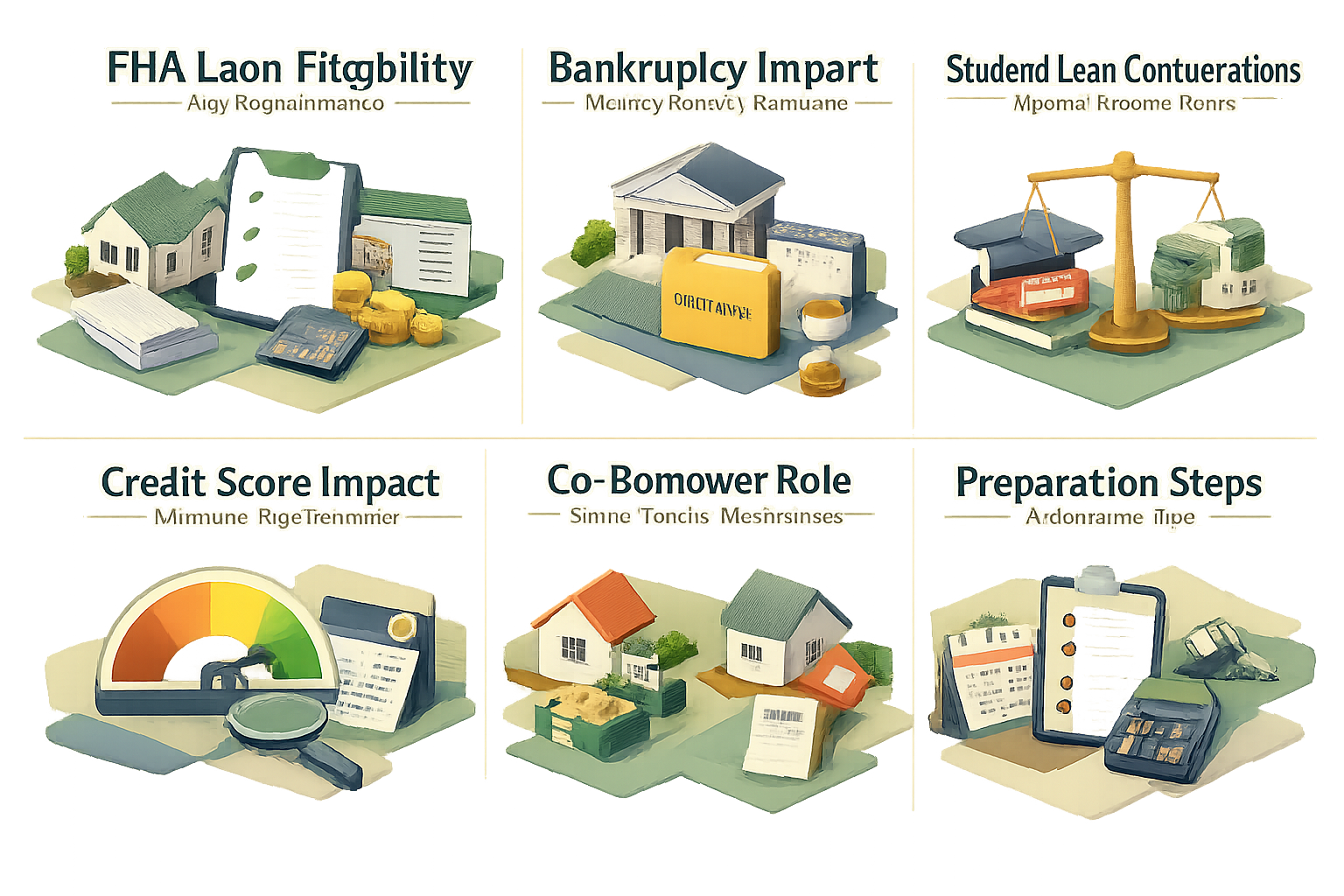
Preparation is the most powerful tool available to homebuyers navigating this type of complex mortgage application. Meeting the requirements for FHA loan with co-borrower recent bankruptcy and student loans isn't simply about waiting out a clock — it's about using that time wisely to rebuild financial strength.
Monitor and Improve Credit Proactively
Both the primary borrower and co-borrower should regularly check their credit reports for errors, especially after a bankruptcy discharge. Inaccurate negative entries can drag scores down unnecessarily. Disputing errors through the major credit bureaus is a straightforward process and can yield meaningful score improvements over time.
Manage Student Loan Accounts Carefully
Keeping student loan accounts in good standing is critical. Even a single missed payment can set back credit recovery efforts significantly. If the co-borrower is on an income-driven repayment plan with very low monthly payments, it may be worth consulting a financial advisor to assess whether transitioning to a standard repayment plan could improve DTI calculations for mortgage purposes.
Build a Stronger Down Payment Reserve
A larger down payment can serve as a meaningful compensating factor. While FHA loans allow as little as 3.5% down for qualifying borrowers, contributing more — such as 10% or more — can demonstrate financial discipline to lenders and may help offset the risk associated with a co-borrower's bankruptcy history.
Work With an Experienced FHA Lender
Not all lenders interpret FHA guidelines in the same way, and lender overlays can vary significantly. Working with a mortgage professional who has experience handling FHA applications involving bankruptcy and student loan debt can make a substantial difference. They can help you understand exactly what's required, identify potential red flags before they become problems, and guide you toward the strongest possible application.
●Conclusion
Qualifying for an FHA loan when a co-borrower has a recent bankruptcy and student loans is genuinely achievable — it simply requires understanding the rules, meeting the timelines, and presenting a well-documented application. The FHA loan program was built to give borrowers a fair path to homeownership, even after financial setbacks. By knowing the waiting periods, managing student loan obligations strategically, and rebuilding credit with intention, you and your co-borrower can position yourselves for approval. If you're ready to explore your options or want to understand exactly where you stand, reach out to a knowledgeable FHA lender today. The road to homeownership may be closer than you think.