Buying a home on a tight credit profile can feel overwhelming, but it doesn't have to be. The Federal Housing Administration (FHA) loan program was designed specifically to help borrowers who may not qualify for conventional financing. If you're exploring the requirements for FHA loan with 580 credit score and child support income, you're already thinking in the right direction. This article breaks down exactly what lenders expect, how child support income is treated during underwriting, and what steps you can take to strengthen your application before you apply.
What Makes FHA Loans a Strong Option for Borrowers With Lower Credit Scores
FHA loans are government-backed mortgages insured by the Federal Housing Administration. Because the government reduces the lender's risk, FHA-approved lenders can offer financing to borrowers with credit profiles that wouldn't typically qualify for conventional loans. That's a meaningful advantage for many first-time homebuyers and those rebuilding their financial history.
The FHA loan minimum credit score threshold that most lenders work with is 580. At that score, borrowers may qualify for the program's lowest down payment option, which is typically 3.5% of the purchase price. Borrowers with scores between 500 and 579 may still be eligible, but they're often required to put down at least 10%. It's worth noting that individual lenders can set their own minimum score requirements above the FHA's baseline, so some institutions may require a 600 or 620 even though the program technically permits 580.
Beyond credit scores, FHA underwriting looks at your debt-to-income (DTI) ratio, employment history, and the property itself. Lenders generally prefer a DTI ratio at or below 43%, though exceptions can sometimes be made with compensating factors like strong reserves or a low loan-to-value ratio. Understanding these thresholds ahead of time helps you approach your application with confidence.
How Child Support Income Is Evaluated During FHA Underwriting
One of the most common questions from single parents and co-parents seeking a mortgage is whether child support counts as qualifying income. The good news is that FHA guidelines do allow child support to be counted — but lenders apply specific rules before they'll include it in your income calculation.
For child support income to be considered, lenders typically require that the payments have been received consistently for a minimum of six months prior to the loan application. They also want to see evidence that the payments are likely to continue for at least three years after the loan closes. This continuation requirement is key, because lenders view income that may stop in the near term as unreliable for a long-term obligation like a mortgage.
In addition to the duration of payments, lenders will review the legal agreement behind the support. A court order or legally binding divorce decree that specifies the payment amount is usually required. Voluntary arrangements without documentation may not be accepted, even if payments have been made regularly. This is an area where working with an experienced FHA lender or mortgage broker can make a real difference in how your file is prepared.
Documentation You'll Need to Verify Child Support as Qualifying Income
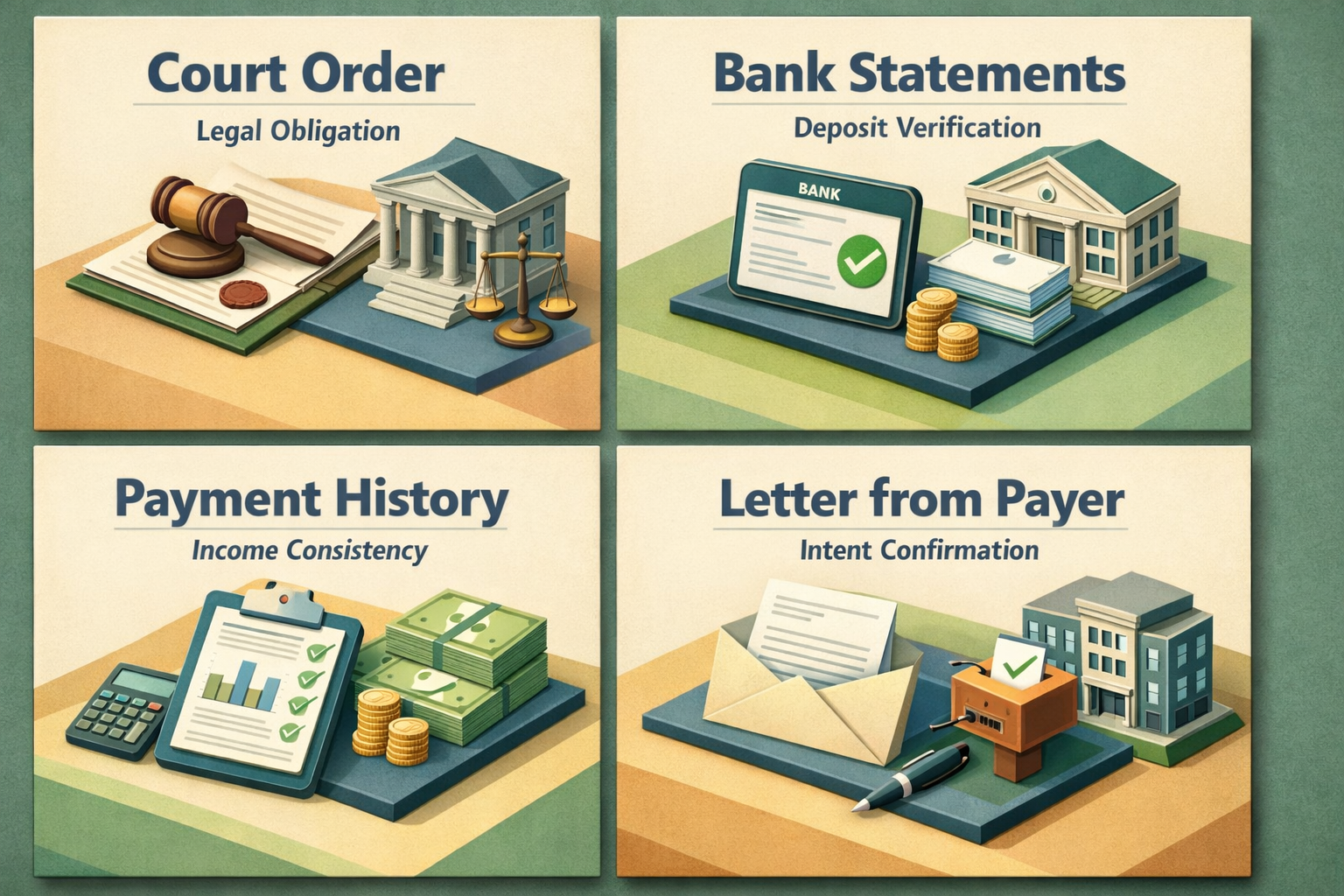
When you're meeting the requirements for FHA loan with 580 credit score and child support income, documentation is everything. Lenders need a paper trail that confirms the income is real, consistent, and legally obligated. Here's what you'll likely be asked to provide:
- Court order or divorce decree: This document establishes the legal obligation and shows the payment amount and duration.
- Bank statements: Lenders typically want to see 12 months of bank statements that show deposits matching the required support amount. Gaps or inconsistencies can raise questions.
- Payment history records: Some lenders may accept printouts from a state child support enforcement agency as additional verification.
- Letter from the paying party: In some cases, a written statement confirming the payer's intent to continue can support your application, though a court order carries much more weight.
It's also worth knowing that if child support payments are not being received consistently, lenders may decline to use that income entirely. If payments have been irregular, you may want to allow more time to build a stronger history before applying. Being proactive about your documentation can save you significant stress during the underwriting process.
Meeting the Credit Score Floor: What a 580 Score Means in Practice
A 580 credit score sits in what credit bureaus often classify as the "fair" range. While it's not ideal, it's workable under the FHA program. Lenders will pull scores from all three major credit bureaus — Equifax, Experian, and TransUnion — and typically use the middle score for qualification purposes. If you're applying with a co-borrower, lenders generally use the lower of the two middle scores.
At 580, your interest rate will likely be higher than what a borrower with a 700-plus score would receive. That's because lenders price risk into the rate, and a lower score signals a higher statistical likelihood of default. Over the life of a 30-year mortgage, even a modest rate difference can translate into tens of thousands of dollars in additional interest. That's why many mortgage advisors recommend taking a few months to improve your score before applying if you're close to a meaningful threshold like 620 or 640.
Steps that may help improve a 580 score include paying down revolving balances, avoiding new hard inquiries, disputing any inaccurate negative items on your credit report, and keeping older accounts open to preserve your credit history length. These aren't quick fixes, but even a 20- to 40-point improvement could open up better rate options and potentially lower your monthly payment.
Debt-to-Income Ratio Considerations When Child Support Is in the Picture
Child support can affect your DTI ratio in two directions, depending on your situation. If you're receiving child support, it adds to your qualifying income, which can lower your DTI and improve your application. If you're paying child support, it counts as a monthly debt obligation, which increases your DTI and could limit how much you can borrow.
For borrowers who pay child support, lenders will include the court-ordered monthly amount in your total debt load. If that obligation pushes your DTI above the standard threshold, you may need to pay down other debts, increase your verifiable income, or explore a less expensive home to bring your ratios back into range.
For borrowers receiving child support, including it as income can be a genuine asset to your application. It may be the income source that pushes your qualifying income high enough to cover your target monthly payment. That's why getting your documentation in order matters so much — properly documented child support income could be the difference between an approval and a denial.
Other FHA Loan Requirements Worth Knowing Before You Apply
Beyond credit scores and income, there are several additional requirements that apply to FHA loans regardless of your income sources. Understanding these upfront helps you avoid surprises during the approval process.
- Primary residence only: FHA loans are intended for owner-occupied properties. You can't use an FHA loan to purchase an investment property or vacation home.
- Mortgage insurance premiums (MIP): FHA loans require both an upfront MIP (typically 1.75% of the loan amount) and an annual MIP paid monthly. This insurance protects the lender and is a cost borrowers should factor into their budget.
- Employment and income history: Lenders typically want to see at least two years of consistent employment or self-employment history. If you've changed jobs recently, that doesn't automatically disqualify you, but lenders will look at whether the change was in the same field.
- Property standards: The home you're buying must meet FHA minimum property requirements. An FHA appraiser will assess the property's condition, and certain safety or habitability issues must be resolved before closing.
- Loan limits: FHA loan limits vary by county and are updated annually. Your target purchase price must fall within the limit for your area.
It's also worth shopping among multiple FHA-approved lenders. Rates, fees, and overlays (lender-specific requirements for FHA loan minimums) can vary meaningfully, and comparing at least two or three offers is a sound practice that could save you money over the life of the loan.
●Conclusion
The requirements for FHA loan with 580 credit score and child support income are manageable with the right preparation. FHA loans offer a real pathway to homeownership for borrowers who've faced credit challenges or rely on non-traditional income sources like child support. The key is understanding what lenders need — consistent payment history, proper legal documentation, and a DTI ratio that works within program guidelines — and building your application accordingly.
Whether you're a first-time homebuyer navigating a divorce settlement or a single parent looking to establish stable housing, the FHA program could be the right fit. Take time to gather your documentation, review your credit report for errors, and speak with an FHA-approved lender who has experience handling child support income. With the right guidance and a clear picture of your finances, homeownership may be closer than you think. At LoanWise, we're here to help you understand your options and take the next confident step forward.