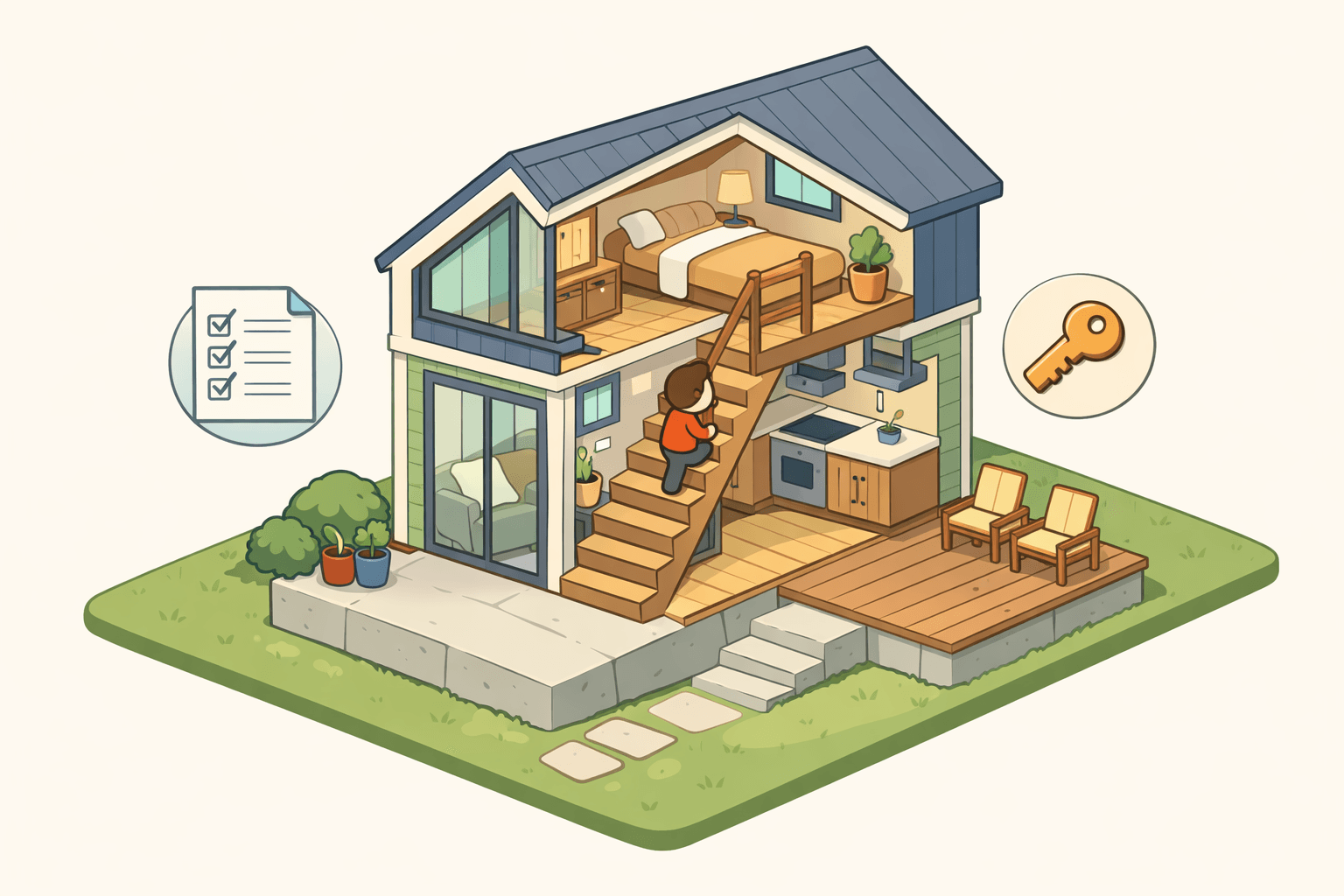
The tiny home movement has captured the attention of homebuyers across the country. Smaller footprints, lower utility costs, and a simpler lifestyle are all part of the appeal. But when it comes to financing, many buyers quickly discover that not every mortgage program is designed with compact living in mind. If you're exploring an FHA tiny home mortgage, there's a lot to understand before you submit an application. The good news is that FHA financing may be an option — but only if the property and the borrower meet a specific set of criteria. This article walks you through the requirements for FHA loan on a tiny home with a loft bedroom, so you can approach the process with confidence and clarity.
What Makes a Tiny Home Eligible for FHA Financing
The Federal Housing Administration does not have a loan product specifically labeled for tiny homes. Instead, FHA loans follow a set of property eligibility standards that any home — including a small one — must satisfy. This means a tiny home could qualify, but it needs to check every box that a traditional home would.
The first and most foundational requirement is that the property must be considered real property, not personal property. This distinction is critical. A tiny home that sits on a permanent foundation and is affixed to land owned by the borrower is far more likely to qualify than one parked on a rented lot or mounted on a trailer. If the home can be moved, it is typically classified as a vehicle or chattel, which falls outside the scope of standard FHA financing.
Beyond the foundation requirement, the home must also serve as the borrower's primary residence. FHA loans are not designed for vacation properties or investment rentals. The buyer must intend to live in the home as their main dwelling. This applies equally to a 900-square-foot cottage and a 2,500-square-foot suburban house.
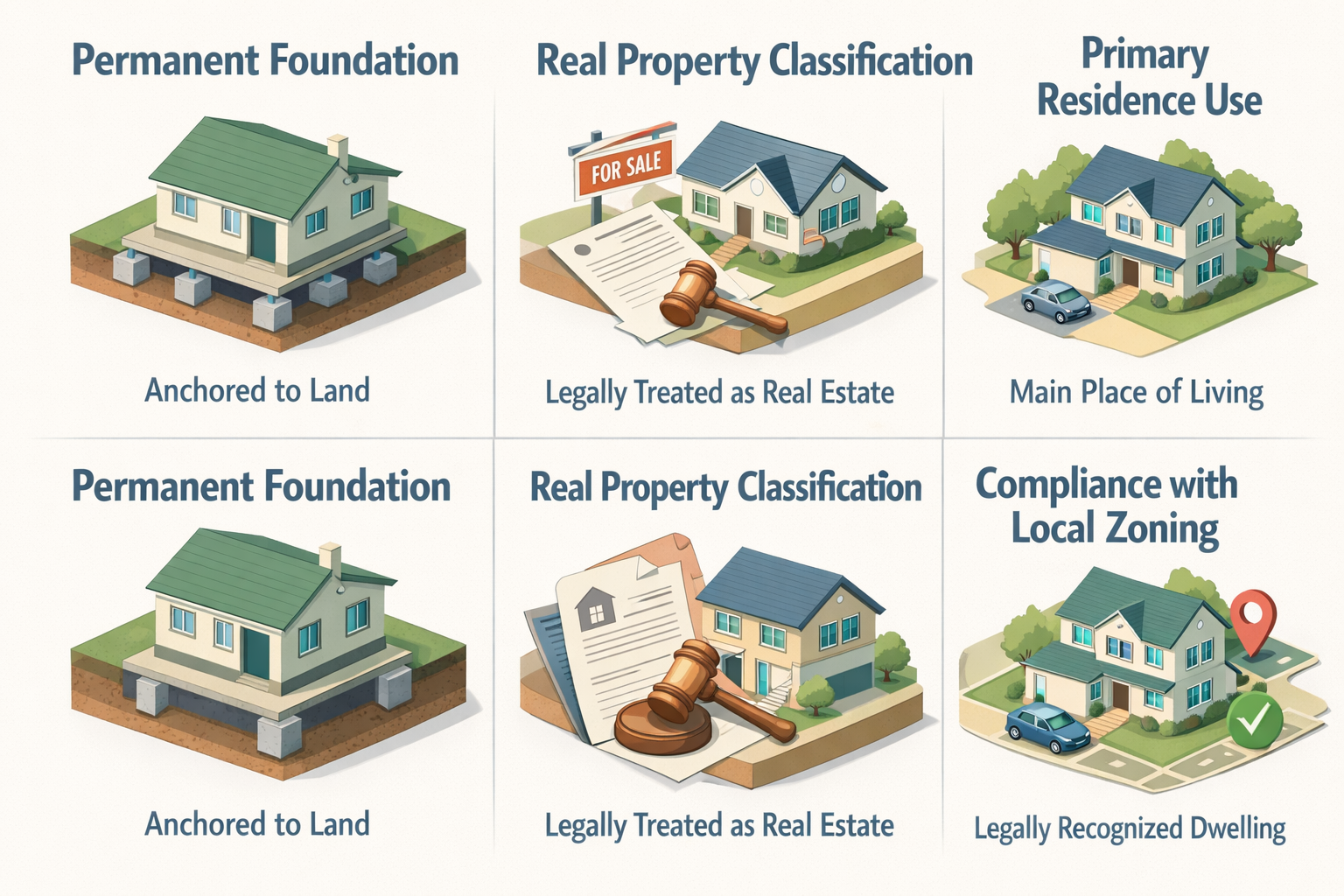
- Permanent foundation: The structure must be anchored to land in a way that meets local building codes.
- Real property classification: The home and land must be legally treated as real estate, not personal property.
- Primary residence use: The borrower must occupy the home as their main place of living.
- Compliance with local zoning: The property must be legally recognized as a residential dwelling in its jurisdiction.
The Minimum Size Rule and Why It Matters for Tiny Homes
One of the most commonly asked questions among tiny home buyers involves square footage. FHA guidelines do reference a minimum floor area requirement, and this is where many tiny homes run into trouble. According to HUD guidelines, a single-family home must have at least 400 square feet of living space to be eligible for FHA financing. Some lenders may apply their own overlays with slightly different thresholds, so it's worth confirming the exact figure with your lender early in the process.
For context, many popular tiny home designs range from 100 to 400 square feet. That means a significant number of tiny homes may fall below the FHA minimum, making them ineligible regardless of how well-built or charming they are. Buyers who are drawn to ultra-compact designs of under 300 square feet may find that FHA financing simply isn't available for those particular properties.
On the other hand, tiny homes that sit closer to the 400-to-600 square foot range may have a better chance of qualifying — provided all other requirements are also met. If you're in the process of selecting or building a tiny home with FHA financing in mind, it's wise to plan around that minimum threshold from the very beginning.
Loft Bedroom FHA Loan Considerations: Ceiling Height and Habitability
The loft bedroom is one of the most distinctive features of a tiny home — and it's also one of the most scrutinized during an FHA appraisal. FHA appraisers use HUD's Minimum Property Standards to evaluate whether every living space in the home is safe, sound, and sanitary. A loft that functions as the home's primary or only sleeping area must meet certain habitability benchmarks to be counted as a legitimate bedroom.
One of the key considerations for a loft bedroom FHA loan is ceiling height. HUD guidelines generally require a minimum ceiling height of 7 feet for at least 50 percent of the room's floor area in habitable spaces. Many loft designs feature sloped or angled ceilings that dip well below this threshold. If the loft doesn't meet the ceiling height standard, an FHA appraiser may decline to count it as a bedroom — or may flag the space as non-conforming.
In addition to ceiling height, the loft must also have adequate access. A fixed staircase is viewed much more favorably than a ship's ladder or pull-down steps. While FHA guidelines don't explicitly ban ladder-style access, appraisers and underwriters may view it as a safety concern, particularly if the loft is the only sleeping area in the home. Other habitability factors include:
- Natural light and ventilation: Habitable rooms typically require at least one window or other means of natural light and air circulation.
- Egress in emergencies: The space should allow occupants a reasonable means of escape in the event of a fire or emergency.
- Adequate access: A fixed staircase is the safest and most appraiser-friendly option for reaching a loft bedroom.
- Structural integrity: The loft floor must be able to support normal residential loads without posing a safety risk.
Because loft bedrooms in tiny homes are so varied in design, the outcome of an FHA appraisal can differ from one property to the next. Working with an appraiser who has experience evaluating non-traditional homes may help ensure a more accurate and fair assessment.
Borrower Credit and Financial Requirements for Unconventional Home FHA Financing
Even when a tiny home clears every property hurdle, the borrower still needs to qualify on their own financial merits. Unconventional home FHA financing follows the same credit and income standards as a traditional FHA mortgage. There are no special exceptions for buying a smaller property.
FHA loans are known for their relatively accessible credit thresholds. Borrowers with a credit score of 580 or higher may qualify for the program's standard 3.5 percent down payment. Those with scores between 500 and 579 may still be eligible, but lenders typically require a 10 percent down payment in those cases. Keep in mind that individual lenders often set their own credit score minimums above FHA's baseline, a practice known as a lender overlay.
In addition to credit score, FHA lenders will evaluate:
- Debt-to-income ratio (DTI): FHA guidelines generally allow a back-end DTI of up to 43 percent, though some lenders may approve higher ratios with compensating factors.
- Employment and income history: Lenders typically look for at least two years of steady employment or self-employment history.
- FHA mortgage insurance premiums (MIP): All FHA loans require both an upfront MIP and an annual MIP, which adds to the monthly cost of the loan.
- Loan limits: FHA loan limits vary by county. Because tiny homes are often lower in price, they typically fall well within local FHA limits — but it's still worth verifying.
One nuance worth noting is that because tiny homes often carry lower purchase prices, the loan amount may be quite small. Some lenders set minimum loan amounts that could make it difficult to finance a very inexpensive property. It's a good idea to ask lenders upfront whether they have a floor on how small a loan they'll originate.
The FHA Appraisal Process for a Tiny Home With a Loft
Every FHA purchase loan requires an appraisal conducted by an FHA-approved appraiser. This appraisal serves two purposes: it establishes the market value of the home, and it confirms that the property meets HUD's Minimum Property Standards. For a tiny home with a loft, this dual role becomes especially important.
During the appraisal, the inspector will walk through every area of the home — including the loft — and document conditions that could affect safety, livability, or value. Common issues flagged in tiny home appraisals include inadequate insulation, limited mechanical systems, non-standard electrical setups, and access concerns related to the loft space. Any deficiencies noted by the appraiser will need to be addressed before the loan can close.
The appraiser will also need to find comparable sales — homes of similar size and type that have sold recently in the same market area. This can be one of the most challenging aspects of financing a tiny home. Because tiny homes are still a relatively niche segment of the housing market, finding true comparables can be difficult. If the appraiser can't find suitable comps, the property may come in at a value that affects the loan amount or raises underwriting concerns.
To prepare for a smoother appraisal experience, buyers and their agents might consider:
- Documenting all construction details, materials, and building permits for the home.
- Researching recent tiny home or small home sales in the area to help support the appraiser's comparable search.
- Ensuring the loft meets ceiling height, ventilation, and access standards before the appraisal visit.
- Choosing an FHA-approved appraiser with experience in non-traditional or specialty housing.
Zoning, Title, and Land Ownership Considerations
Beyond the physical structure of the home, FHA financing also requires that the property exist in a legally sound context. Zoning laws vary dramatically from one municipality to the next, and tiny homes have historically faced resistance in areas with strict minimum square footage requirements for residential dwellings. Before falling in love with a specific tiny home, it's worth confirming with local planning authorities that the home is permitted as a legal residence on that particular lot.
Title is another important area. For a loft bedroom FHA loan or any FHA mortgage to close, the title must be clear — meaning no unresolved liens, boundary disputes, or encumbrances that could interfere with ownership. A title search and title insurance policy are standard parts of any FHA closing.
Land ownership also plays a role. If the buyer owns or is purchasing the land along with the home, that's the most straightforward path to FHA eligibility. If the home sits on leased land, FHA may still be possible in some cases — for example, in certain manufactured housing or leasehold situations — but the terms of the land lease must meet specific FHA guidelines regarding lease duration and protections for the homeowner.
Tips for Homebuyers Pursuing an FHA Tiny Home Mortgage
Navigating the requirements for FHA loan on a tiny home with a loft bedroom is manageable when you approach the process strategically. Here are some practical steps that may improve your chances of a successful application:
- Work with a lender experienced in non-traditional properties: Not every lender is comfortable with tiny homes or loft configurations. Seeking out a lender who has closed loans on similar properties can save time and reduce surprises.
- Get pre-approved early: Pre-approval helps you understand your borrowing power and signals to sellers that you're a serious buyer.
- Confirm the home's square footage against FHA minimums: Measure the living space carefully before committing to a property. If it's under 400 square feet, FHA may not be a viable path.
- Inspect the loft before the appraisal: Have a contractor or inspector walk through the loft space and flag any issues with ceiling height, ventilation, egress, or access that could come up during the FHA appraisal.
- Verify zoning and permits: Make sure the home is legally classified as a residence and that all construction work has been properly permitted and inspected by local authorities.
- Explore alternative loan programs: If FHA isn't a fit, other options such as conventional loans, USDA loans (for eligible rural areas), or personal property loans may be worth considering depending on the home's classification and location.
Buying a tiny home is an exciting step, but it requires more due diligence than a conventional home purchase. The more prepared you are going in, the smoother the FHA tiny home mortgage process is likely to be.
●Conclusion
Understanding the requirements for FHA loan on a tiny home with a loft bedroom is the first step toward turning a compact living dream into a reality. From minimum square footage and loft habitability standards to credit qualifications and appraisal hurdles, the path to FHA financing for a tiny home involves careful planning at every stage. While it's not always the simplest road, it's absolutely a road that many motivated buyers have traveled successfully. If you're ready to explore your options, connecting with a knowledgeable mortgage professional who understands both FHA guidelines and non-traditional properties could make all the difference. At LoanWise, we're here to help you find the financing path that fits your goals — no matter how big or small the home.