
Buying a co-operative apartment — commonly called a co-op — is a unique experience in the world of real estate. Instead of purchasing real property outright, you're buying shares in a corporation that owns the building. That distinction alone makes financing more complex than a standard home purchase. Add an FHA loan and a 40-year mortgage term into the mix, and it's easy to see why many homebuyers have questions. Understanding the requirements for FHA loan on a co-operative apartment with 40 year mortgage can help you determine whether this financing path is right for you and how to prepare before you apply.
What Makes Co-Op Financing Different From a Traditional Mortgage
When you purchase a traditional home or condominium, you receive a deed that proves you own real property. A co-op works differently. You're purchasing shares of stock in a housing corporation, and in exchange, you receive a proprietary lease that gives you the right to occupy a specific unit. Because you don't technically own real estate, many conventional lenders are reluctant to finance co-ops, and government-backed programs have their own set of rules.
The FHA — the Federal Housing Administration — does allow financing for certain co-op units, but not all co-ops qualify. The building itself must meet specific approval standards, and the borrower must meet standard FHA eligibility requirements as well. This dual-layer of qualification is one reason why FHA co-op financing is considered a specialty lending product that requires careful preparation.
For homebuyers who are drawn to urban markets — particularly in cities like New York, Chicago, or Washington D.C. where co-ops are common — understanding how FHA guidelines apply to these properties is essential before making an offer.
FHA Co-Op Loan Eligibility: How the 40-Year Mortgage Term Fits In
The FHA has historically offered loan terms of up to 30 years for most residential transactions. However, HUD has introduced expanded guidelines that may allow certain FHA-backed mortgages to extend to a 40-year term. This longer amortization period was initially explored as a loss mitigation tool — meaning it was designed to help existing FHA borrowers who were struggling with their payments. More recently, regulatory discussions have explored whether 40-year terms could be used more broadly, including for new purchase loans.
When it comes to FHA co-op loan eligibility 40 year mortgage scenarios, it's important to understand that the availability of a 40-year term may depend on lender participation, HUD's current published guidelines, and the specific circumstances of the loan. Not every FHA-approved lender offers 40-year terms, and not every co-op transaction will qualify. Borrowers should consult directly with an FHA-approved lender to confirm whether a 40-year term is available for their specific co-op purchase.
The primary appeal of a 40-year mortgage is a lower monthly payment. Spreading a loan balance over 480 months instead of 360 months reduces the required payment, which could help borrowers who need extra affordability flexibility. The trade-off, however, is paying significantly more interest over the life of the loan. This is a consideration every borrower should weigh carefully with the help of a licensed mortgage professional.
Project Approval Standards: Does the Co-Op Building Qualify?
One of the most critical steps in pursuing FHA financing for a co-op is confirming that the housing cooperative itself meets HUD's project approval requirements. The FHA does not approve every co-op building automatically. The cooperative corporation must meet a set of organizational and financial standards before any unit within it can be financed using an FHA loan.
Key project-level requirements typically include:
- Legal structure: The co-op must be organized as a nonprofit or cooperative housing corporation under applicable state law, with clear documentation of the corporate structure and governance.
- Ownership concentration limits: HUD generally requires that no single entity owns more than a certain percentage of the total shares in the cooperative, helping to prevent excessive investor concentration.
- Owner-occupancy ratio: A minimum percentage of units must be occupied by shareholders rather than renters. HUD guidelines may require at least 80% owner-occupancy, though this can vary based on project type and approval status.
- Financial health of the co-op: The cooperative corporation must demonstrate financial stability, including adequate reserve funds and no significant delinquency among shareholders on their maintenance fees or assessments.
- Insurance requirements: The co-op building must carry adequate hazard insurance, flood insurance where applicable, and liability coverage that meets FHA standards.
- No pending litigation: The cooperative must not be involved in active litigation that could materially affect its financial viability or the value of the units.
If the co-op has not previously been approved by HUD, someone — either the lender or the cooperative board — may need to initiate the approval process. This can add time to the transaction, so it's wise to investigate the building's approval status early in your home search.
Borrower Requirements for FHA Loan on a Co-Operative Apartment With 40 Year Mortgage
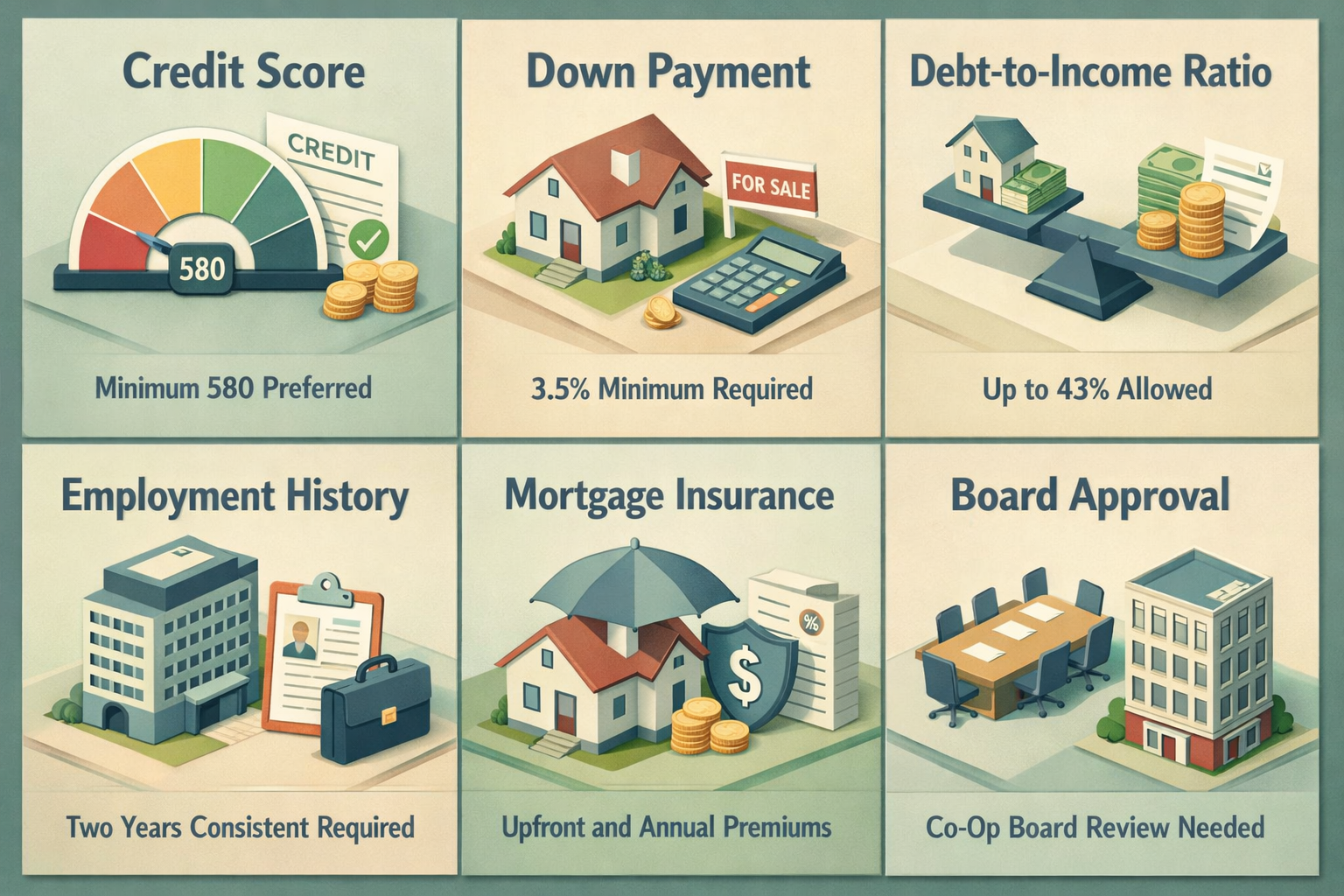
Beyond the property-level requirements, individual borrowers must also satisfy FHA's standard eligibility criteria. Meeting these standards is a key part of navigating the full set of requirements for FHA loan on a co-operative apartment with 40 year mortgage. Here's what lenders and HUD typically look for:
Credit Score and History
FHA loans are known for being more accessible to borrowers with less-than-perfect credit. Generally, a credit score of 580 or higher may allow for a lower down payment, while scores between 500 and 579 may require a larger down payment. Borrowers with scores below 500 are typically ineligible. Keep in mind that individual lenders may set their own credit overlays — meaning they could require higher scores than HUD's minimums.
Down Payment
FHA loans typically require a minimum down payment of 3.5% for borrowers who meet the 580-score threshold. For co-ops, this down payment applies to the purchase price of the shares and any associated costs. The down payment funds must come from an eligible source, such as savings, a gift from a family member, or an approved down payment assistance program.
Debt-to-Income Ratio
FHA guidelines generally allow a debt-to-income (DTI) ratio of up to 43%, though some lenders may approve higher ratios with compensating factors. For co-op buyers, the monthly housing cost calculation typically includes the mortgage payment, the co-op's monthly maintenance fee, taxes, and insurance. Because maintenance fees can be significant in co-op buildings, this combined housing expense can push DTI higher — making it especially important to review your numbers carefully before applying.
Employment and Income Verification
Borrowers must demonstrate stable, verifiable income. Lenders typically look for at least two years of consistent employment history. Self-employed borrowers may face additional documentation requirements, including two years of tax returns and profit-and-loss statements.
FHA Mortgage Insurance Premiums
All FHA loans require both an upfront mortgage insurance premium (UFMIP) and an annual mortgage insurance premium (MIP) paid monthly. These costs are factored into the overall cost of borrowing and should be reviewed as part of your affordability analysis. On a 40-year loan, these premiums would be paid over a longer period, adding to the total cost of the loan.
Understanding the Proprietary Lease and Share Loan Structure
Because a co-op purchase involves buying shares rather than real property, the mortgage structure is technically a share loan or a cooperative unit loan rather than a traditional mortgage deed of trust. The lender takes a security interest in the borrower's shares and the proprietary lease rather than in real estate itself.
This structure means that the co-op's board of directors also plays a role in the transaction. Most co-op boards require prospective buyers to submit a board application and may interview candidates before approving the sale. Board rejections — even after a loan is approved — can derail a transaction, which is a risk unique to co-op purchases that doesn't exist in standard home sales.
For FHA purposes, the proprietary lease must meet certain requirements. It should have a remaining term long enough to extend beyond the life of the loan, and it should not contain provisions that would unreasonably restrict the borrower requirements to transfer shares or encumber them as collateral. Lenders will review the proprietary lease closely as part of underwriting.
Tips for Strengthening Your Application Before You Apply
Navigating FHA co-op financing successfully often comes down to preparation. Here are some practical steps that could help improve your chances of approval:
- Check the co-op's HUD approval status early. Ask the co-op board or your real estate agent whether the building is currently on HUD's approved co-op list. If it isn't, find out what steps would be needed to pursue approval.
- Review the co-op's financials. Request the co-op's most recent financial statements, reserve fund balance, and any pending assessments. Lenders will scrutinize these documents, and you should too.
- Improve your credit score before applying. Even small improvements in your credit score can open up better terms. Pay down revolving debt, avoid new credit inquiries, and dispute any errors on your credit report.
- Reduce your debt-to-income ratio. Paying off or paying down existing debts before applying can improve your DTI, which is especially important given that co-op maintenance fees will be included in your housing expense calculation.
- Work with an FHA-approved lender experienced in co-op financing. Not all lenders are familiar with the nuances of co-op share loans. Working with a lender who has experience in this space can make a meaningful difference in how smoothly the process goes.
- Understand the board approval process. Connect with the co-op board early to understand their application process, required documentation, and timeline. Coordinate this with your lender to avoid delays.
●Conclusion
The requirements for FHA loan on a co-operative apartment with 40 year mortgage are layered and specific, covering both the borrower's financial profile and the co-op building's organizational standards. While this type of financing may not be available in every market or through every lender, it could offer a viable path to homeownership for buyers who are drawn to co-op living and need the flexibility of an FHA-backed product. The 40-year term, where available, might provide additional monthly payment relief — though it comes with long-term cost trade-offs worth considering carefully. If you're exploring this financing option, working with a knowledgeable, FHA-approved lender who understands co-op share loans is one of the most important steps you can take. At LoanWise, we're here to help you navigate complex mortgage scenarios with clarity and confidence. Reach out today to speak with a lending specialist who can walk you through your options.