For many first-time homebuyers, coming up with a large down payment is one of the biggest obstacles to homeownership. That's exactly why FHA loans have remained one of the most popular mortgage options in the United States for decades. Backed by the Federal Housing Administration, these loans are designed to make buying a home more accessible — especially for borrowers who may not have a large savings cushion or a perfect credit history. Understanding the requirements for FHA loan down payment is a critical first step before you start the homebuying process. In this guide, we'll walk you through exactly what's needed, what's allowed, and how you can make the most of this government-backed program.
What Makes FHA Loans Different from Conventional Mortgages
FHA loans are government-backed mortgages insured by the Federal Housing Administration, a division of the U.S. Department of Housing and Urban Development (HUD). Because the federal government insures these loans, lenders take on less risk — and that means they can offer more flexible qualification standards to borrowers.
Unlike conventional loans, which typically require higher credit scores and larger down payments, FHA loans are structured to help moderate- and low-income buyers enter the housing market. They're also popular among buyers who've experienced past financial challenges, since the program tends to be more forgiving with credit history.
One of the most significant advantages is the lower upfront cost. While conventional loans may require anywhere from 5% to 20% down, FHA loans offer a much lower entry point — making homeownership a realistic goal for a wider range of buyers. That said, FHA loans do come with mortgage insurance premiums (MIP), which borrowers should factor into their overall cost calculations.
FHA Loan Minimum Down Payment: Breaking Down the Numbers
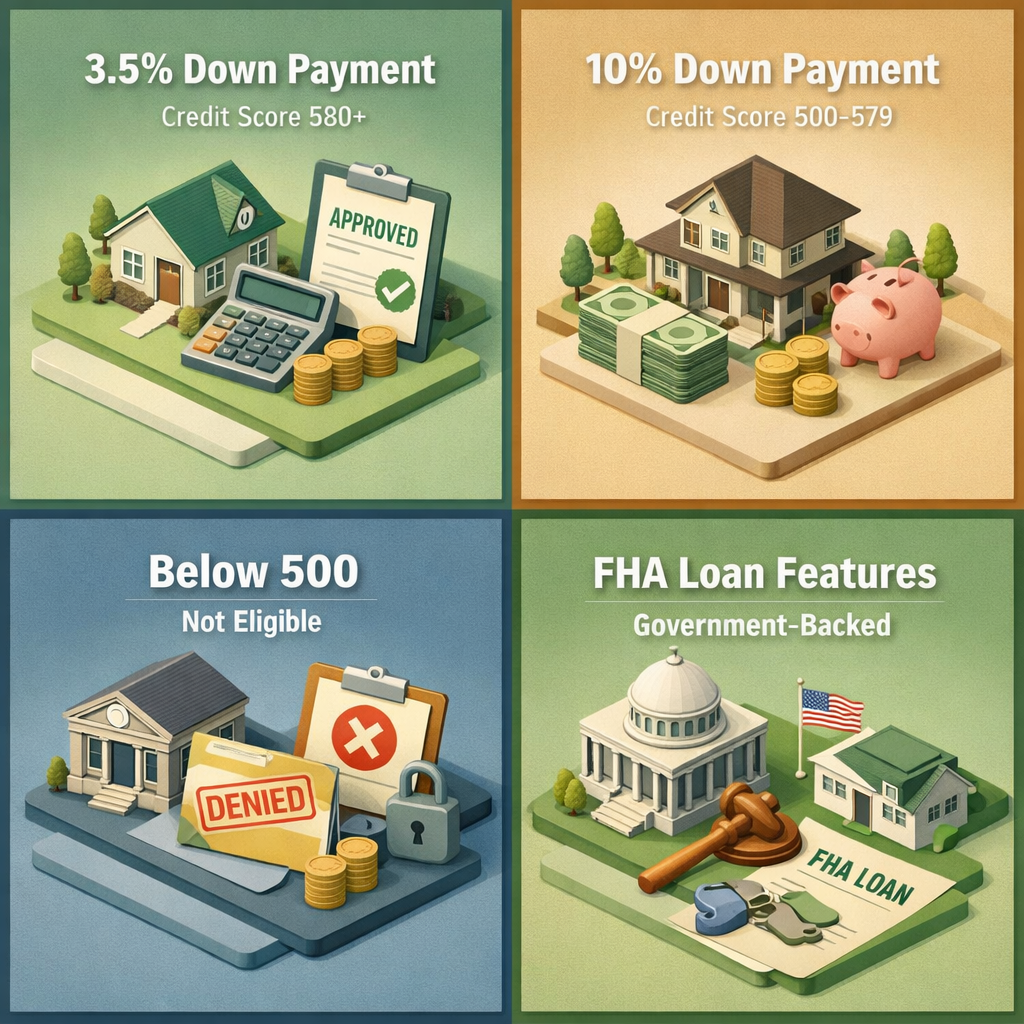
The FHA loan minimum down payment is one of the program's most well-known features. Qualified borrowers may be eligible to put down as little as 3.5% of the home's purchase price. However, this low down payment tier is tied directly to your credit score, which we'll cover in the next section.
Here's a quick look at how the down payment requirement is structured:
- 3.5% down payment: Available to borrowers with a credit score of 580 or higher.
- 10% down payment: Required for borrowers with credit scores between 500 and 579.
- Below 500 credit score: Borrowers typically do not qualify for FHA financing under standard program guidelines.
To put this in practical terms, if you're purchasing a $300,000 home and you meet the 580 credit score threshold, you'd need a minimum down payment of $10,500. If your score falls between 500 and 579, that figure rises to $30,000. These numbers illustrate just how impactful your credit profile can be when it comes to the upfront cost of buying a home.
It's also worth noting that the down payment must be applied toward the purchase of a primary residence. FHA loans are not intended for investment properties or vacation homes, so the property you're buying must be where you plan to live.
FHA Loan Eligibility and Credit Score: What Lenders Look For
Your FHA loan eligibility credit score plays a major role in determining both whether you qualify and how much you'll need to put down. As mentioned, the FHA sets minimum score thresholds at 500 and 580, but it's important to understand that individual lenders may impose their own, more stringent requirements — often referred to as "lender overlays."
In practice, many lenders prefer to work with borrowers who have scores of 620 or higher, even though the FHA technically allows scores as low as 500. If your score is on the lower end, you may need to shop around to find a lender who's willing to work within FHA's minimum guidelines.
Beyond credit scores, lenders will also evaluate:
- Debt-to-income (DTI) ratio: FHA guidelines generally allow a DTI of up to 43%, though some lenders may approve higher ratios with compensating factors.
- Employment and income history: Borrowers typically need to demonstrate steady employment, usually for at least two years.
- Payment history: A pattern of on-time payments — especially for housing — can strengthen your application.
- Bankruptcy and foreclosure waiting periods: FHA has specific waiting periods after major credit events, such as two years after a Chapter 7 bankruptcy discharge.
If your credit score isn't quite where it needs to be, don't be discouraged. There are steps you can take to improve it over time, such as paying down revolving debt, disputing inaccuracies on your credit report, and avoiding new credit inquiries before applying.
Can I Use Gift Money for FHA Down Payment? Understanding the Rules
One of the most common questions from prospective FHA borrowers is: can I use gift money for FHA down payment? The good news is — yes, you can. The FHA program allows borrowers to use gifted funds to cover all or part of their down payment, which can be a significant lifeline for buyers who have limited personal savings.
However, the gift money must meet specific documentation requirements to be considered acceptable by lenders. Here's what's typically required:
- Eligible gift donors: Funds may come from family members, close friends, employers, labor unions, charitable organizations, or government agencies. The key is that the donor must have a documented relationship with the borrower.
- Gift letter: The donor must provide a signed letter stating the amount of the gift, the relationship to the borrower, and confirmation that the funds are a true gift — not a loan that needs to be repaid.
- Paper trail: Lenders will want to see documentation of the gift transfer, such as bank statements showing the withdrawal from the donor's account and the deposit into the borrower's account.
- No repayment expected: This is critical. If there's any expectation of repayment, the funds are treated as a loan and may affect your DTI ratio and FHA loan eligibility.
It's wise to discuss gift fund documentation with your loan officer early in the process, as incomplete paperwork can delay your closing or jeopardize your approval.
Exploring FHA Down Payment Assistance Programs
Even a 3.5% down payment can feel out of reach for some buyers. That's where FHA down payment assistance programs come into play. These programs — offered through state housing finance agencies, local governments, and nonprofit organizations — can provide grants or low-interest second loans to help cover the required down payment and sometimes even closing costs.
FHA down payment assistance programs vary widely by location, so eligibility requirements, income limits, and the amount of assistance available will differ depending on where you live. Some common types of assistance include:
- Grants: These are funds that don't need to be repaid. They're often limited to first-time homebuyers or buyers who meet specific income thresholds.
- Forgivable second loans: Some programs offer a second mortgage that is forgiven after a set period — typically five to ten years — as long as the borrower continues living in the home.
- Deferred payment loans: These are second loans with no monthly payments required until the home is sold, refinanced, or paid off.
To find programs available in your area, consider reaching out to your state's housing finance agency or a HUD-approved housing counselor. These resources can help you identify which programs you may qualify for and walk you through the application process. Combining an FHA loan with a down payment assistance program could potentially allow you to purchase a home with very little money out of pocket — though terms and availability will vary.
Additional Costs to Plan for Beyond the Down Payment
While the down payment is the most talked-about upfront cost, it's not the only expense you'll need to prepare for when taking out an FHA loan. Budgeting accurately from the start can help prevent unpleasant surprises at the closing table.
Here are some of the key costs to keep in mind:
- Closing costs: These typically range from 2% to 5% of the loan amount and can include lender fees, title insurance, appraisal fees, and prepaid expenses like homeowners insurance and property taxes. Unlike the down payment, closing costs may sometimes be negotiated with the seller or rolled into certain assistance programs.
- Upfront mortgage insurance premium (UFMIP): FHA loans require an upfront MIP of 1.75% of the base loan amount, which can be financed into the loan.
- Annual mortgage insurance premium (MIP): In addition to the upfront MIP, FHA borrowers pay an ongoing annual premium, which is divided into monthly installments. The rate varies based on loan term, loan amount, and loan-to-value ratio.
- Home inspection: While not always required by lenders, a home inspection is strongly recommended to identify potential issues before purchase.
Understanding the full picture of homebuying costs will help you enter the process with confidence and avoid being caught off guard. A mortgage professional can provide a Loan Estimate early in the process to give you a clearer idea of all anticipated costs.
●Conclusion
The requirements for FHA loan down payment are designed to make homeownership more accessible, but success starts with preparation. Whether you're working toward the 3.5% minimum, building your credit score, gathering gift fund documentation, or researching local down payment assistance programs, every step you take brings you closer to owning your own home. FHA loans may offer a more flexible path than conventional financing, but they still require careful planning and a clear understanding of what lenders expect. If you're ready to explore your options, connecting with a knowledgeable mortgage professional is one of the best moves you can make. At LoanWise, we're here to help you navigate the homebuying journey with clarity and confidence — from your first question to your final closing.