
Buying a home is one of the biggest financial steps most people will ever take. For many homebuyers, saving up a full down payment can feel like a slow and steep climb. That's why gift funds — money given by another person to help cover your down payment — have become such a popular option. But if the gift is coming from someone who isn't a family member, things can get a little more complicated. Understanding the requirements for conventional loan with 5% down payment from non-relative gift is essential before you start the homebuying process. Knowing what lenders expect — and preparing the right documentation — could mean the difference between a smooth closing and an unexpected roadblock.
What Is a Conventional Loan and Why Does the Down Payment Source Matter
A conventional loan is a mortgage that isn't backed by a government agency like the FHA, VA, or USDA. Instead, these loans follow guidelines set by Fannie Mae and Freddie Mac, the two government-sponsored enterprises that purchase most conventional mortgages from lenders. Because these loans aren't government-insured, lenders tend to look more carefully at where your funds are coming from.
When you're putting down just 5% down payment on a home purchase, you're borrowing a significant portion of the property's value. Lenders want to be confident that your down payment is legitimate, that you haven't taken on hidden debt to fund it, and that the money is truly yours to use. This is why the source of your conventional loan down payment matters so much in the underwriting process.
Gift funds are generally acceptable for conventional loans, but the guidelines around conventional loan down payment gift requirements vary depending on who's giving the money. Most people assume gifts can only come from family members — and while that's the most straightforward path, gifts from non-relatives may also be allowed under certain conditions.
Who Qualifies as a Non-Relative Gift Donor Under Conventional Guidelines
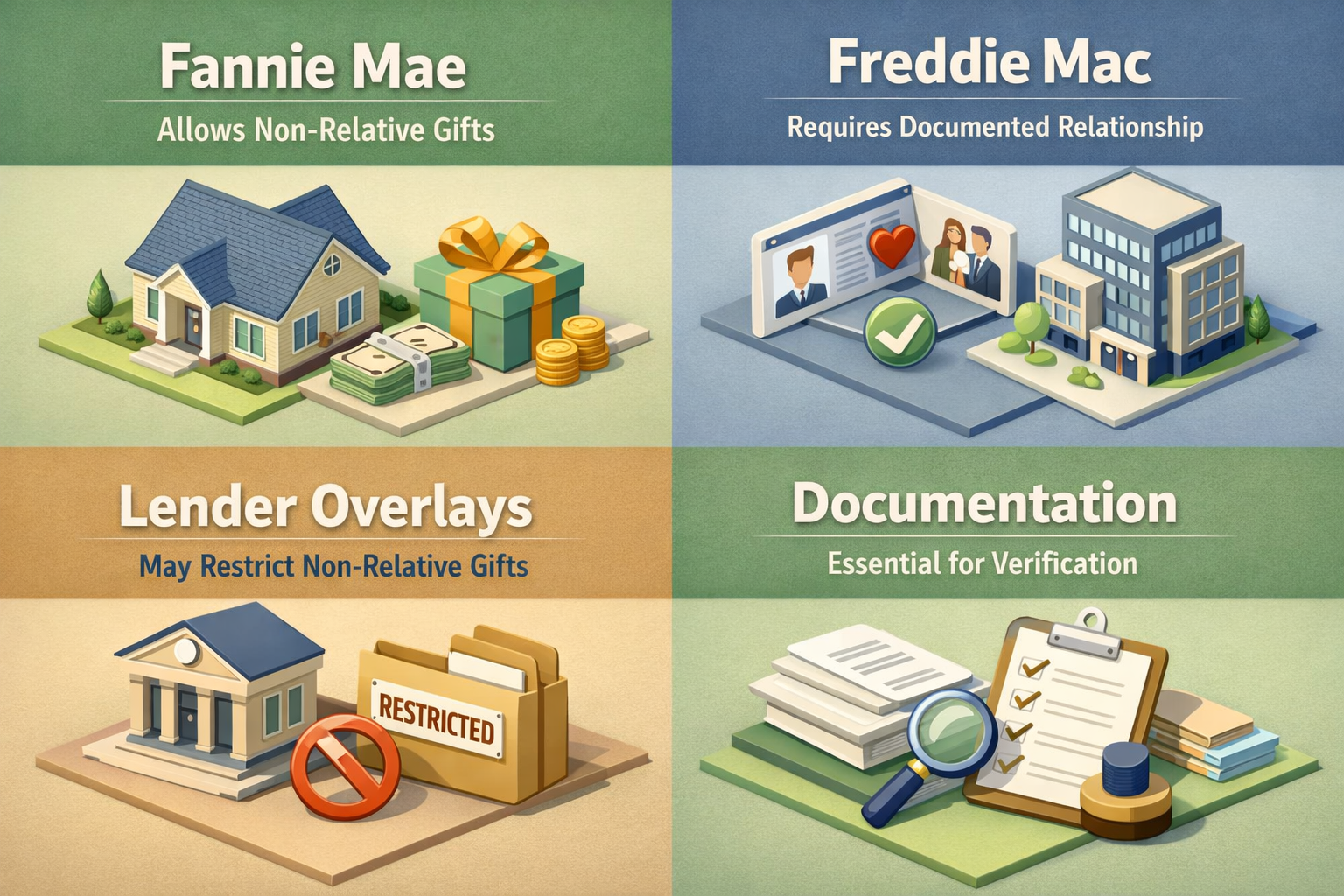
Under Fannie Mae guidelines, acceptable gift donors for conventional loans typically include relatives by blood, marriage, adoption, or legal guardianship. However, non-relatives may also be considered acceptable donors in certain situations. A close friend, domestic partner, or even a fiancé could potentially qualify as a gift donor, depending on how the lender and the loan investor interpret the guidelines.
Freddie Mac has similar policies, often allowing gifts from people with a "clearly defined and documented interest" in the borrower. This means the relationship between you and the gift donor may need to be explained and supported with documentation.
It's worth noting that not all lenders interpret these guidelines the same way. Some lenders may have overlapping policies — sometimes called "lender overlays" — that are stricter than the base Fannie Mae or Freddie Mac requirements. If you're planning to use a gift from a non-relative, it's a good idea to confirm the lender's specific policy early in the process.
- Fannie Mae: May allow gifts from non-relatives with a documented relationship to the borrower
- Freddie Mac: Typically requires evidence of a genuine, pre-existing relationship
- Lender overlays: Some lenders may restrict non-relative gifts regardless of agency guidelines
Key Documentation Requirements for a Non-Relative Gift on a 5% Down Conventional Loan
Meeting the requirements for conventional loan with 5% down payment from non-relative gift relies heavily on documentation. Lenders and underwriters need to verify that the funds are truly a gift — not a loan in disguise — and that the money has been properly transferred. Here's what's typically required:
A Signed Gift Letter
The most important document is a gift letter signed by the donor. This letter must clearly state the donor's name, address, and relationship to you (the borrower). It also needs to specify the exact dollar amount being gifted, the property address, and — critically — a statement that the funds are a gift with no expectation of repayment. Lenders are firm about this last point. If there's any indication the money is a loan, it could disqualify the gift entirely.
Proof of the Donor's Ability to Give
Lenders may ask for bank statements or other financial documents from the donor showing that the gift funds actually existed in the donor's account before being transferred. This helps rule out the possibility that the donor borrowed money specifically to pass it along to you.
Evidence of Transfer
You'll also need to show that the funds have been deposited into your account. This typically means providing bank statements showing the incoming transfer, along with a copy of the canceled check or wire transfer confirmation if applicable.
Relationship Documentation
Since the gift is from a non-relative, some lenders may ask for additional evidence of your relationship with the donor. This could include correspondence, photos, or a written explanation of how you know each other. While this requirement isn't universal, it's more common when the donor isn't a family member.
How the 5% Down Payment Rule Interacts with Non-Relative Gift Funds
Conventional loans typically require at least 3% to 5% down depending on the loan program, the borrower's credit profile, and whether it's a first-time homebuyer product. When you're putting down exactly 5%, the entire amount may be allowed to come from a gift — but this depends on the loan-to-value ratio and the specific program you're using.
Under some Fannie Mae programs, if you're putting down less than 20%, the borrower may be required to contribute at least some of their own funds before a gift can cover your 5% down payment the rest. However, certain programs — particularly those designed for first-time homebuyers — may allow the full down payment to come from gift funds, even at the 5% level.
The key is understanding your specific loan program. A knowledgeable loan officer can help you determine whether a 100% gift is allowed for your situation or whether you need to contribute some funds from your own savings first. This nuance matters a great deal when the gift is coming from a non-relative, as some programs apply additional scrutiny in those cases.
Also keep in mind that gift funds used for the down payment cannot simultaneously serve as reserves. If your loan program requires cash reserves after closing, those funds will need to come from your own accounts — not from the gift.
Red Flags That Could Cause Underwriters to Question Your Gift Funds
Even when you follow the right steps, there are certain patterns that may raise concerns during underwriting. Being aware of these ahead of time can help you avoid unnecessary delays or denials.
- Large unexplained deposits: If a significant sum of money appears in your bank account without a clear paper trail, underwriters will ask questions. Always document the source of any large deposit, especially if it's a gift.
- Repayment language: Any wording — in texts, emails, or the gift letter itself — that hints at repayment could cause the gift to be reclassified as a loan. This would significantly affect your debt-to-income ratio and may disqualify the funds.
- Donor's funds appearing borrowed: If the donor's bank statements show a sudden influx of cash just before the transfer to you, underwriters may question whether those funds were borrowed. Be prepared for the donor's finances to be scrutinized as well.
- Inconsistent timelines: If the gift letter date, the transfer date, and your bank statements don't line up clearly, it could create confusion during review.
Transparency is your best strategy. The more clearly documented and straightforward the gift trail is, the smoother your underwriting experience is likely to be.
Tips for Homebuyers Using Non-Relative Gift Funds to Buy a Home
If you're planning to use a gift from a non-relative as part of your home purchase strategy, a little advance planning can go a long way. Here are some practical steps to help the process go smoothly:
Start the Conversation with Your Lender Early
Before you even make an offer on a home, talk to your lender about your plans. Ask specifically about their policy on non-relative gift donors. If their overlay doesn't allow it, you may want to shop for a lender whose guidelines are more accommodating.
Transfer the Gift Funds Well in Advance
Ideally, gift funds should be transferred to your account at least 60 days before you apply for the mortgage. Once funds have been in your account for two full bank statement cycles, they're generally considered "seasoned" and may require less documentation to explain. This can simplify the process considerably.
Keep a Clean Paper Trail
From the moment the donor begins the transfer, make sure every step is documented. Keep copies of bank statements from both sides, the wire transfer confirmation, and the signed gift letter. Organization now can prevent significant stress later.
Understand Private Mortgage Insurance (PMI) Implications
When you put down less than 20% on a conventional loan, you'll typically be required to pay private mortgage insurance. This cost doesn't go away just because your down payment came from a gift. Factor PMI into your monthly budget when evaluating affordability.
●Conclusion
Navigating the requirements for conventional loan with 5% down payment from non-relative gift is entirely possible with the right preparation. While conventional loan programs generally permit gift funds from non-relatives, lenders will want thorough documentation and a clear explanation of the donor relationship. Working with an experienced loan officer who understands agency guidelines — and any lender-specific overlays — is one of the smartest moves you can make as a homebuyer in this situation. With proper planning, transparent documentation, and open communication with your lending team, using a gift from a trusted friend or close associate to help you achieve homeownership is a realistic and achievable goal.