Buying a home when you're self-employed is absolutely possible — but it does come with a few extra steps. If you've saved up a solid 20% down payment, you're already ahead of many buyers in the market. That said, lenders will still look closely at how you earn your income before approving your loan. Understanding the requirements for conventional loan with 20% down payment and self-employed borrower status can save you time, reduce stress, and help you walk into the lender's office fully prepared. This guide breaks down everything you need to know, from documentation to credit scores and beyond.
Why Self-Employed Borrowers Face a Different Path to Approval
When you work for an employer, verifying your income is straightforward — your lender simply reviews your W-2 forms and pay stubs. But when you're self-employed, your income picture can look quite different on paper. Business owners, freelancers, and independent contractors often write off a significant portion of their earnings as business expenses. While that's a smart tax strategy, it can reduce the income figure that lenders use to qualify you for a loan.
Lenders aren't trying to make things difficult. They're required to assess your ability to repay the loan based on documented, stable income. Because self-employed income can fluctuate from year to year, lenders typically need more evidence to feel confident in your application. The good news is that a 20% down payment goes a long way in demonstrating your financial commitment and reducing the lender's risk.
Core Documentation Requirements for Self-Employed Conventional Loan Applicants
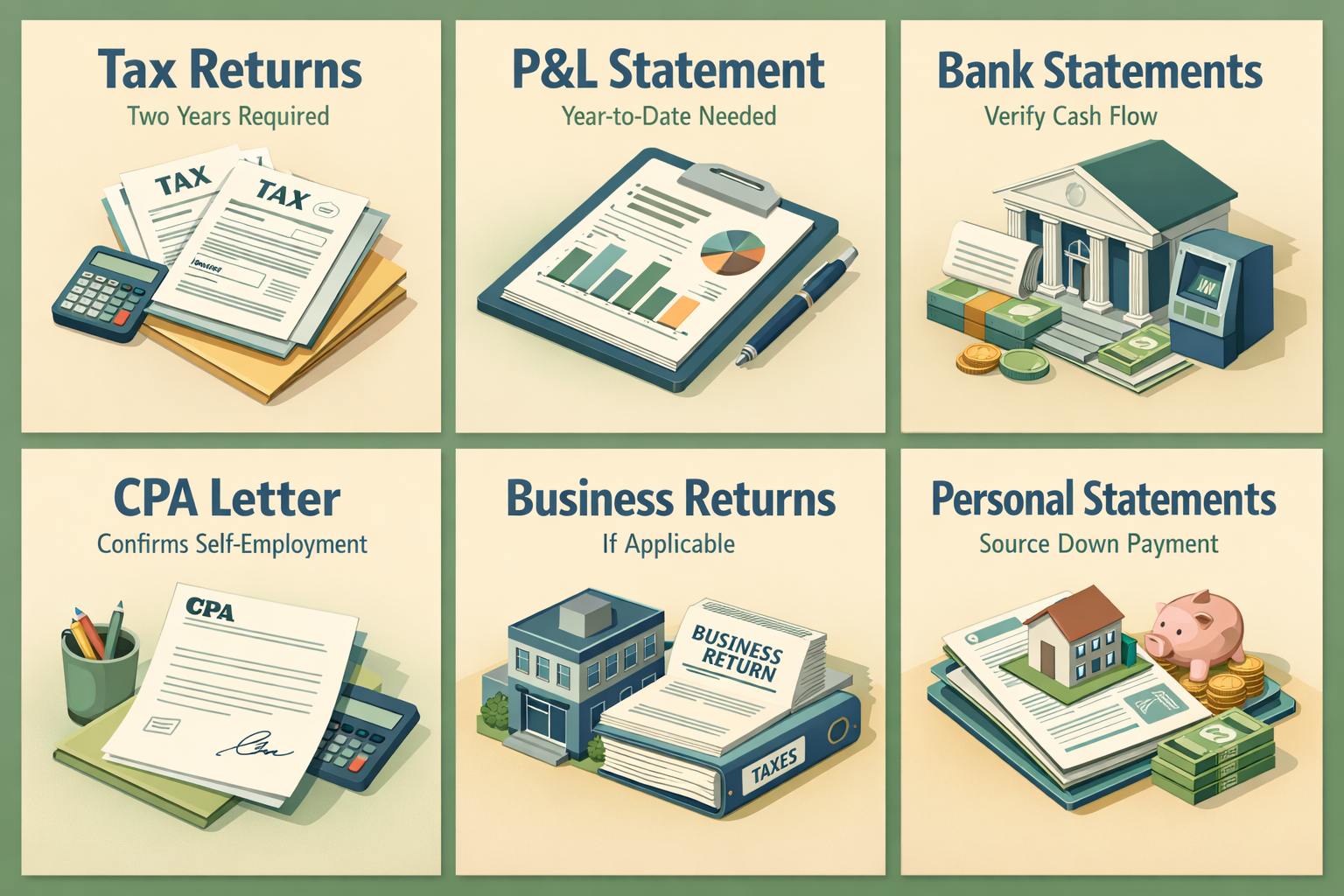
Meeting the requirements for conventional loan with 20% down payment and self-employed borrower status starts with gathering the right paperwork. Lenders generally require more documentation from self-employed applicants than from salaried workers. Here's what you'll likely need to prepare:
- Two years of personal federal tax returns: Lenders use these to calculate your qualifying income. They look at your net income after deductions, not your gross revenue.
- Two years of business tax returns: If you own a corporation, S-corp, or partnership, expect to provide business returns as well. Sole proprietors may only need Schedule C documentation.
- Year-to-date profit and loss (P&L) statement: Many lenders request a current P&L to understand your recent business performance, especially if your most recent tax return is more than a few months old.
- Business bank statements: These help verify that your business has consistent cash flow and is financially healthy.
- Personal bank statements: Lenders want to see that your personal finances are stable and that your down payment funds are properly sourced.
- CPA letter or business license: A letter from a licensed accountant confirming your self-employment status and business viability may be required by some lenders.
Having these documents organized before you apply can speed up the underwriting process considerably. It also signals to your lender that you're a prepared and serious borrower.
How Lenders Calculate Income for Self-Employed Borrowers
One of the most confusing aspects of the mortgage process for self-employed borrowers is understanding how lenders actually calculate your qualifying income. Unlike a salaried employee whose income is a simple monthly figure, your income may require a more detailed analysis.
Lenders typically average your net income over the past two years. For example, if you earned a net income of $80,000 in year one and $100,000 in year two, your qualifying income might be averaged to approximately $90,000 per year, or $7,500 per month. However, if your income declined from one year to the next, some lenders may use the lower figure — or even decline your application if the drop appears significant.
It's also worth noting that lenders add back certain non-cash deductions to your income. Depreciation, depletion, and amortization are common add-backs that can increase your qualifying income. Working with a knowledgeable loan officer who understands self-employed income calculations could make a meaningful difference in how much you're ultimately approved for.
If your tax returns show inconsistent or declining income, it may be worth speaking with a tax professional and a mortgage advisor before you file your next return. Some deductions that reduce your tax bill today might hurt your loan eligibility tomorrow.
Credit Score and Debt-to-Income Standards for Conventional Loans
Beyond income documentation, there are additional financial benchmarks you'll need to meet. A conventional mortgage — particularly one backed by Fannie Mae or Freddie Mac guidelines — typically requires a minimum credit score of 620. However, to access the most competitive interest rates, a score of 740 or higher is generally preferred by lenders.
As a self-employed borrower putting down 20%, your credit profile carries even more weight. Since you're already eliminating the need for private mortgage insurance (PMI) with your down payment, lenders will focus heavily on your credit history to assess repayment risk. Paying down existing debt, avoiding new credit inquiries, and maintaining a low credit utilization ratio in the months before you apply can all help strengthen your score.
Your debt-to-income ratio (DTI) is another critical factor. This measures how much of your gross monthly income goes toward recurring debt payments, including the new mortgage. Conventional loan guidelines typically allow a maximum DTI of around 45%, though some lenders may approve up to 50% with strong compensating factors. For self-employed borrowers, keeping DTI below 43% is often a safer target.
The Advantage of Putting 20% Down as a Self-Employed Homebuyer
There's a reason why a 20% down payment is such a powerful tool in a self-employed homebuyers' arsenal. When you put down 20% on a conventional loan, you immediately avoid private mortgage insurance, which can add a notable cost to your monthly payment. More importantly, it signals to the lender that you have the financial discipline and resources to manage a significant purchase.
From a risk perspective, a larger down payment means the lender is financing a smaller portion of the home's value. This lower loan-to-value (LTV) ratio — typically 80% with a 20% down payment — gives lenders more confidence in the loan and may even help offset some concerns they might have about the variable nature of self-employed income.
Additionally, a 20% down payment can open doors to better loan terms. Lenders often reserve their most favorable interest rates and loan structures for borrowers with strong equity positions. For self-employed buyers who may already face additional scrutiny during underwriting, this financial leverage can be a meaningful advantage.
Self-Employment History and Business Stability Requirements
Lenders don't just look at your income numbers — they also evaluate the stability of your self-employment. Most conventional loan guidelines require that you've been self-employed in the same line of work for at least two years. This two-year history helps lenders feel confident that your income is reliable and likely to continue.
If you recently transitioned from salaried employment to self-employment in the same field, some lenders may be willing to consider your application after just one year of self-employment, provided you have a strong track record in that profession. However, this is not universally accepted and may depend on individual lender overlays.
Lenders may also look at the overall health and structure of your business. For example, a growing business with increasing revenue is viewed more favorably than one with declining sales or shrinking margins. If you operate under an LLC, S-corp, or other business entity, lenders might review both your personal and business financial health together to form a complete picture.
Keeping your business finances separate from your personal finances — through dedicated business bank accounts and clean bookkeeping — can simplify the underwriting process and project a more professional financial image to your lender.
Tips to Strengthen Your Conventional Loan Application as a Self-Employed Borrower
Meeting the conventional loan self-employed 20% down payment requirements is achievable with the right preparation. Here are some practical strategies that may help you present the strongest possible application:
- Plan your tax strategy carefully: Consult with a tax professional well before applying for a mortgage. Minimizing deductions in the year or two before your application could boost your qualifying income.
- Build cash reserves: In addition to your down payment, lenders often like to see several months of mortgage payments held in reserve. Strong reserves can compensate for income variability.
- Work with a mortgage specialist: Not all loan officers are equally experienced with self-employed borrowers. Seek out a lender who regularly works with business owners and understands how to properly calculate and document self-employed income.
- Get pre-approved early: A pre-approval gives you a realistic picture of what you can borrow and may reveal any gaps in your documentation before you're in a time-sensitive purchase situation.
- Maintain clean financial records: Organized, consistent bookkeeping makes it easier for underwriters to verify your income and reduces the chances of delays or requests for additional documentation.
- Consider your timing: If your most recent tax year showed lower income due to unusual circumstances, it may be worth waiting until you can demonstrate stronger numbers before applying.
Self-employed borrowers who take a proactive approach often find the mortgage process far smoother than they expected. With the right guidance and preparation, homeownership is well within reach.
●Conclusion
Navigating the requirements for conventional loan with 20% down payment and self-employed borrower status takes preparation, patience, and the right team in your corner. While lenders do apply additional scrutiny to self-employed applicants, a 20% down payment, solid credit, and thorough documentation can position you as a highly qualified buyer. The key is to start preparing early — ideally one to two years before you plan to purchase. At LoanWise, we're here to help self-employed homebuyers understand their options and move forward with confidence. Connect with one of our experienced loan advisors today to get started on your path to homeownership.