
Life doesn't always follow a straight line — and neither does the path to homeownership. If you've recently lost your job and received an inheritance you'd like to put toward a home purchase, you may be wondering whether a conventional loan is still within reach. The good news is that it might be possible, but it does require careful preparation and a solid understanding of lender expectations. The requirements for conventional loan with 10% down from inheritance and recent job loss involve several moving parts, including income verification, asset documentation, and credit qualifications. This article walks you through each factor so you can approach the process with confidence and clarity.
What Is a Conventional Loan and How Does the 10% Down Option Work
A conventional loan is a type of mortgage that isn't backed by a government agency like the FHA or VA. Instead, it follows guidelines set by Fannie Mae and Freddie Mac, the two government-sponsored enterprises that purchase most conventional mortgages from lenders. Because these loans aren't insured by the federal government, lenders typically hold borrowers to stricter qualification standards.
One of the appealing features of conventional loans is their flexibility around down payments. While a 20% down payment eliminates the need for private mortgage insurance (PMI), many conventional loan programs allow down payments as low as 3% to 5% for qualified borrowers. A 10% down payment sits in a comfortable middle ground — it reduces your loan-to-value ratio meaningfully, which may help you qualify even in circumstances where your financial picture is less than perfect.
With 10% down, you'll still be required to carry private mortgage insurance until your equity reaches 20%, but your monthly premium is typically lower than it would be with a smaller down payment. This makes the 10% threshold a practical goal for many buyers, particularly those using inherited funds to bridge the gap between savings and a full 20% down payment.
Using Inherited Funds as a Down Payment: What Lenders Require
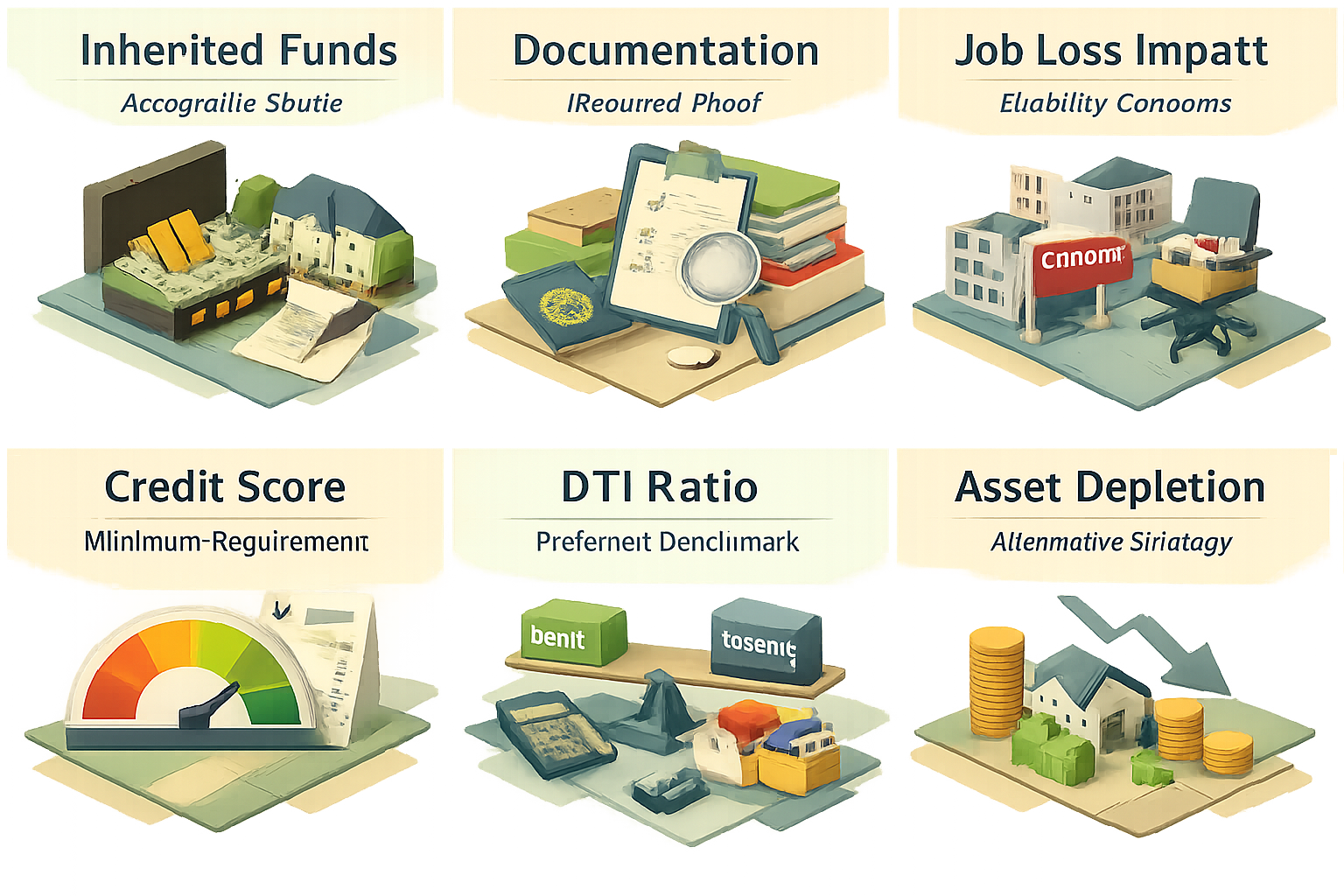
Many homebuyers wonder whether inherited money qualifies as an acceptable source of funds for a conventional loan down payment. The answer is generally yes — but lenders will require thorough documentation to verify where the money came from and confirm it's legitimately yours.
Unlike gift funds from a living relative (which require a formal gift letter and sometimes proof that no repayment is expected), inherited funds are typically treated as your own personal assets once they've been transferred to your account. However, lenders will still want to trace the source of those funds as part of their standard underwriting process, often referred to as "sourcing and seasoning."
Documenting Your Inherited Down Payment
To satisfy underwriting requirements when using a conventional loan down payment from inheritance, you'll likely need to provide:
- A copy of the will, trust document, or probate court order showing you as a named beneficiary
- Bank or estate account statements showing the deposit of inherited funds into your personal account
- A letter from the estate attorney or executor confirming the inheritance amount and your entitlement
- Your own bank statements covering at least two to three months to show the funds are now in your possession
If the inheritance was received recently and hasn't been in your account for long, the lender may ask for additional context. Seasoning — the period during which funds sit in your account before being used — can sometimes ease the documentation burden. Funds that have been in your account for 60 days or more are often considered seasoned and may require less paperwork. If the inheritance was received very recently, be prepared to provide a full paper trail.
How Recent Job Loss Affects Your Conventional Loan Eligibility
This is often the most challenging part of the equation. Conventional loan guidelines — particularly those set by Fannie Mae and Freddie Mac — place significant emphasis on stable, verifiable income. When you've recently experienced a job loss, demonstrating that stability becomes considerably more difficult.
Most lenders will want to see a consistent two-year employment history, and any significant gap — especially a current period of unemployment — will raise questions during underwriting. That said, a recent job loss doesn't automatically disqualify you. The key factors lenders may consider include:
- How recent the job loss was: A layoff that occurred months ago and was followed by new employment may be viewed more favorably than an ongoing unemployment situation.
- Whether you have a new job offer: Some lenders may accept a written offer letter from a new employer as evidence of future income, particularly if the start date is imminent.
- Your occupation and industry: Borrowers in specialized fields with strong job market demand may receive more flexibility from underwriters.
- Your overall financial strength: A large down payment, excellent credit score, and substantial reserves can offset some income-related concerns.
It's important to be transparent with your lender about your employment situation. Attempting to conceal a job loss can result in loan denial — or worse, allegations of mortgage fraud. Lenders verify employment close to closing, so any material change in your employment status must be disclosed.
Credit Score and Debt-to-Income Ratio Standards That Apply
Beyond income and down payment, conventional loans have specific benchmarks related to your creditworthiness. Understanding these standards can help you assess where you stand before applying.
Credit Score Requirements
Most conventional loan programs require a minimum credit score of 620, though some lenders may set their own minimum higher. A score in the mid-to-upper 700s will typically earn you more competitive interest rates and may make underwriters more willing to overlook other weaknesses in your application, such as a recent employment gap.
If your credit score took a hit due to the same circumstances that caused your job loss — such as missed payments or higher credit utilization — it's worth taking a few months to improve your score before applying. Paying down balances, catching up on any late payments, and avoiding new credit inquiries can help move the needle.
Debt-to-Income Ratio Considerations
Your debt-to-income (DTI) ratio compares your monthly debt obligations to your gross monthly income. For conventional loans, lenders typically prefer a DTI ratio at or below 45%, though some automated underwriting systems may allow up to 50% for borrowers with strong compensating factors.
Here's where job loss creates a significant complication: if you have no active income, your DTI may be calculated very unfavorably — or the loan may not be approvable at all under standard guidelines. This is one reason why securing new employment before applying is often the most practical approach. If you're still unemployed, some lenders may consider asset depletion as an income calculation method, where a portion of your assets (including inherited funds) is converted into a hypothetical monthly income figure.
Asset Depletion as an Alternative Income Strategy for Unemployed Borrowers
For borrowers who are between jobs but have significant assets — such as a substantial inheritance — asset depletion or asset dissipation is a lending approach worth exploring. This method allows lenders to calculate a theoretical monthly income based on your liquid assets, which can then be used to qualify you for a mortgage even when you have little or no current employment income.
The general formula involves taking your total eligible assets, subtracting the down payment and closing costs, and then dividing the remaining balance by the number of months in the loan term. For example, if you had $300,000 in liquid assets after your down payment and were applying for a 30-year mortgage, the lender might divide $300,000 by 360 to arrive at an $833 monthly income figure.
Not all lenders offer asset depletion programs, and those that do may have varying eligibility criteria. This type of approach is more commonly found among portfolio lenders, credit unions, and some specialty mortgage programs. It may also fall under the category of non-QM (non-qualified mortgage) lending, which typically carries slightly higher interest rates in exchange for greater flexibility.
If you believe asset depletion could work for your situation, it's wise to speak with multiple lenders and compare how each calculates qualifying income from assets. The inherited funds that make up your down payment may or may not be counted in this calculation, depending on the lender's guidelines.
Practical Steps to Improve Your Approval Odds Before Applying
Meeting the requirements for conventional loan with 10% down from inheritance and recent job loss is more achievable when you take deliberate steps to strengthen your overall application. Here's what you can do to put yourself in the best possible position:
- Secure new employment first: If at all possible, wait until you've started a new job before applying. Even a few weeks of pay stubs from a new employer can significantly improve your standing with underwriters.
- Organize your inheritance documentation early: Gather all estate-related paperwork, bank statements, and letters from the executor well in advance of your application. Delays in documentation can slow the underwriting process or raise red flags.
- Build up your cash reserves: Lenders like to see that you'll still have funds available after closing. Having two to six months of mortgage payments in reserve — beyond your down payment — can serve as a meaningful compensating factor.
- Check and improve your credit score: Pull your credit reports from all three bureaus and dispute any errors. Pay down revolving debt to lower your credit utilization ratio.
- Work with an experienced mortgage professional: Not all lenders handle unconventional situations the same way. A knowledgeable loan officer who has experience with inheritance funds and employment gaps may be able to match you with a lender whose guidelines fit your scenario.
- Consider a co-borrower: If a family member or spouse has steady income and is willing to co-sign, their income could be used to satisfy the lender's DTI requirements, making approval more accessible.
Timing Your Application for the Best Outcome
Timing can make a meaningful difference when you're navigating the requirements for conventional loan with 10% down from inheritance and recent job loss. Applying too soon after a layoff — before you've had a chance to establish new income or let your inherited funds season in your account — may result in a denial that could have been avoided with a bit of patience.
A general rule of thumb is to wait until your situation has stabilized. This might mean waiting until you've received at least one or two pay stubs from a new job, until your inherited funds have been in your personal account for at least 60 days, and until your credit profile is as strong as it can reasonably be.
That said, real estate markets move quickly, and waiting too long could mean missing out on a favorable home or interest rate environment. Working with a trusted mortgage advisor can help you find the right balance between readiness and opportunity. A pre-qualification or pre-approval conversation — even before you're fully ready to apply — can help you understand exactly what lenders look for and how to close them.
Remember, lenders are not trying to disqualify you. They're trying to assess risk and ensure that the loan they approve is one you can successfully repay. Approaching the process with full transparency, solid documentation, and a realistic timeline gives you the best chance of a positive outcome.
●Conclusion
Qualifying for a conventional loan after a job loss while using inherited funds as a down payment is a nuanced but navigable situation. The key is understanding what lenders are looking for — stable income, verifiable assets, a solid credit profile, and thorough documentation — and then preparing your application to address each of those areas as thoroughly as possible. While the road may require a bit more planning than a straightforward application, many borrowers in similar circumstances do successfully achieve homeownership. If you're ready to explore your options, speaking with a knowledgeable mortgage professional at LoanWise can help you build a strategy tailored to your unique situation.