
Buying a home is one of the most exciting milestones in life, but for households with mixed immigration or residency status, the mortgage process can feel especially complicated. If you're exploring qualifying for an FHA loan with a co-borrower who is a non-resident alien, you're not alone. Many families across the United States include at least one person who holds a non-resident visa or work authorization, and navigating federal mortgage guidelines in these situations requires a clear understanding of the rules. The good news is that FHA loans are designed to be inclusive and accessible — but there are specific eligibility standards that apply when a non-resident alien is involved. This guide breaks it all down in plain language so you can approach the process with confidence.
What the FHA Actually Says About Non-Resident Alien Co-Borrowers
The Federal Housing Administration (FHA) insures mortgages made by approved lenders, which means lenders must follow HUD guidelines when underwriting these loans. When it comes to borrower eligibility, FHA guidelines distinguish between U.S. citizens, lawful permanent residents (green card holders), and non-permanent resident aliens — a category that includes many visa holders and temporary workers.
A non-resident alien, for FHA purposes, typically refers to a foreign national who does not hold lawful permanent residency status in the United States. This group may include individuals on work visas such as H-1B, L-1, or O-1, as well as those on student or diplomatic visas. The FHA does not automatically disqualify non-resident aliens from participating in a mortgage, but their role as a co-borrower introduces additional layers of review.
According to HUD guidelines, non-permanent resident aliens may be eligible for FHA financing if they have a valid Social Security number and meet standard creditworthiness criteria. However, the guidelines are less straightforward when the non-resident alien is a co-borrower alongside a primary borrower who is a U.S. citizen or lawful permanent resident. Lenders are generally required to evaluate the likelihood that the non-resident co-borrower will continue to have legal authorization to remain and work in the U.S. throughout the loan term.
It's worth noting that individual lender overlays — rules stricter than the FHA minimum — can vary significantly. Some lenders may be more flexible than others, so shopping around is an important step for mixed-status households.
Key Eligibility Factors for a Non-Resident Alien FHA Mortgage
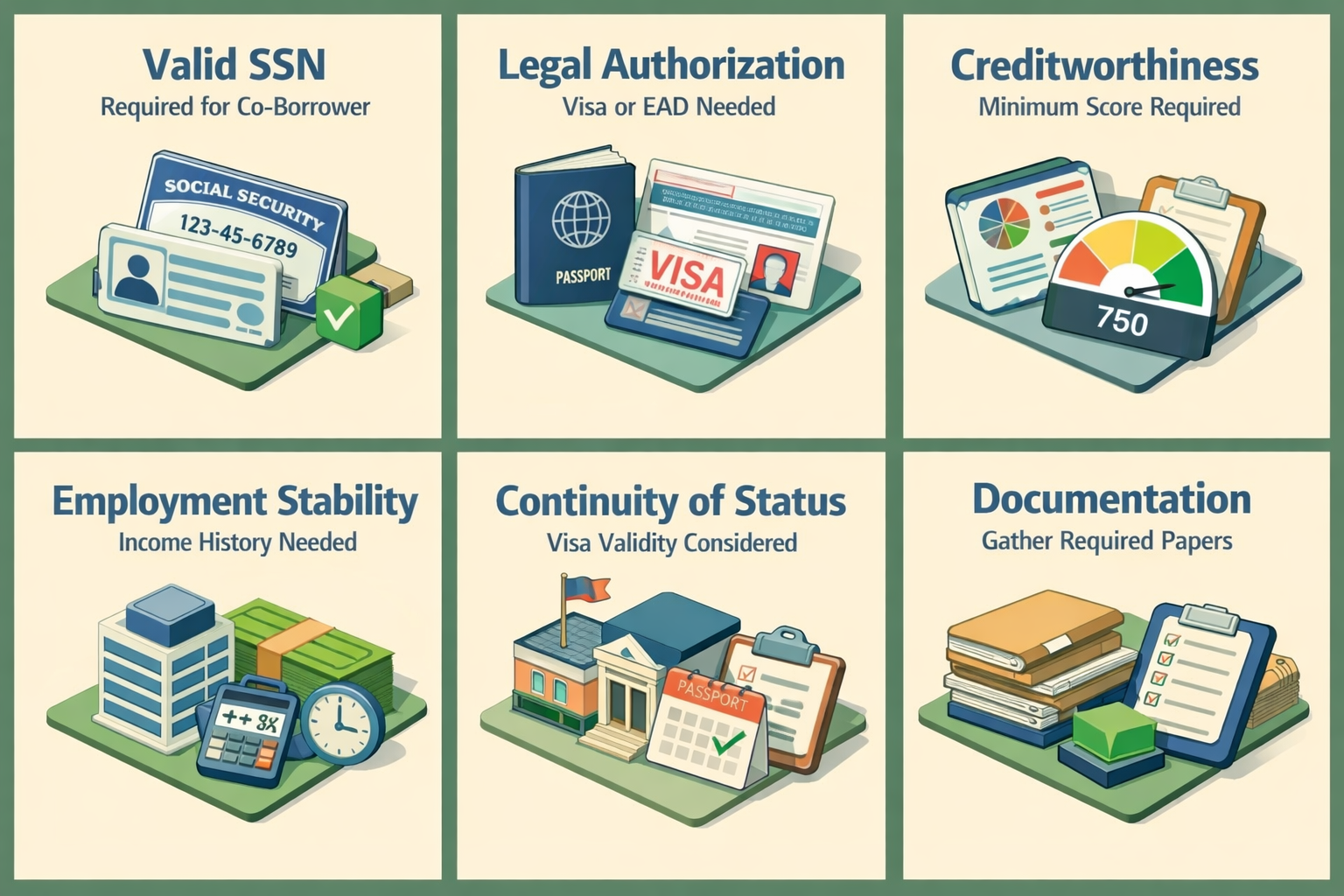
When a household is pursuing an FHA loan with a foreign co-borrower, lenders will examine several eligibility factors beyond what's required for a standard FHA application. Understanding these requirements in advance can help you prepare a stronger file.
- Valid Social Security Number: The non-resident alien co-borrower typically needs a valid Social Security number (SSN) issued by the Social Security Administration. An Individual Taxpayer Identification Number (ITIN) alone may not satisfy this requirement under standard FHA guidelines, though some lenders and programs may handle this differently.
- Legal Authorization to Reside in the U.S.: The co-borrower must generally demonstrate that they are lawfully present in the country. This is typically evidenced by a valid visa, employment authorization document (EAD), or other immigration documentation.
- Creditworthiness: All co-borrowers, regardless of residency status, must meet FHA credit standards. This includes a minimum credit score — often 580 or higher for the standard 3.5% down payment — and an acceptable debt-to-income (DTI) ratio.
- Employment and Income Stability: Lenders will assess whether the non-resident co-borrower has a reliable income history in the U.S. or from foreign sources. Documenting this income thoroughly is essential, especially if it comes from overseas employers.
- Continuity of Residency Status: Underwriters may consider the likelihood that a non-resident co-borrower's visa or work authorization will remain valid. If a visa is expiring soon and renewal is uncertain, this could raise concerns during underwriting.
Meeting these criteria doesn't guarantee approval, but it positions your application as clearly and compellingly as possible for the lender's review.
Documentation Requirements for Mixed-Status Households
One of the most critical aspects of qualifying for an non-resident alien FHA mortgage with a co-borrower who is a non-resident alien is assembling a thorough documentation package. Lenders underwriting these files often require more paperwork than a standard FHA transaction, and being organized can significantly speed up the process.
Here's what you might expect to gather for both borrowers:
- Government-issued photo identification for all borrowers
- Immigration documents for the non-resident co-borrower, such as a valid visa, I-94 arrival/departure record, Employment Authorization Document (EAD), or passport with entry stamps
- Social Security cards for all borrowers listed on the application
- Two years of federal tax returns and W-2s or 1099s for all borrowers with U.S.-based income
- Foreign income documentation, if applicable — this may include translated pay stubs, employer letters, or overseas bank statements
- Three months of bank statements showing funds available for the down payment and reserves
- Employment verification letters, especially for the non-resident co-borrower, confirming current employment status and the likelihood of continued employment
Lenders may also request a letter of explanation from the non-resident alien co-borrower outlining their immigration history, current status, and plans to remain in the United States. Being transparent and proactive with this documentation can reduce delays and demonstrate credibility to the underwriter.
How Credit Scores and DTI Ratios Apply to International Co-Signer Mortgage Eligibility
Credit scoring and debt-to-income ratios are central to any FHA mortgage evaluation, and they apply equally to non-resident alien co-borrowers. However, there are unique challenges that international borrowers may face in this area.
Building a U.S. Credit Profile: Many non-resident aliens have limited or no U.S. credit history, even if they have strong credit records in their home countries. Unfortunately, foreign credit histories are generally not recognized by U.S. credit bureaus. This can result in a thin credit file or no credit score at all, which complicates the underwriting process.
If the non-resident co-borrower lacks a traditional U.S. credit score, some lenders may consider non-traditional credit references — such as utility payments, rent history, or consistent insurance premium payments — to help establish creditworthiness. This approach is allowed under FHA guidelines in certain circumstances, but not all lenders are equipped to process it.
Debt-to-Income Considerations: FHA guidelines typically allow a maximum back-end DTI ratio of around 43% to 50%, depending on compensating factors. When evaluating a joint application with a non-resident co-borrower, the lender will combine the incomes and debts of all borrowers on the application. Including a co-borrower with steady, documentable income — even from foreign sources — may actually strengthen the DTI picture, potentially improving overall qualification.
It's also important to understand how debts in a foreign country are handled. Lenders may or may not include foreign debts in the DTI calculation, depending on whether they can be verified. Consulting with a knowledgeable FHA-approved lender early in the process is the best way to understand how your specific situation will be evaluated.
FHA Loan Requirements for Mixed-Status Households: Property and Occupancy Rules
Beyond borrower eligibility, FHA loans also carry specific rules about the property being financed and how it will be used. These rules apply regardless of the residency status of any borrower on the loan.
Primary Residence Requirement: FHA loans are designed for owner-occupied primary residences only. At least one borrower on the loan must intend to occupy the home as their principal residence. If the primary borrower — typically the U.S. citizen or permanent resident — will live in the home, this requirement is generally satisfied even if the non-resident co-borrower does not reside there full-time.
Property Standards: The home must meet FHA's minimum property standards (MPS), which are assessed during an FHA appraisal. This means the property must be safe, sound, and secure. Issues like structural deficiencies, health hazards, or significant deferred maintenance could delay or derail approval, regardless of borrower status.
Loan Limits: FHA loan limits vary by county and are updated annually. For mixed-status households in high-cost areas, it's important to verify that the purchase price falls within the applicable FHA loan limit for that region. If the home's price exceeds the limit, a different loan product — such as a conventional jumbo loan — may be required.
Understanding these property-side requirements helps ensure that once your borrower eligibility is confirmed, the property itself won't introduce unexpected hurdles into the closing process.
Practical Strategies to Strengthen Your FHA Application as a Mixed-Status Household
If you're navigating the complexities of an FHA loan with a foreign co-borrower, a few smart strategies can meaningfully improve your chances of approval.
- Work with an FHA-experienced lender: Not all mortgage lenders have experience handling non-resident alien co-borrower files. Look for lenders with a track record in international or mixed-status household transactions. They'll be better equipped to navigate underwriting nuances and present your file clearly to the FHA.
- Build U.S. credit history early: If the non-resident co-borrower doesn't yet have U.S. credit, start building it as soon as possible. Secured credit cards, credit-builder loans, and becoming an authorized user on an existing account are common starting points.
- Strengthen the down payment: Making a larger down payment — beyond the FHA minimum of 3.5% — can serve as a compensating factor that reassures lenders, especially when aspects of the application are less conventional.
- Maintain clean, consistent immigration documentation: Ensure all visas, work authorizations, and immigration paperwork are current and organized. Any lapses or inconsistencies could raise flags during underwriting.
- Consult an immigration attorney if needed: If there's any uncertainty about the non-resident co-borrower's current or future immigration status, getting guidance from an immigration attorney before applying for a mortgage can prevent surprises later.
- Get pre-approved early: A pre-approval process allows you to identify potential obstacles before you're under contract on a home, giving you time to address issues without the pressure of a closing deadline.
●Conclusion
Homeownership is a goal that many mixed-status households share, and the FHA loan program offers one of the most accessible paths to achieving it. While qualifying for an FHA loan with a co-borrower who is a non-resident alien comes with its own set of documentation and eligibility considerations, it's entirely possible with the right preparation and lender support. The key is to understand the rules, gather your paperwork thoroughly, and partner with a mortgage professional who has genuine experience in this area. At LoanWise, we're here to help you navigate the process with clarity and confidence — so your household can move forward toward the home you deserve. Ready to take the next step? Connect with one of our FHA-knowledgeable loan advisors today.