
Owning a home while earning income from a tourism-dependent business or job comes with unique financial rhythms. Revenue flows heavily during peak travel seasons and slows considerably during the off-months. When you also carry an adjustable-rate mortgage (ARM) — a loan whose interest rate changes over time based on market conditions — those fluctuating payments can create real financial stress. The good news is that there are genuine options for refinancing ARM mortgage with seasonal income from tourism, and understanding them can help you make a smarter, more stable move. This guide walks through what lenders look for, which loan programs may be the best fit, and how to prepare your finances for the best possible outcome.
Why ARM Mortgages Can Feel Risky for Tourism-Based Earners
An adjustable-rate mortgage typically starts with a lower fixed interest rate for an introductory period — often three, five, seven, or ten years — before adjusting periodically based on a financial index. For many borrowers, this initial rate is attractive. But once the adjustment period begins, monthly payments can rise unpredictably.
For homeowners who rely on tourism income — whether they operate a vacation rental, run a beachside restaurant, work in hospitality management, or guide tours — this unpredictability is doubly challenging. Income tends to peak during summer months or holiday travel seasons and dip sharply in the off-season. When an ARM rate adjusts upward at the same time income slows, the financial squeeze can become difficult to manage.
Refinancing from an ARM into a fixed-rate mortgage is often considered the most straightforward solution. A fixed-rate loan locks in one consistent interest rate for the life of the loan, making monthly budgeting far more predictable. However, qualifying for a refinance when your income is seasonal requires extra preparation and the right lending approach.
How Lenders Typically Evaluate Seasonal and Self-Employment Income
One of the biggest hurdles when exploring refinance ARM mortgage seasonal tourism income options is demonstrating consistent, reliable earnings to a lender. Most conventional lenders calculate qualifying income by averaging your gross earnings over the past two years. For seasonally employed workers, this averaging method can actually work in your favor — it smooths out the high and low months into a more representative annual figure.
Here's what lenders typically look at when evaluating seasonal or variable income:
- Two years of federal tax returns: Lenders want to see a stable or increasing income trend. If your tourism-related income has grown year over year, that strengthens your application.
- Profit and loss statements: If you're self-employed in the tourism industry, a current year-to-date profit and loss statement prepared by a licensed accountant may be required.
- Bank statements: Lenders may review several months of bank statements to confirm that deposits align with reported income and that you can cover payments during slower months.
- Employment history: A consistent history working in the same seasonal field — even with the same employer each year — is generally viewed more favorably than frequent industry changes.
- Reserves: Having cash reserves equal to several months of mortgage payments can signal to lenders that you can handle income gaps without defaulting.
It's worth noting that documentation standards can vary between lenders and loan programs. Working with a mortgage professional who has experience with non-traditional income borrowers may help you identify the most realistic path forward.
Fixed-Rate Refinancing: The Most Common Goal for ARM Borrowers
For most homeowners with an ARM, the primary refinancing goal is converting to a conventional fixed-rate mortgage. A 30-year or 15-year fixed-rate loan offers payment consistency that an ARM simply cannot guarantee. This stability is especially valuable when your income changes with the calendar.
Conventional fixed-rate refinancing typically requires a minimum credit score (often 620 or higher, though requirements vary by lender), a reasonable debt-to-income ratio, and sufficient home equity — generally at least 20% to avoid private mortgage insurance. If your home has appreciated in value since you purchased it, you may have more equity than you realize, which could improve your eligibility.
Even if current market rates are higher than your original ARM introductory rate, converting to a fixed mortgage might still be worth it. Locking in a predictable payment could protect you from future ARM rate increases and reduce financial stress during slower tourism seasons.
Non-QM and Bank Statement Loans as Alternative Pathways
If traditional income documentation doesn't reflect your true earning capacity — which is common for tourism business owners who write off significant expenses — Non-Qualified Mortgage (Non-QM) programs may offer a practical alternative. These loans are designed for borrowers whose financial profiles don't fit neatly into conventional underwriting guidelines.
Bank statement loans are among the most useful Non-QM options for seasonal earners. Instead of relying on tax returns, these programs use 12 to 24 months of personal or business bank statements to calculate average monthly income. If your bank deposits are strong even though your taxable income appears low on paper, a bank statement loan could unlock refinancing options that conventional programs might deny.
Other Non-QM structures worth exploring include:
- Asset depletion loans: These allow lenders to calculate income based on liquid assets divided over a set number of months, which can benefit homeowners with substantial savings even during slower income periods.
- Debt service coverage ratio (DSCR) loans: If you own a short-term vacation rental property, some lenders qualify you based on the rental income the property generates rather than your personal income — making this a potentially strong fit for tourism property investors.
- 1099 income loans: If you work as a seasonal contractor or freelancer in the tourism sector, some lenders can qualify you using 1099 forms instead of full tax returns.
Non-QM loans may come with slightly higher interest rates than conventional loans, but they can provide access to refinancing that might otherwise be unavailable. It's important to compare total loan costs carefully and evaluate whether the trade-off makes financial sense for your situation.
FHA and VA Refinancing Options Worth Considering
Government-backed loan programs may also be viable when exploring options for refinancing ARM mortgage with seasonal income from tourism. These programs sometimes offer more flexible qualification criteria than conventional loans, which can be helpful for borrowers with seasonal or variable income histories.
FHA Streamline Refinance is available to existing FHA loan holders and is designed to simplify the refinancing process. It typically requires limited documentation and may not require a new appraisal or full income verification in some cases. However, if your current mortgage is not already an FHA loan, you'd need to qualify for a standard FHA refinance, which does involve income review.
VA Interest Rate Reduction Refinance Loans (IRRRL), sometimes called VA Streamline Refinances, are available to eligible veterans and service members with existing VA loans. Like the FHA Streamline, the VA IRRRL process is simplified and may require minimal income documentation. This could be a significant advantage for tourism-sector veterans dealing with seasonal income variability.
Both FHA and VA programs have specific eligibility requirements, loan limits, and costs. It's best to speak with a lender approved for these programs to determine whether you qualify and whether the refinance math works in your favor.
Practical Steps to Strengthen Your Refinance Application
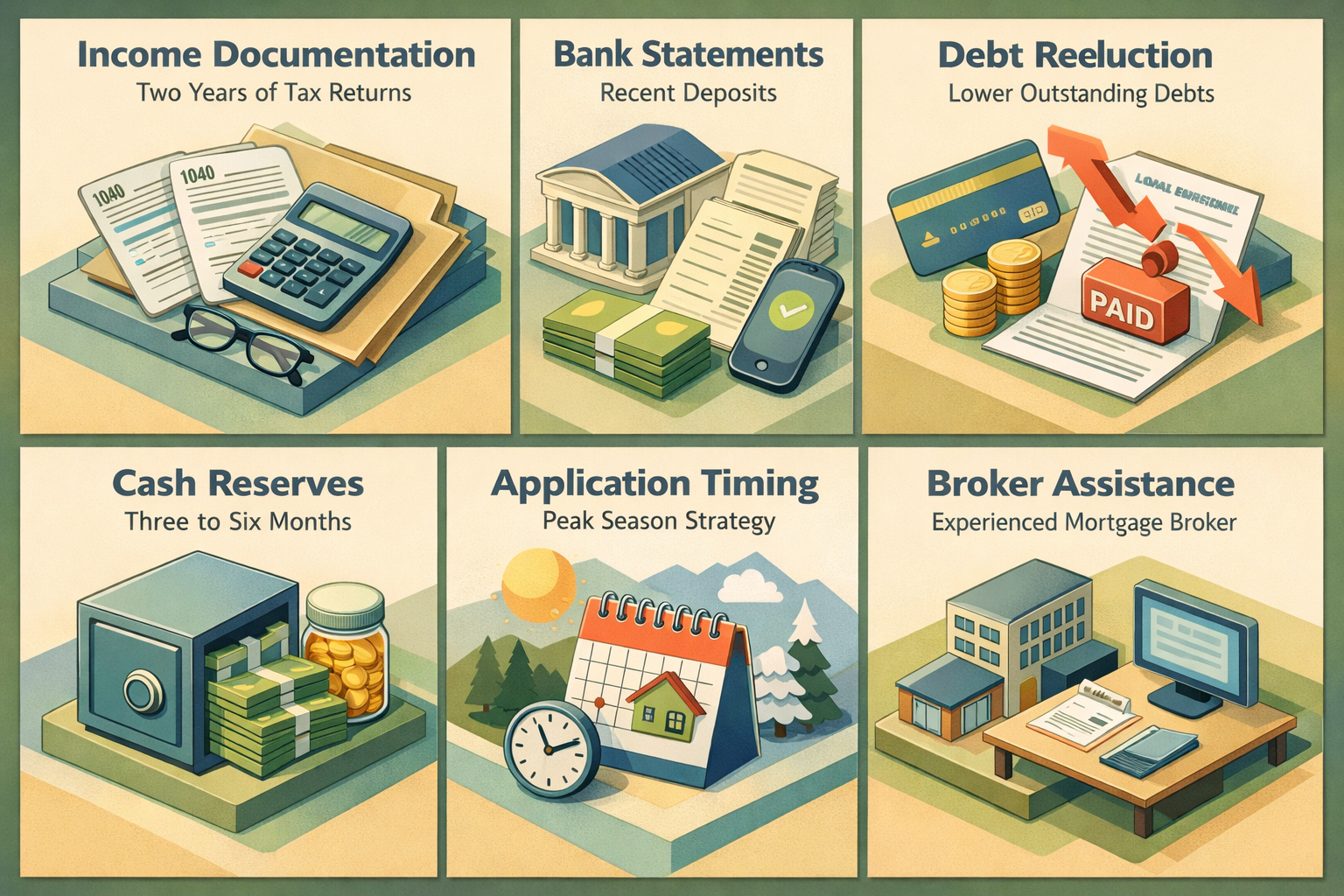
No matter which refinancing program you pursue, preparation can significantly improve your chances of approval. Here are several strategies that may help tourism-income borrowers put their best financial foot forward:
- Time your application strategically: If possible, apply during or just after your peak tourism season when your bank balances are highest and income is easiest to document. Lenders may view strong recent deposits more favorably.
- Reduce outstanding debts: Paying down credit card balances or other loans before applying can lower your debt-to-income ratio, which is a key approval factor.
- Build your cash reserves: Demonstrating that you have three to six months of mortgage payments in a savings or checking account signals financial resilience to lenders.
- Keep income documentation organized: Gather two years of tax returns, all 1099s or W-2s, recent bank statements, and any business financial records before you start the application process.
- Work with an experienced mortgage broker: A broker who understands seasonal income borrowers can match you with lenders who are more accustomed to evaluating non-traditional financial profiles.
- Check your credit score early: Dispute any errors on your credit report and avoid opening new lines of credit before your refinance closes, as both can affect your score and approval odds.
These steps won't guarantee approval, but they can meaningfully improve the strength of your application and help you qualify for more favorable loan options.
●Conclusion
Navigating the options for refinancing ARM mortgage with seasonal income from tourism is genuinely more complex than a standard refinance, but it's far from impossible. Whether you pursue a conventional fixed-rate loan, a Non-QM bank statement program, or a government-backed streamline option, the key is understanding how lenders evaluate your income and matching yourself with the right loan structure. Tourism-dependent earners bring real financial strength — what's needed is the right documentation strategy and a lender who knows how to see it clearly. At LoanWise, we're here to help you explore your refinancing options with confidence, so your home stays as stable as your long-term goals. Reach out today to speak with a mortgage specialist who understands the unique financial landscape of seasonal borrowers.