
Refinancing a home loan is already a multi-step process, but when your income comes from a specialized field like rare book appraisals, it can feel even more daunting. Adjustable-rate mortgages, or ARMs, often appeal to buyers who expect to move or refinance within a few years — but when those rate adjustments start climbing, the urgency to lock in a fixed rate becomes real. The challenge for rare book appraisers, antique specialists, and similar professionals is that their income is often project-based, seasonal, or irregular in ways that traditional lenders may not immediately understand. The good news is that the mortgage market has evolved, and there are meaningful options for refinancing ARM mortgage with income from rare book appraisals available today. This article walks through those options in plain language so you can approach lenders with confidence.
Why Adjustable-Rate Mortgages Create Urgency for Irregular-Income Borrowers
An adjustable-rate mortgage starts with an initial fixed period — often five, seven, or ten years — before the interest rate begins to shift based on a market index. For homeowners with stable, predictable incomes, managing those adjustments may be manageable. But for professionals like rare book appraisers, whose project volume and fees can shift significantly from one quarter to the next, a rising monthly payment could create genuine financial stress.
ARM loans are typically tied to benchmarks such as the Secured Overnight Financing Rate (SOFR). When those benchmarks rise, your monthly mortgage payment follows. This unpredictability, layered on top of income that may already vary month to month, is a strong reason why many appraisers and other irregular-income earners consider refinancing into a fixed-rate mortgage sooner rather than later.
Refinancing into a fixed-rate loan offers payment stability, which can make budgeting far easier when your consulting fees or appraisal contracts aren't consistent. The key is knowing how to present your income profile in a way lenders can evaluate fairly.
How Lenders View Income from Rare Book Appraisals and Similar Specialty Fields
Most conventional mortgage lenders prefer borrowers with W-2 employment because it signals consistent, verifiable earnings. Rare book appraisers, however, often operate as sole proprietors, independent contractors, or part-time consultants — income structures that require a different documentation approach.
Lenders evaluating non-traditional income sources like appraisal fees, consulting contracts, or auction-related commissions will typically look for a two-year history of that income. They may average earnings across 24 months to arrive at a qualifying monthly figure, which means a strong second year can offset a slower first year, and vice versa.
Here's what lenders often request when reviewing irregular income:
- Two years of federal tax returns, including all schedules, especially Schedule C for self-employed borrowers
- Profit and loss statements prepared by a licensed CPA or accountant
- Business bank statements showing consistent deposits over 12 to 24 months
- Contracts or letters of engagement from clients, museums, auction houses, or libraries
- CPA-prepared income verification letters that attest to the nature and continuity of your work
It's also worth noting that lenders may apply write-off adjustments. If your tax returns show significant business deductions, the qualifying income figure could be lower than your gross receipts — a common issue for self-employed borrowers in niche fields.
Loan Programs That May Support ARM Refinance with Appraisal Income
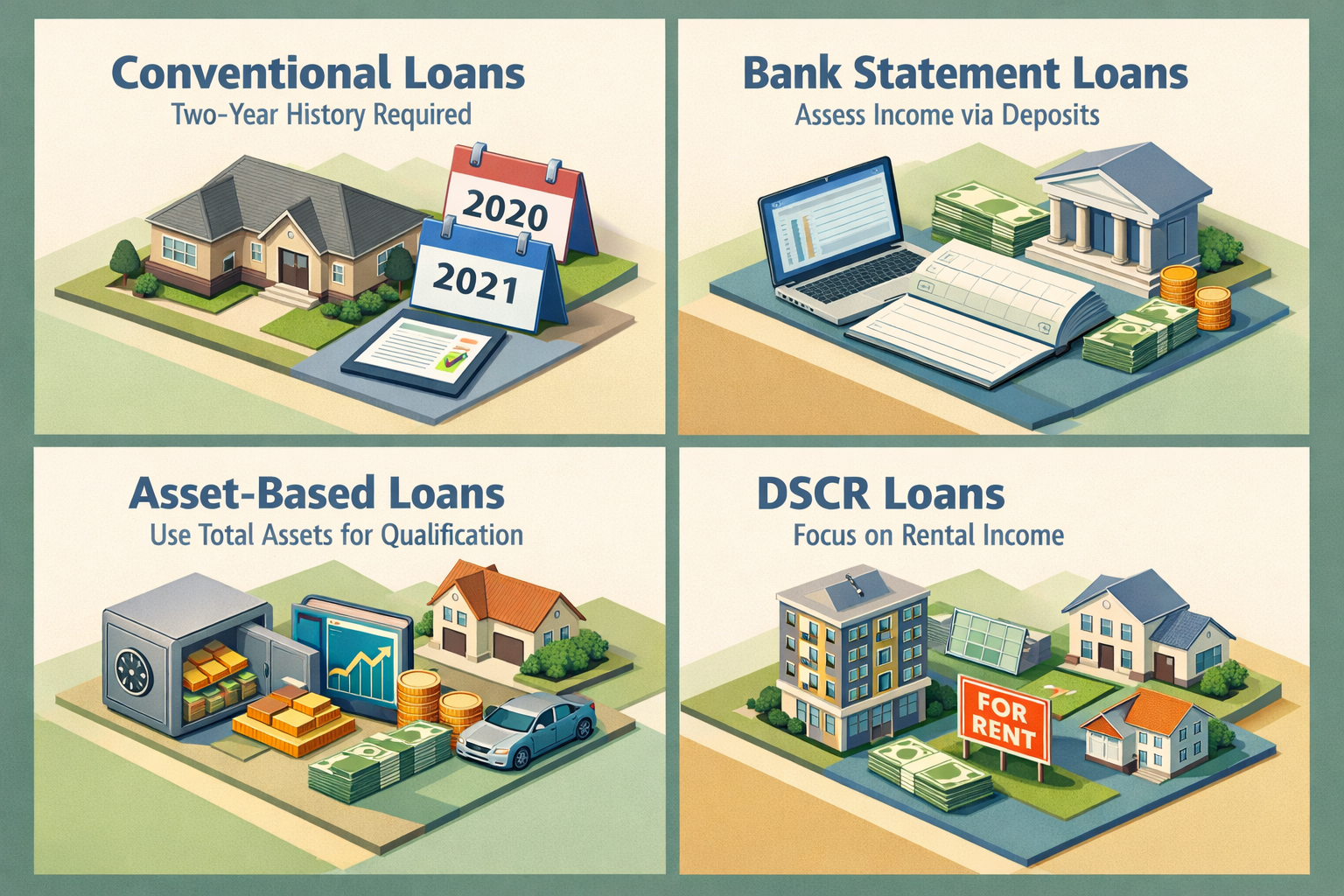
The right refinance program depends heavily on your credit profile, equity position, loan size, and how well you can document your income. Several loan types may be worth exploring.
Conventional Refinance Loans
Conventional loans backed by Fannie Mae or Freddie Mac do allow self-employed borrowers and those with commission-based or irregular income to qualify, provided they can demonstrate a two-year history. If your appraisal business has been operating consistently and your tax returns show sufficient net income after deductions, a conventional refinance could be a strong option with competitive rates.
Bank Statement Loans (Non-QM)
For borrowers whose tax returns don't fully reflect their cash flow — a common situation when legitimate business deductions reduce taxable income — bank statement loans offer an alternative path. These non-qualified mortgage (Non-QM) products allow lenders to assess your income based on 12 or 24 months of bank deposits rather than tax returns. This can be a practical solution when appraising rare books or manuscripts generates solid revenue that isn't fully visible on a 1040.
Asset-Based or Asset Depletion Loans
If you've accumulated meaningful savings, investment accounts, or other liquid assets — perhaps from years of specialty appraisals or auction commissions — some lenders offer asset depletion programs. These calculate a theoretical monthly income from your total assets and use that figure for qualification purposes, even if your current income is minimal or variable.
DSCR Loans (for Investment Properties)
If the property you're refinancing is an investment or rental property rather than your primary residence, a Debt Service Coverage Ratio (DSCR) loan may be relevant. These products focus on the rental income generated by the property rather than your personal income, which sidesteps the irregular-income challenge altogether.
Exploring Your Options for Refinancing ARM Mortgage with Income from Rare Book Appraisals
When navigating the options for refinancing ARM mortgage with income from rare book appraisals, preparation is everything. Lenders who work with self-employed borrowers or those with non-standard income streams tend to respond well to organized, well-documented files. Here are practical steps that may improve your chances of a smooth refinance process.
Work with a CPA Who Understands Mortgage Qualification
Some CPAs optimize tax returns purely to minimize tax liability, which can inadvertently reduce your qualifying income for a mortgage. Ideally, you'll work with a tax professional who understands how lenders read returns — someone who can help you balance legitimate deductions with a strong income picture for lending purposes.
Build and Maintain a Consistent Paper Trail
Lenders want to see that your appraisal income isn't a one-time event. Invoices, signed contracts, letters from institutions you've worked with, and records of recurring clients all strengthen your file. Rare book appraisers who consult for estate attorneys, auction houses, universities, or insurance companies may be able to demonstrate a recurring client base that suggests income stability.
Consider Timing Your Refinance Application
If your income varies seasonally — perhaps peaking when estate auctions are common — consider applying during or shortly after a strong revenue period. Lenders pulling recent bank statements will see a more favorable snapshot of your cash flow.
Improve Your Debt-to-Income Ratio Where Possible
Paying down credit cards or other revolving debt before applying can lower your debt-to-income ratio (DTI), which is one of the key metrics lenders use to evaluate refinance applications. Even a modest improvement in DTI could make a material difference when income documentation is already complex.
The Role of Credit Scores and Home Equity in Non-Traditional Income Refinancing
When income documentation is less straightforward, lenders often lean more heavily on other compensating factors — particularly credit scores and home equity. For rare book appraisers and others with refinancing with non-traditional income sources situations, these two elements may carry extra weight in the underwriting process.
A strong credit score — generally considered to be 700 or above for conventional loans, though requirements vary by lender and program — signals financial responsibility and reduces the perceived risk of lending to someone with fluctuating income. Borrowers with excellent credit scores may find that lenders are more flexible in how they evaluate non-standard income documentation.
Home equity is equally important. If your home has appreciated since you first purchased it, or if you've paid down a meaningful portion of your mortgage principal, you may have built substantial equity. Higher equity reduces the lender's risk and can open doors to better loan terms. Borrowers with significant equity may also qualify for programs that don't require as extensive income verification, particularly through certain Non-QM products.
It may also be worth requesting a new appraisal on your home if you believe values in your area have risen. A higher appraised property value could improve your loan-to-value ratio (LTV), which may positively influence both your eligibility and the interest rate you're offered.
Comparing Fixed-Rate Refinance Benefits Against the Costs of Switching
Refinancing does come with costs — closing costs, lender fees, title insurance, and potentially prepayment penalties on your existing ARM. For someone with a commission-based income mortgage refinance profile, it's worth doing a careful break-even analysis before committing.
A break-even calculation compares your total refinancing costs against the monthly savings you'd gain from a lower or more stable payment. If it takes 36 months to recoup closing costs through payment savings, and you plan to stay in the home for at least five years, a refinance likely makes financial sense. If your timeline is shorter, the math may not favor refinancing at this moment.
Here are some costs commonly associated with refinancing that you should factor in:
- Origination fees charged by the lender, often a percentage of the loan amount
- Title search and title insurance to confirm ownership and protect against claims
- Appraisal fee for the lender's required property valuation
- Prepayment penalties, if your current ARM includes them for early payoff
- Escrow and recording fees set by your local government
Some lenders offer no-closing-cost refinance options, where fees are rolled into the loan balance or offset by a slightly higher interest rate. For borrowers managing irregular cash flow, this structure may reduce the upfront financial burden — though it typically means paying more over the life of the loan.
●Conclusion
Refinancing an adjustable-rate mortgage when your income comes from rare book appraisals or similar specialty work is genuinely achievable — it simply requires more preparation and the right lending partner. By understanding how lenders evaluate non-traditional income, exploring programs like bank statement loans and Non-QM products, and strengthening your application with solid credit and home equity, you can meaningfully improve your chances of approval. The options for refinancing ARM mortgage with income from rare book appraisals are broader than many borrowers realize. At LoanWise, our team works with borrowers across a wide range of income profiles and can help you identify the path most likely to work for your specific situation. Reach out today to start a conversation about your refinance options.