
When your business needs fast access to capital, the sheer number of financing options can feel overwhelming. Two of the most commonly compared products are the merchant cash advance and the business line of credit. Both can put working capital in your hands quickly, but they work in very different ways — and choosing the wrong one could cost you significantly more than you bargained for. Whether you're a small business owner managing seasonal cash flow, an entrepreneur funding a new initiative, or a commercial borrower looking for flexible financing, understanding these two products side by side is an important first step. This guide walks you through how each option works, what it typically costs, and how to figure out which one fits your situation best.
What Is a Merchant Cash Advance and How Does It Work?
A merchant cash advance (MCA) is a form of revenue-based financing where a lender provides a lump sum of capital in exchange for a percentage of your future sales — typically daily credit and debit card receipts. Unlike a traditional loan, an MCA isn't technically structured as debt. Instead, it's framed as the purchase of future receivables.
Here's how the repayment typically works: the MCA provider deducts a fixed percentage of your daily card sales, known as the holdback rate, until the full advance plus fees are repaid. Because repayment is tied to revenue, slower sales days mean smaller repayments, while stronger days mean you pay back more. This can feel flexible at first glance, but it also means you have very limited control over how quickly you're repaying.
The cost of a merchant cash advance is usually expressed as a factor rate rather than an annual percentage rate (APR). For example, a factor rate of 1.30 on a $50,000 advance means you'd repay $65,000 in total. When converted to an APR equivalent, MCAs can carry extremely high effective rates — often significantly higher than most other business financing products. Entrepreneurs should approach these numbers carefully and model out the true total cost before signing any agreement.
MCAs are often marketed to businesses that have consistent card sales volume but may not qualify for traditional financing due to limited credit history, lower credit scores, or shorter time in business. Approval decisions are typically fast — sometimes within 24 to 48 hours — which makes them attractive in urgent situations.
Understanding the Business Line of Credit and Its Flexibility
A business line of credit is a revolving financing facility that gives you access to a set credit limit. You draw from it as needed, repay what you've used, and then borrow again — much like a credit card, but typically with higher limits and lower interest rates. This makes it one of the most flexible tools available to small business owners.
Unlike an MCA, a business line of credit charges interest only on the amount you've drawn, not on the full credit limit. This structure can make it significantly more cost-effective for businesses that need occasional access to capital rather than a large, one-time infusion of cash.
Lines of credit can be either secured or unsecured. Secured lines are backed by collateral — such as inventory, equipment, or accounts receivable — and often come with lower interest rates. Unsecured lines rely more heavily on your creditworthiness and business financials. Qualification typically requires a solid credit score, demonstrable revenue history, and at least one to two years in business, though requirements vary by lender.
Repayment terms are more structured than an MCA. You'll usually make monthly minimum payments that include both principal and interest. Some lenders offer draw periods followed by repayment periods, similar to a home equity line of credit structure. For commercial borrowers managing inventory cycles, payroll gaps, or project-based expenses, a line of credit may offer a much more manageable and transparent repayment experience.
Comparing Costs: Factor Rates, APRs, and the Real Price of Borrowing
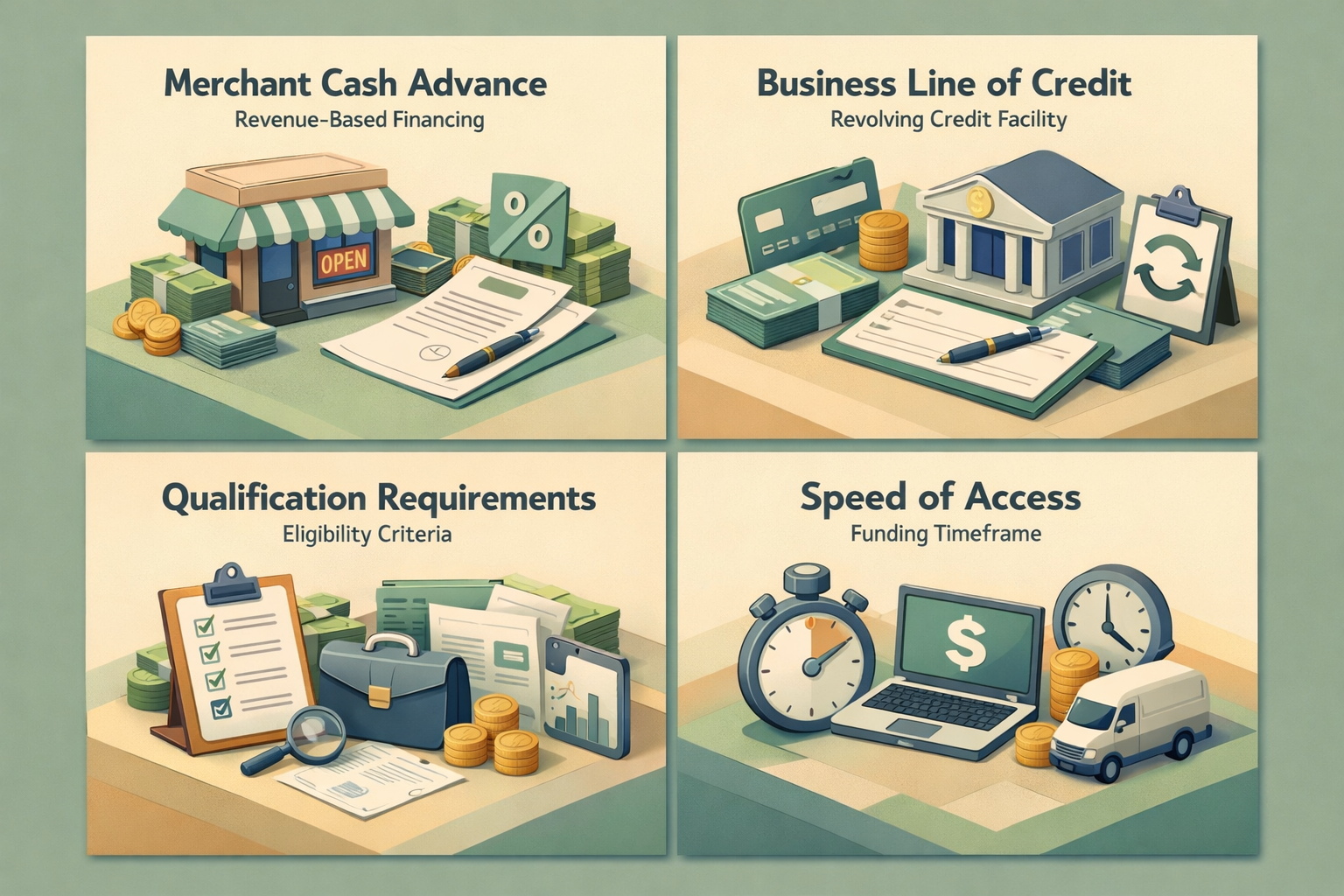
Cost is often the most critical factor when choosing between these two financing products — and the difference can be substantial. Understanding how each product prices its capital is essential before you commit.
With a merchant cash advance, you're dealing with factor rates, not interest rates. A factor rate between 1.10 and 1.50 is common, though it can vary widely based on your sales volume, industry, and the provider's risk assessment. The challenge is that factor rates can be misleading. Because the cost is fixed upfront and repayment happens quickly — sometimes within three to twelve months — the effective APR can be extremely high compared to other lending products. Small business owners who calculate only the dollar cost of an MCA, rather than the annualized rate, may underestimate how expensive this financing really is.
A business line of credit typically charges interest rates that range more predictably, and because you're only paying interest on what you draw, your total cost is directly tied to how much you use and how quickly you repay. Many lenders also charge annual fees, draw fees, or maintenance fees, so it's important to read the full terms. That said, for most creditworthy borrowers, a line of credit will almost certainly be less expensive over time than a merchant cash advance of similar size.
When evaluating both options, always ask for the total cost of financing in dollar terms, the effective APR, and any additional fees. Comparing apples to apples — rather than factor rates to APRs — is the clearest way to make an informed decision.
Qualification Requirements: Who Typically Gets Approved for Each?
One of the most practical distinctions between these two products is how each lender evaluates your eligibility. Understanding this upfront can save you time and help you apply where you're most likely to succeed.
Merchant cash advance providers tend to focus primarily on your daily or monthly card sales volume. Because the advance is repaid from future revenue, lenders are most interested in whether your sales are consistent enough to support the holdback deductions. Credit scores matter less here than in traditional financing. Some providers may approve businesses with credit scores in the 500s, or those that have been operating for as little as six months. This accessibility is one of the primary reasons MCAs remain popular among newer or credit-challenged businesses.
Business lines of credit generally require stronger qualifications. Most lenders — including banks, credit unions, and many online lenders — will want to see a credit score of at least 600 to 650 for unsecured products, though higher scores unlock better terms. You'll also typically need at least one to two years in business and sufficient annual revenue to support the credit limit you're requesting. Lenders may review tax returns, bank statements, profit and loss statements, and other financial documentation as part of the underwriting process.
If you're a newer business or have credit challenges, an MCA might be more accessible in the short term. However, it's worth working toward building your credit profile so you can qualify for lower-cost products like a line of credit as your business matures.
Speed and Convenience: Which Option Gets You Capital Faster?
For many small business owners and entrepreneurs, timing is everything. A delayed equipment purchase, a missed bulk inventory deal, or an unexpected operational expense can all have real consequences. So how do these two products compare when urgency is a factor?
Merchant cash advances are widely known for their speed. Many MCA providers can approve and fund an advance within one to three business days. The application process is usually minimal — often just a few months of bank or processing statements — and decisions are largely automated. This makes MCAs particularly attractive when you need capital immediately and don't have time for a lengthy underwriting process.
Business lines of credit can also be funded relatively quickly, especially through online lenders or fintech platforms. Some digital lenders offer decisions within 24 to 48 hours and funding within a few days. Traditional banks and credit unions may take longer — sometimes one to three weeks — due to more rigorous underwriting. However, once a line of credit is established, future draws are almost instant, which makes it a powerful ongoing tool for managing cash flow.
If you already have a line of credit in place, it's almost always faster to draw from it than to apply for a new MCA. This is one of the strongest arguments for establishing a business line of credit before you urgently need it, rather than waiting until a financial gap appears.
When a Merchant Cash Advance Might Make Sense for Your Business
Despite their higher costs, merchant cash advances do have legitimate use cases. There are situations where the speed, accessibility, and flexible repayment structure of an MCA may outweigh the premium you pay for it.
- You have high card sales volume but poor credit: If your business processes significant revenue through card transactions but your credit history doesn't support a line of credit, an MCA may be one of the few accessible options.
- You need capital urgently: When a time-sensitive opportunity — like a bulk inventory purchase or a short-term contract requiring upfront costs — arises and you can't wait for traditional underwriting, an MCA's speed may justify its cost.
- Your revenue is seasonal or variable: The holdback repayment model means you pay less when business is slow, which can feel more manageable than fixed monthly loan payments during an off-season.
- You're confident in your margins: If your business generates strong enough profit margins that absorbing the cost of an MCA still leaves you with positive ROI on the capital deployed, it may be a reasonable short-term tool.
That said, MCAs should generally be viewed as a last resort or short-term bridge rather than an ongoing financing strategy. The cumulative cost of multiple advances can quickly erode business profitability.
Building a Smarter Long-Term Financing Strategy for Your Business
The most financially savvy small business owners don't rely on a single financing product — they build a layered strategy that gives them flexibility, cost efficiency, and access to capital at different stages of growth.
If you currently rely on merchant cash advances, consider it a signal to focus on strengthening your credit profile. Pay down existing obligations, keep your business bank account balances consistent, file clean financials, and separate your personal and business finances if you haven't already. Over time, these habits can position you to qualify for a business line of credit, an SBA loan, or other lower-cost alternatives.
If you're already creditworthy, establishing a business line of credit now — even if you don't need it immediately — is one of the smartest moves you can make. Having an open credit facility means you're never in a position where urgency forces you into expensive financing. It also helps build your business credit history, which opens even more doors as your company grows.
Commercial borrowers looking at larger needs may also want to explore SBA loan programs, term loans, or asset-based lending depending on their specific objectives. The key is matching the financing product to the purpose, cost tolerance, and repayment capacity of your business — not just reaching for whatever is fastest or most accessible in the moment.
●Conclusion
Both the merchant cash advance and the business line of credit serve real needs in the small business financing landscape. The right choice depends on your credit profile, how quickly you need funds, how much you can afford to pay for capital, and how long you've been in business. For most established small business owners and entrepreneurs, a business line of credit will offer more flexibility and significantly lower costs over time. An MCA, while expensive, may fill a gap when other options aren't available. Whatever path you choose, always model out the full cost of borrowing before signing — and consider speaking with a knowledgeable lending advisor who can help you find the most appropriate solution for your unique situation. At LoanWise, we're here to help you make confident, well-informed financing decisions every step of the way.