
For many small business owners and entrepreneurs, waiting 30, 60, or even 90 days for customers to pay outstanding invoices can create serious cash flow problems. When operating expenses don't pause for slow-paying clients, finding a reliable short-term financing solution becomes critical. That's where invoice financing — including invoice factoring — can offer a practical path forward. These two funding tools are often confused with one another, but they work in meaningfully different ways. Understanding those differences could help you choose the right option for your business and avoid costly surprises down the road.
Understanding the Cash Flow Problem Invoice Financing Solves
Most businesses that sell to other businesses — known as B2B companies — extend credit to their customers. This means goods or services are delivered upfront, with payment expected later. While this arrangement is standard practice in many industries, it creates a timing gap between when expenses are incurred and when revenue actually arrives.
For small business owners, this gap can be particularly painful. Payroll still needs to be met, suppliers expect payment on time, and overhead costs don't disappear simply because a client hasn't settled their invoice yet. According to general lending principles, a business may appear profitable on paper while still struggling with day-to-day liquidity — a situation sometimes called being cash flow poor.
Invoice-based financing solutions exist specifically to close this gap. Rather than waiting for customers to pay, business owners can access a portion of the invoice's value right away, converting receivables into working capital. The trade-off is typically a fee or interest cost, but for many entrepreneurs, the ability to keep operations running smoothly is well worth it.
What Is Invoice Financing and How Does It Work?
Invoice financing — sometimes called accounts receivable financing — is a lending arrangement where a business uses its unpaid invoices as collateral to secure a loan or line of credit. In this model, the lender advances a percentage of the invoice value, often ranging from 70% to 90%, depending on factors like the creditworthiness of your customers and your industry.
Here's how the process typically works:
- Your business issues an invoice to a customer for goods or services delivered.
- You submit that invoice to a financing company or lender.
- The lender advances a large portion of the invoice value — usually within a few days.
- When your customer pays the invoice, you receive the remaining balance, minus the lender's fees.
One important distinction: with invoice financing, your business retains responsibility for collecting payment from your customers. The lender simply uses the invoices as security. Your customers may not even know a third-party lender is involved, which can help preserve existing business relationships.
The cost of invoice financing typically includes a factor rate or interest charge, along with potential processing fees. These costs can vary widely depending on the lender, your industry, and the perceived risk of your customer base, so it's worth comparing multiple options carefully.
Breaking Down Invoice Factoring: A Different Kind of Receivables Solution
Invoice factoring is related to invoice financing but operates quite differently in practice. With factoring, your business sells its outstanding invoices to a third-party company called a factor, rather than using them as loan collateral. The factor then takes over the responsibility of collecting payment directly from your customers.
The typical factoring process looks like this:
- You complete work or deliver goods and issue an invoice to your customer.
- You sell that invoice to a factoring company at a discount.
- The factor advances you a percentage of the invoice value — often 70% to 85% — almost immediately.
- The factor collects payment from your customer when the invoice is due.
- Once collected, the factor sends you the remaining balance, minus their factoring fee.
Because the factor takes over collections, your customers will know that a third party is involved. This transparency might feel uncomfortable for some business owners, particularly those who value maintaining direct relationships with their clients. However, reputable factoring companies are typically professional in their collections approach, and many businesses find the arrangement works well in practice.
Factoring fees — sometimes called discount rates — are charged as a percentage of the invoice value and may increase the longer it takes your customer to pay. It's important to review the fee structure carefully before committing to any factoring arrangement.
Key Differences Between Invoice Financing and Factoring at a Glance
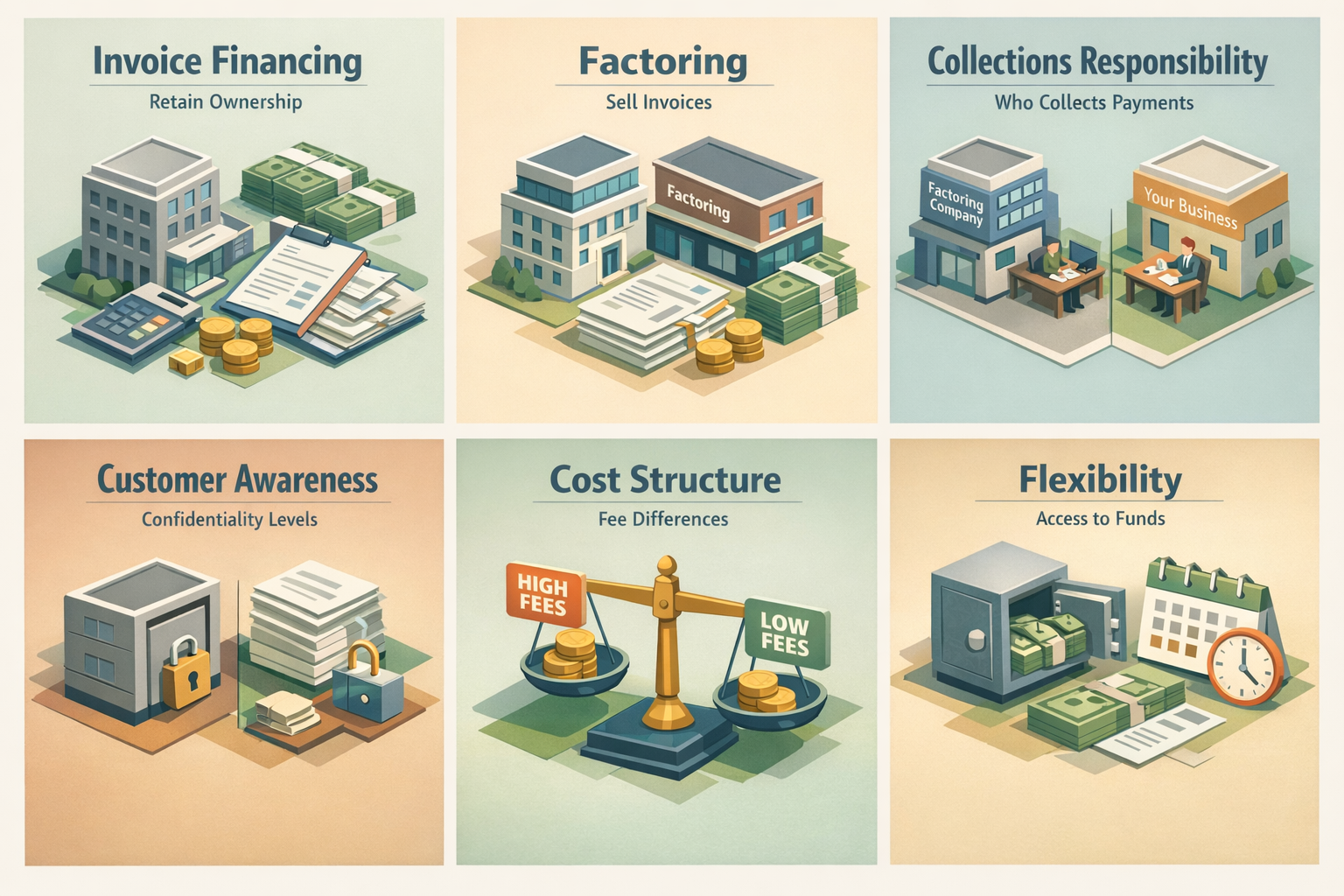
While both solutions tap into the value of your unpaid invoices, several important distinctions set them apart. Understanding these differences can help you make a more informed decision for your specific situation.
- Ownership of invoices: With invoice financing, you retain ownership. With factoring, you sell the invoices outright to the factor.
- Collections responsibility: Invoice financing keeps collections in your hands. Factoring transfers that responsibility to the factor.
- Customer awareness: Invoice financing is often confidential. Factoring typically requires your customers to know a third party is collecting on your behalf.
- Credit evaluation: Lenders offering invoice financing may look more closely at your own business credit profile. Factoring companies often place greater emphasis on the creditworthiness of your customers.
- Cost structure: Both options carry fees, but the structures differ. Invoice financing may charge interest over time, while factoring commonly uses a flat discount rate per invoice.
- Flexibility: Invoice financing through a line of credit may offer more flexibility to draw funds as needed, whereas factoring typically applies invoice by invoice.
Neither option is universally better than the other. The right choice often depends on your business model, the strength of your customer relationships, and how involved you want to be in the collections process.
Which Businesses Tend to Benefit Most From These Funding Tools?
Invoice financing and factoring are most commonly used by B2B companies that issue invoices with net payment terms. Certain industries tend to rely on these tools more heavily than others, including:
- Staffing and recruitment agencies — which often have large weekly payrolls but may wait weeks or months for client payments.
- Trucking and freight companies — where fuel and maintenance costs are ongoing but invoice payment cycles can be lengthy.
- Manufacturing and wholesale distributors — that deliver large orders upfront and extend 30- to 60-day terms to buyers.
- Construction subcontractors — who frequently face payment delays tied to project milestones.
- Professional services firms — such as marketing agencies or IT consultants that bill clients after project completion.
Startups and newer businesses may find factoring particularly accessible because approval decisions often hinge more on their customers' credit quality than on their own limited business history. This can make factoring a viable option even when traditional bank loans or SBA programs aren't yet within reach.
Established businesses with strong customer relationships and solid credit profiles, on the other hand, might prefer invoice financing for its confidentiality and the control it offers over the collections process.
Weighing the Costs and Risks Before You Commit
Before signing any invoice financing or factoring agreement, it's important to read the fine print carefully. Here are some factors that could affect the total cost and suitability of each option:
- Advance rates: The percentage of your invoice value you receive upfront varies by provider and customer risk. A lower advance rate means you'll wait longer to access more of your money.
- Fee accumulation: Factoring fees typically increase the longer your customer takes to pay. A slow-paying client could make what seemed like a modest discount rate much more expensive over time.
- Recourse vs. non-recourse factoring: With recourse factoring, if your customer doesn't pay, you're on the hook to repay the factor. Non-recourse factoring offers more protection but usually comes with higher fees.
- Contract terms: Some providers require long-term commitments or minimum volume requirements. Others offer spot factoring, where you choose which invoices to sell on a case-by-case basis.
- Impact on customer relationships: If your business depends on close, ongoing relationships with a small number of key clients, introducing a third-party collector through factoring might require careful consideration.
It's also worth comparing invoice-based solutions against other short-term business financing options, such as a business line of credit or a merchant cash advance, to ensure you're choosing the most cost-effective path for your situation.
●Conclusion
Both invoice financing and invoice factoring can be powerful tools for small business owners and entrepreneurs looking to bridge cash flow gaps without waiting on slow-paying customers. The best option for your business likely depends on how much control you want to retain over collections, how your customers might respond to third-party involvement, and what fee structures align with your profit margins. As with any financing decision, it's wise to compare multiple lenders or factoring companies, ask detailed questions about fees and contract terms, and consider speaking with a financial advisor or experienced commercial lending professional. At LoanWise, we're here to help business owners explore their options with confidence — because the right financing solution could make all the difference in your growth journey.