
Real estate investors who own multiple rental properties often find themselves in a unique financial position — asset-rich, income-diverse, and ready to purchase a high-value home. But when it comes to securing large-scale financing, the path isn't always straightforward. Understanding how to qualify for a jumbo loan with rental income from multiple properties requires a clear grasp of lender expectations, income documentation rules, and portfolio management strategies. This guide walks you through everything you need to know to approach the process with confidence.
What Makes Jumbo Loans Different from Conventional Financing
Jumbo loans are mortgage products that exceed the conforming loan limits set by the Federal Housing Finance Agency (FHFA). Because they can't be purchased by Fannie Mae or Freddie Mac, lenders take on more risk — and that means they typically apply stricter qualification standards than those used for conventional loans.
For borrowers who own multiple investment properties, this distinction matters quite a bit. Lenders offering jumbo products tend to require stronger credit profiles, larger down payments, and more substantial cash reserves. The scrutiny applied to income documentation is also heightened, especially when a portion of that income comes from rental properties rather than traditional employment.
That said, owning multiple income-generating properties isn't a disadvantage. In fact, when documented correctly, rental income can be a powerful asset in your jumbo loan application — potentially demonstrating financial stability and long-term cash flow that a standard W-2 borrower simply can't replicate.
How Lenders Evaluate Rental Income from Investment Properties
One of the most important things to understand about jumbo loan requirements for investment property income is that lenders don't typically count the full rental amount you collect each month. Most lenders apply a vacancy factor — often around 75% of gross rental income — to account for potential vacancies, maintenance costs, and other ownership expenses. This means if your properties collectively generate $10,000 per month in rent, a lender might count roughly $7,500 toward your qualifying income.
How this income gets calculated can vary depending on the lender and the loan program. Many jumbo lenders rely on your federal tax returns, specifically Schedule E, which reports rental income and expenses. If you've been deducting significant losses — something many landlords do through depreciation — it could reduce your qualifying income on paper, even if your actual cash flow is strong.
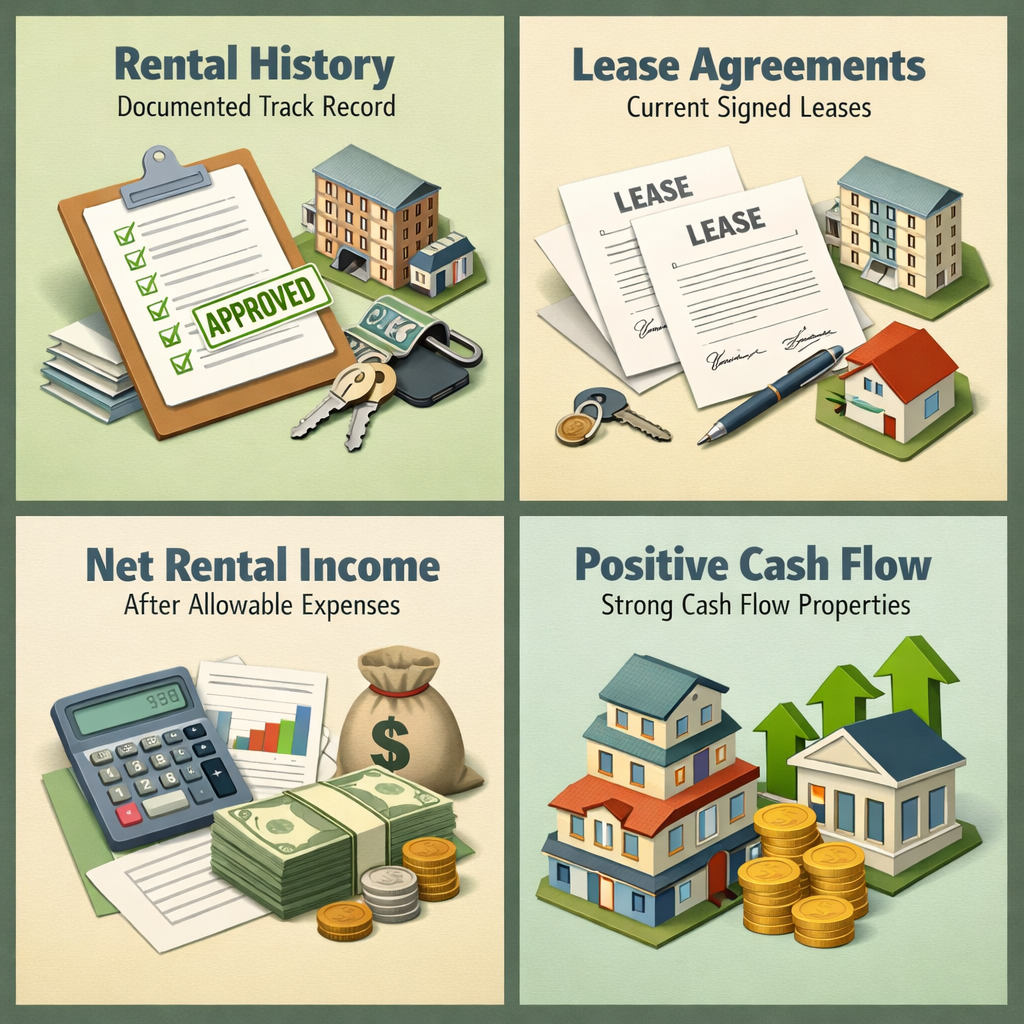
Some key factors lenders typically assess include:
- Rental history: A documented track record of receiving consistent rent is generally required, often spanning at least one to two years.
- Lease agreements: Current signed leases help verify that properties are actively generating income at the time of application.
- Net rental income: After applying allowable expenses from Schedule E, lenders calculate net income, which may differ significantly from gross rent collected.
- Positive cash flow: Properties with strong positive cash flow after mortgage payments and expenses tend to support your application more effectively.
It's also worth noting that some jumbo lenders offer non-QM (non-qualified mortgage) programs specifically designed for real estate investors. These programs may allow alternative income documentation, such as bank statements or a debt service coverage ratio (DSCR) calculation, which could be more favorable for portfolio landlords.
Credit Score and Down Payment Expectations for High-Balance Borrowers
Even with substantial rental income supporting your application, your credit profile plays a central role in jumbo loan qualification. Lenders typically look for higher credit scores compared to conventional loan minimums. While requirements vary by lender, many jumbo programs expect scores of 700 or above, with some premium programs requiring 720 or higher.
A strong credit score signals to lenders that you manage debt responsibly — an especially important indicator when you're carrying mortgages on multiple investment properties simultaneously. Each of those property loans appears on your credit profile and contributes to your overall debt obligations, which makes your payment history and debt management even more significant.
Down payment requirements for jumbo loans are also typically higher. Borrowers may need to put down anywhere from 10% to 30% of the purchase price, depending on the loan amount, the lender's guidelines, and your overall financial profile. For real estate investors with multiple financed properties, lenders may lean toward the higher end of that range to offset perceived risk.
In addition to the down payment itself, lenders often require borrowers to demonstrate substantial cash reserves — sometimes covering 12 months or more of mortgage payments across all financed properties. This reserve requirement can be a significant hurdle, but it also reflects the financial depth that many seasoned investors already possess.
Debt-to-Income Ratio Challenges When You Own Multiple Properties
Your debt-to-income (DTI) ratio is one of the most closely examined metrics in any mortgage application, and it becomes particularly complex when you hold multiple investment properties. DTI compares your total monthly debt obligations — including all mortgage payments, credit card minimums, car loans, and other recurring debts — to your gross monthly income.
For jumbo loans, many lenders prefer a DTI below 43%, though some may allow slightly higher ratios depending on compensating factors like excellent credit and large reserves. The challenge for multi-property investors is that every financed rental property adds to the debt side of this equation, even if the rental income offsets much of the cost.
The way lenders treat each rental property can make a substantial difference. If a property carries a positive cash flow after the mortgage payment and expenses, it may reduce your DTI rather than inflate it. Conversely, if a property runs at a loss on paper — even due to depreciation deductions — it could increase your DTI and tighten your qualifying window.
Strategies that may help manage your DTI include:
- Paying down existing debt before applying to reduce monthly obligations.
- Refinancing rental property mortgages at lower rates to reduce monthly payments.
- Ensuring all rental properties have current leases to maximize income documentation.
- Working with a lender familiar with investor profiles who understands how to properly structure income calculations.
How to Qualify for Jumbo Loan with Rental Income from Multiple Properties Using the Right Documentation
Documentation is where many real estate investors either strengthen or undermine their jumbo loan application. To successfully demonstrate how to qualify for a jumbo loan with rental income from multiple properties, you'll want to approach your paperwork with care and organization.
Most traditional jumbo lenders will want to see:
- Two years of federal tax returns, including all schedules, particularly Schedule E for rental income from multiple investment properties and expenses.
- Current lease agreements for each rental property you own, showing tenant names, monthly rent amounts, and lease terms.
- Mortgage statements for each financed investment property.
- Bank statements showing consistent rental deposits and sufficient reserves.
- A complete real estate owned (REO) schedule listing all properties, their values, outstanding balances, and rental income.
If your tax returns show significant depreciation deductions that reduce your reported income, you may want to explore non-QM jumbo options. Some lenders allow DSCR-based underwriting, where qualification is based on the rental income relative to the property's debt obligations rather than your personal income. This approach can be particularly well-suited for investors whose actual cash flow is strong but whose tax returns tell a more complicated story.
It's also helpful to prepare a written explanation of your investment strategy and property portfolio. Lenders who understand your financial picture holistically are often better positioned to approve complex applications involving multiple income streams and properties.
Reserve Requirements and Asset Verification for Portfolio Investors
One area where seasoned real estate investors often have an advantage is asset depth. Jumbo lenders place significant weight on reserves — the liquid or semi-liquid assets you'd have available after covering your down payment and closing costs. These reserves serve as a financial safety net, demonstrating that you could continue making mortgage payments even if income temporarily declined.
For borrowers with multiple financed properties, reserve requirements can be substantial. Lenders may require several months of PITI (principal, interest, taxes, and insurance) reserves for each financed property, not just the new jumbo loan. Retirement accounts, brokerage accounts, and savings deposits are commonly accepted, though lenders may apply a discount to retirement funds to account for early withdrawal penalties.
The good news is that real estate investors who've been building their portfolios over time often hold meaningful equity across their properties. While home equity itself typically doesn't count as liquid reserves, it may factor into the lender's overall assessment of your financial strength and net worth.
Being proactive about asset documentation — providing clear, organized bank statements and investment account records — can make the underwriting process smoother and demonstrate the financial discipline that jumbo lenders want to see.
Choosing the Right Lender and Loan Structure for Your Investor Profile
Not all lenders are equally equipped to evaluate complex investor profiles. Traditional banks and credit unions may have rigid underwriting guidelines that don't accommodate the nuances of multi-property rental income. Working with a lender who has specific experience with jumbo loans for real estate investors can make a meaningful difference in both the approval outcome and the loan terms you receive.
Mortgage brokers who specialize in jumbo and non-QM lending may have access to a broader range of loan products, including investor cash flow programs, asset depletion loans, and portfolio lending options that aren't available through standard retail channels. These products may offer more flexible income documentation requirements while still providing competitive rates for well-qualified borrowers.
When evaluating lenders and loan structures, consider asking:
- Do you offer DSCR-based jumbo loans for investment property portfolios?
- How do you treat depreciation when calculating qualifying rental income?
- What are your reserve requirements for borrowers with multiple financed properties?
- Do you offer portfolio loan programs that don't follow standard agency guidelines?
Taking the time to shop among lenders — and working with one who genuinely understands your investment strategy — can position you for a smoother approval process and a loan structure that aligns with your long-term financial goals.
●Conclusion
Qualifying for a jumbo loan when you own multiple rental properties is certainly more involved than a standard home purchase application, but it's entirely achievable with the right preparation. Lenders want to see organized documentation, strong credit, healthy reserves, and a clear picture of your rental income — and when those elements come together, your portfolio could actually work in your favor. Whether you're purchasing a luxury primary residence or expanding your real estate holdings, understanding how to qualify for a jumbo loan with rental income from multiple properties gives you the knowledge to move forward with clarity and confidence. Connect with a lending specialist at LoanWise to explore jumbo loan options tailored to your investment profile.