
Filing for bankruptcy doesn't have to mean the end of your homeownership dreams. In fact, many borrowers are surprised to learn that understanding how to qualify for FHA loan with recent Chapter 13 bankruptcy and gift funds is not only possible — it may be more achievable than they expect. The Federal Housing Administration (FHA) offers one of the most flexible mortgage programs available, and its guidelines around bankruptcy and down payment sources are notably more forgiving than conventional loan standards. Whether you're currently in a Chapter 13 repayment plan or recently received a discharge, this guide walks you through what lenders typically look for, how gift money factors in, and what steps you can take right now to strengthen your application.
Understanding Chapter 13 Bankruptcy and FHA Loan Eligibility
Chapter 13 bankruptcy is a court-supervised repayment plan that allows individuals to reorganize their debts over a three-to-five-year period rather than liquidating assets. Unlike Chapter 7, which involves a full discharge of most debts, Chapter 13 lets borrowers keep property while paying creditors back over time. This distinction matters a great deal when it comes to FHA loan eligibility.
According to FHA guidelines, borrowers who are currently in a Chapter 13 repayment plan may still be eligible for an FHA-insured mortgage under certain conditions. Generally, the borrower must have made at least 12 months of on-time payments to the bankruptcy trustee, and they must receive written permission from the bankruptcy court or trustee to take on new mortgage debt. This is a critical step that many borrowers overlook.
For borrowers who have already received a Chapter 13 discharge, FHA typically requires a waiting period of two years from the discharge date before applying for a new mortgage. However, lenders may still consider applications after just one year if there are documented extenuating circumstances — such as a serious illness or job loss — that contributed to the original filing. Keep in mind that individual lenders may impose their own overlay requirements that are stricter than the FHA minimums, so it's worth speaking with multiple lenders to compare your options.
It's also important to understand that a Chapter 13 filing will remain on your credit report for seven years from the filing date. While this can affect your credit score, lenders who specialize in FHA lending are often experienced at evaluating borrowers with complex credit histories. The key is demonstrating consistent financial responsibility from the point of filing onward.
FHA Loan Requirements After Bankruptcy: What Lenders Review
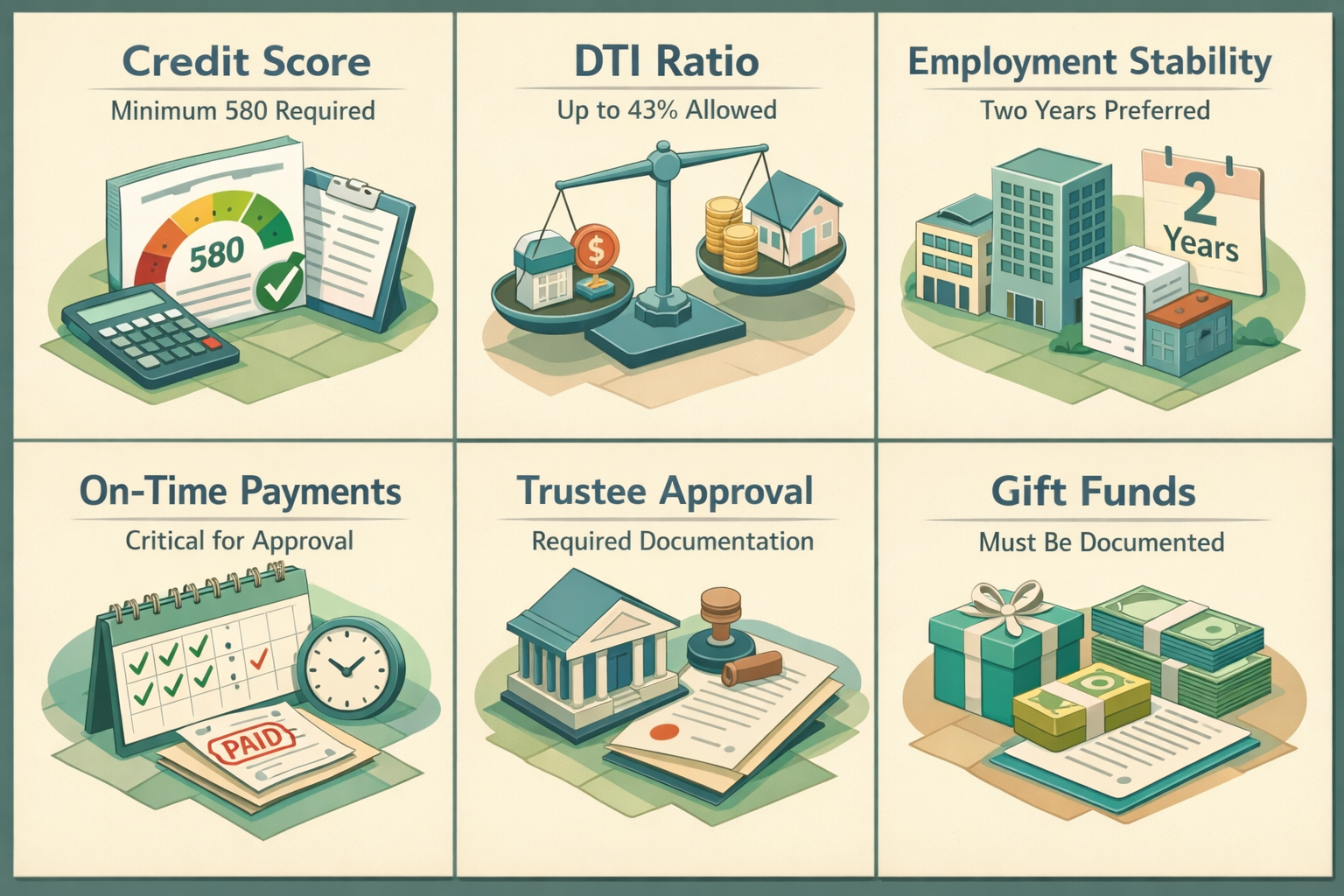
When reviewing an FHA application from a borrower with a recent bankruptcy history, lenders typically look at several factors beyond just the bankruptcy itself. Understanding these FHA loan requirements bankruptcy guidelines can help you prepare a stronger application.
- Credit score: FHA loans generally require a minimum credit score of 580 to qualify for the standard 3.5% down payment. Scores between 500 and 579 may still qualify but would typically require a 10% down payment. After a Chapter 13 filing, rebuilding your score through on-time payments and responsible credit use is essential.
- Debt-to-income ratio (DTI): FHA guidelines typically allow a DTI ratio of up to 43%, though some lenders may approve borrowers with higher ratios if compensating factors are present. Your Chapter 13 payments may be factored into this calculation while you're still in the plan.
- Employment and income stability: Lenders want to see consistent employment — typically at least two years in the same field. If your bankruptcy was related to a period of unemployment, demonstrating re-established stable income is particularly important.
- On-time payment history since filing: Any late payments after your bankruptcy filing date can be a serious red flag. Lenders will closely review whether you've maintained all required payments to creditors and the trustee.
- Trustee approval documentation: If you're still in an active Chapter 13 plan, you'll need a formal letter from your bankruptcy trustee approving the new mortgage obligation. Some trustees may require that you demonstrate the new payment fits within your plan budget.
Being proactive about gathering these documents before you apply can help streamline the process significantly. Working with a mortgage professional who has experience with FHA loan requirements bankruptcy situations may also give you a meaningful advantage.
How Gift Funds Work in FHA Home Financing
One of the most helpful features of FHA lending is the program's flexibility around down payment sources — and gift funds are a prime example. For many borrowers rebuilding after bankruptcy, saving a full down payment from personal funds alone can be a challenge. FHA guidelines allow the entire 3.5% down payment to come from gift money, which can make homeownership significantly more accessible.
According to FHA guidelines, gift funds may come from a range of acceptable sources, including:
- Family members (parents, siblings, grandparents, etc.)
- Close friends with a clearly documented relationship to the borrower
- Employers or labor unions
- Charitable organizations
- Government agencies or public entities offering down payment assistance programs
However, there are strict documentation requirements that both the borrower and the gift donor must satisfy. The lender will typically require a gift letter signed by the donor that clearly states the amount of the gift, the relationship between the donor and borrower, and — critically — that the funds are a gift and not a loan. If the gift is even loosely implied to be repayable, it may be treated as a liability and counted against your DTI, which could complicate approval.
In addition to the gift letter, lenders will usually require documentation showing the transfer of funds, such as bank statements from both the donor and the borrower reflecting the deposit. Some lenders may also ask for evidence of the donor's ability to give the funds, particularly if the gift is large relative to the donor's account balance.
It's worth noting that gift funds cannot come from interested parties to the transaction — meaning the seller, real estate agent, or builder generally cannot provide gift funds under FHA rules. Understanding these boundaries upfront helps avoid last-minute surprises during underwriting.
Combining Gift Money and Bankruptcy Recovery: A Strategic Approach
Knowing how to qualify for FHA loan with recent Chapter 13 bankruptcy and gift funds requires a thoughtful strategy that addresses both elements at the same time. These two factors — your bankruptcy history and your down payment source — are evaluated somewhat independently, but they work together to form an overall picture of your readiness as a borrower.
Here's how to approach this strategically:
- Start rebuilding credit immediately: From the moment your Chapter 13 plan is approved, every on-time payment matters. Consider applying for a secured credit card or becoming an authorized user on a responsible family member's account to help rebuild your score more quickly.
- Communicate openly with your trustee: If you're still in an active plan and anticipate wanting to buy a home within the next year or two, let your trustee know early. Some trustees may need time to evaluate whether taking on mortgage payments is consistent with your repayment obligations.
- Coordinate the gift funds process early: Ask your potential gift donor to avoid large cash deposits or unusual account activity in the months before the gift transfer. Lenders will often request two to three months of bank statements, and unexplained deposits can cause delays or denials.
- Choose an FHA-experienced lender: Not all lenders handle FHA loan requirements bankruptcy cases with equal comfort. Look for lenders who specifically advertise experience with post-bankruptcy borrowers — they'll be more familiar with the documentation requirements and less likely to apply excessive overlays.
- Consider compensating factors: If your credit score or DTI is borderline, compensating factors like substantial cash reserves, a low loan-to-value ratio, or a long history of stable employment can help tip the scales in your favor.
Patience and preparation are your two greatest assets in this process. The more organized and transparent your application is, the smoother the underwriting experience is likely to be.
Credit Score Recovery Tips Specifically for FHA Applicants After Bankruptcy
Your credit score plays a central role in FHA eligibility, and rebuilding it after a Chapter 13 filing requires both time and consistent effort. The good news is that FHA's minimum credit score thresholds are more accessible than those required for conventional mortgages, which often start at 620 or higher.
Here are some practical steps that may help accelerate your credit recovery:
- Monitor your credit reports regularly: After bankruptcy, errors on your credit report are not uncommon. Use the federally mandated free annual credit report services to review all three bureaus — Equifax, Experian, and TransUnion — and dispute any inaccuracies promptly.
- Keep utilization low: If you have any open credit accounts, aim to keep your balance below 30% of the available credit limit. Lower utilization rates tend to have a positive effect on credit scores over time.
- Avoid opening too many new accounts at once: Each application for new credit triggers a hard inquiry, which can temporarily lower your score. Be strategic about when and how often you apply for new credit lines.
- Make every payment on time: Payment history is typically the largest single factor in most credit scoring models. A consistent record of on-time payments — even on small accounts — can make a meaningful difference over 12 to 24 months.
- Ask about rapid rescore services: Some mortgage lenders offer rapid rescoring, a process that can update your credit file with new positive information faster than the normal reporting cycle. This may be helpful if you're close to a qualifying score threshold.
Rebuilding credit after bankruptcy isn't instant, but with disciplined habits, many borrowers find that their scores recover meaningfully within one to two years — potentially putting qualify for FHA loan within reach ahead of schedule.
Common Mistakes to Avoid When Applying for an FHA Loan Post-Bankruptcy
Even well-prepared borrowers can stumble during the FHA application process when a recent bankruptcy is involved. Being aware of these common pitfalls may help you avoid unnecessary setbacks.
- Skipping the trustee approval step: If you're still in an active Chapter 13 plan and you apply for a mortgage without getting trustee approval first, the application will almost certainly be denied. This step is non-negotiable.
- Using undocumented gift funds: Depositing gift money into your account without a proper paper trail is a red flag for underwriters. Always get a signed gift letter and ensure the transfer is clearly traceable from the donor's account to yours.
- Applying too soon: Even if you technically meet the 12-month on-time payment requirement, applying before you've had adequate time to rebuild your credit profile may result in a higher interest rate or outright denial. Give yourself extra time whenever possible.
- Ignoring lender overlays: FHA sets minimum standards, but individual lenders may add their own requirements on top. A lender might require a higher credit score or a longer post-bankruptcy waiting period than FHA mandates. Shopping around is essential.
- Not disclosing the bankruptcy upfront: Some borrowers are tempted to hope the lender won't notice. This is a mistake. Lenders always check public records and credit reports thoroughly. Being upfront about your bankruptcy history — and demonstrating how you've addressed it — is far more effective than hoping it goes unnoticed.
Avoiding these mistakes can help keep your application moving forward smoothly and reduce the chances of a frustrating denial that sets your timeline back further.
●Conclusion
Understanding how to qualify for FHA loan with recent Chapter 13 bankruptcy and gift funds is genuinely achievable with the right preparation and the right lending partner. FHA's flexible guidelines around bankruptcy waiting periods and down payment sources make it one of the most accessible mortgage programs for borrowers who are working hard to rebuild their financial lives. By maintaining on-time payments throughout your repayment plan, proactively securing trustee approval, carefully documenting any gift funds, and steadily rebuilding your credit profile, you may be closer to qualifying for a home loan than you realize. The path forward requires patience, organization, and informed decision-making — but it's a path that many borrowers have successfully walked. At LoanWise, we're here to help you understand your options and take confident steps toward homeownership. Reach out to one of our experienced mortgage professionals today to discuss your specific situation and explore what may be possible for you.