
Buying a home during or after retirement is more common than many people realize. Whether you're downsizing, relocating, or investing in a new property, your income picture looks different now — and that's okay. The real question is: how do lenders see it? Understanding how to calculate mortgage affordability with retirement pension and part-time gig income is a crucial first step before you ever speak with a loan officer. This guide breaks down the process in plain language, so you can walk into any lending conversation with confidence.
Why Non-Traditional Income Sources Change the Mortgage Equation
Most mortgage affordability guidelines were originally built around a simple model: one or two borrowers with steady W-2 employment income. When your income comes from a pension, Social Security, or part-time freelance work, lenders have to adjust how they calculate your borrowing power. This doesn't mean you're at a disadvantage — it just means the process works a little differently.
Lenders are primarily concerned with two things: consistency and documentation. Pension income is often viewed favorably because it's predictable and long-term. Gig income, on the other hand, may require more paperwork to prove stability. Understanding these distinctions helps you prepare a stronger application and avoid surprises during underwriting.
It's also worth noting that lenders evaluate gross income — the amount before taxes — when calculating your debt-to-income ratio (DTI). So knowing how your various income streams are counted together is essential to understanding the full picture of your mortgage affordability.
Breaking Down Pension Income in Mortgage Qualification
Pension income is typically treated as stable, verifiable income by most lenders. Whether it comes from a former employer's defined benefit plan, a government pension, or a military retirement benefit, lenders generally count it at full value as long as it can be documented and is expected to continue.
To verify pension income, lenders usually ask for:
- Award letters or benefit statements from the pension administrator
- Recent bank statements showing consistent deposits
- Tax returns from the past one to two years showing pension distributions
If your pension income is set to continue for at least three years, most conventional loan guidelines will allow it to be counted in full. Some programs may have slightly different rules, so it's worth asking your loan officer how your specific pension type will be treated.
Social Security retirement benefits follow a similar path. Lenders typically count Social Security as qualifying income, and some programs even allow a "gross-up" — meaning they may count a slightly higher amount to reflect the fact that Social Security income is often not taxed or is taxed at a lower rate. This gross-up could potentially increase your qualifying income, which may improve your affordability calculation.
How Lenders Evaluate Part-Time Gig and Freelance Income
Part-time gig income — whether from rideshare driving, freelance consulting, tutoring, or online platforms — adds complexity to a mortgage application. Lenders want to see that this income is consistent, not just occasional. That's why most lenders require a history of at least two years of self-employment or gig income before they'll count it toward your qualifying income.
Here's what lenders typically look for when evaluating gig income:
- Two years of tax returns (Schedule C or 1099 forms) showing consistent earnings
- Profit and loss statements for the current year, especially if income has changed recently
- Bank statements showing regular deposits from gig platforms
- Evidence that the work is likely to continue rather than a one-time arrangement
One important nuance: lenders typically use the net income from self-employment after deductions, not the gross amount you earned. If you write off significant expenses on your taxes, your qualifying income may be lower than expected. A tax strategy that works well for reducing your tax bill could actually reduce your borrowing power — so it's worth having a conversation with both your accountant and your loan officer before applying.
The Step-by-Step Method to Calculate Mortgage Affordability With Retirement Pension and Part-Time Gig Income
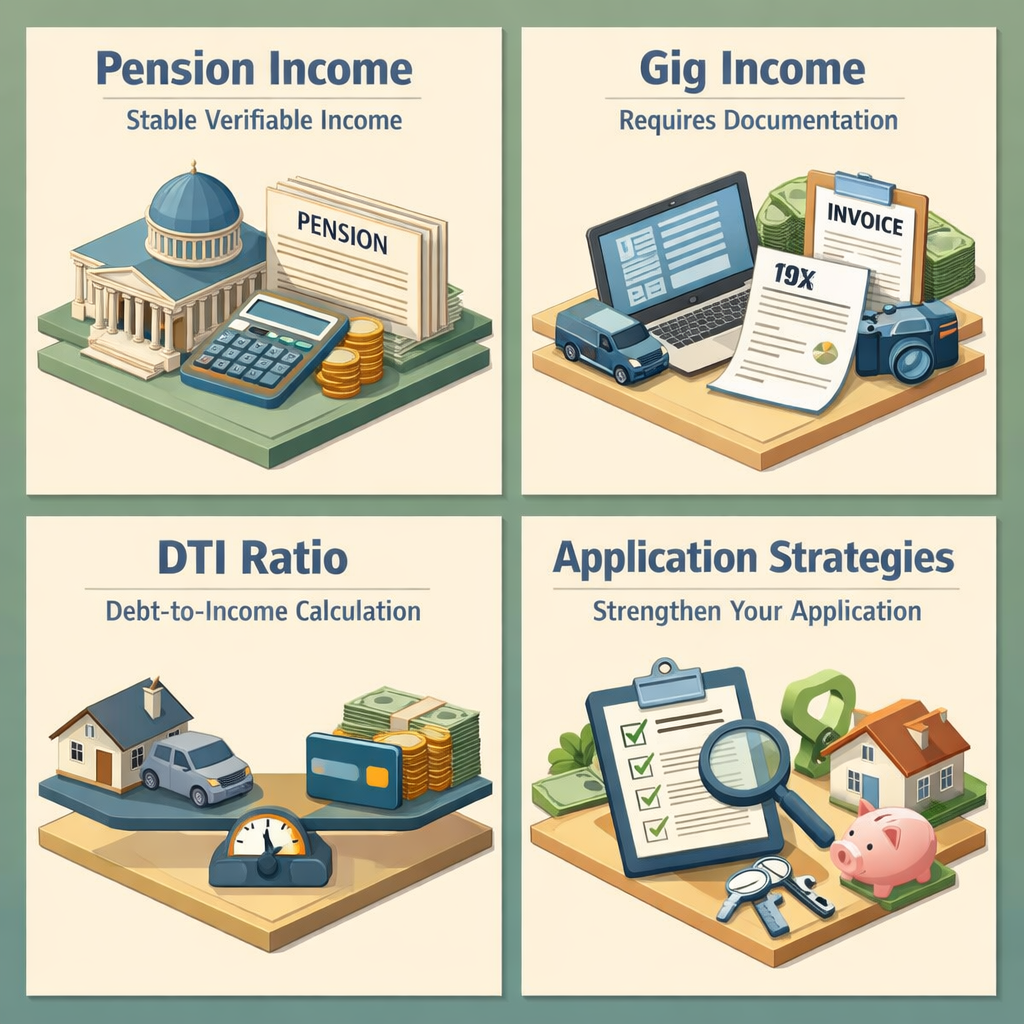
Knowing how to calculate mortgage affordability with retirement pension and part-time gig income starts with a clear picture of your total qualifying monthly income and your existing monthly debt obligations. Here's a simplified framework to get started:
Step 1: Add Up Your Qualifying Monthly Income
List all income sources that a lender is likely to count. This may include:
- Monthly pension payments (gross amount)
- Social Security benefits (full amount or grossed-up amount)
- Gig or freelance income averaged over 24 months (net of expenses)
- Any rental income, dividends, or annuity payments, if applicable
Add these together to get your total estimated qualifying monthly income.
Step 2: Identify Your Monthly Debt Obligations
List all recurring monthly debt payments, including:
- Car loans or leases
- Credit card minimum payments
- Student loans
- Any other installment or revolving debt
Step 3: Apply the Debt-to-Income Ratio Guidelines
Most conventional loan programs prefer a total DTI ratio — all monthly debts plus your proposed mortgage payment — of no more than 43% to 45% of your gross monthly income, though some programs may allow higher ratios with compensating factors. To find your maximum mortgage payment, multiply your qualifying monthly income by the DTI limit and subtract your existing monthly debts.
For example, if your qualifying income is $4,500 per month and you have $400 in monthly debts, and the lender uses a 43% DTI limit: $4,500 x 0.43 = $1,935 — minus $400 in existing debts — leaves a maximum mortgage payment of approximately $1,535 per month. This number includes principal, interest, taxes, and insurance (PITI).
Step 4: Estimate the Loan Amount
Once you know your maximum monthly payment, you can use an online mortgage calculator to work backward to the approximate loan amount that fits within that payment at current interest rates. Keep in mind that rates fluctuate, so build in some buffer room.
Strategies to Strengthen Your Mortgage Application as a Retiree or Gig Worker
Even if your income picture is unconventional, there are several strategies that may help you qualify for a mortgage on more favorable terms:
- Asset depletion income: Some lenders allow borrowers with significant retirement assets — such as IRAs, 401(k)s, or brokerage accounts — to count a portion of those assets as "income" even if they're not currently withdrawing from them. This could meaningfully increase your qualifying income.
- Larger down payment: Putting more money down reduces the loan amount and lowers your required monthly payment, which in turn makes it easier to meet DTI requirements.
- Co-borrower: Adding a co-borrower with steady income can strengthen the application significantly.
- Non-QM loan programs: Non-qualified mortgage programs may offer more flexible income documentation requirements, including bank statement loans that use 12 to 24 months of deposits rather than tax returns. These may be worth exploring if traditional qualification proves difficult.
- Reduce existing debt: Paying off or paying down credit cards and installment loans before applying can lower your DTI and improve your chances of approval.
It's also worth keeping your credit score in good shape. A higher credit score may give you access to better rates and more loan program options, which can make a meaningful difference in long-term affordability.
Common Mistakes Retirees and Gig Workers Make When Applying for a Mortgage
Avoiding common missteps can save you time, frustration, and potentially thousands of dollars. Here are some pitfalls to watch for:
- Assuming your income won't count: Many retirees underestimate the value of their pension and Social Security income. In many cases, these stable sources may make you a strong candidate for financing.
- Not documenting gig income properly: Inconsistent records or missing tax returns can make gig income difficult to use in qualification. Keep clean, organized records throughout the year.
- Over-relying on gross gig earnings: Remember that lenders typically use net income after write-offs. Overestimating your qualifying income could lead to an unpleasant surprise during underwriting.
- Ignoring the impact of taxes on pension income: Depending on your tax situation, some of your pension income may be subject to federal or state taxes, which affects your take-home amount — though lenders still typically use gross figures.
- Not shopping multiple lenders: Different lenders have different policies on how they treat retirement and gig income. Shopping around may reveal significantly different qualifying amounts and interest rates.
●Conclusion
Understanding how to calculate mortgage affordability with retirement pension and part-time gig income isn't as daunting as it might seem at first. With the right documentation, a clear picture of your qualifying income, and guidance from an experienced loan officer, many retirees and semi-retired borrowers successfully navigate the mortgage process. The key is to plan ahead, know what lenders are looking for, and explore all available options — including non-traditional programs that may better fit your financial profile. At LoanWise, we're here to help you find the right path forward, no matter what stage of life you're in.