
Inheriting a rental property can be a meaningful financial windfall — but turning that asset into qualifying income for a large mortgage isn't always straightforward. If you're wondering how to qualify for a jumbo loan with inherited rental property income, you're not alone. Many homebuyers and real estate investors find themselves in this exact situation: they've inherited income-producing real estate, they want to leverage that cash flow to buy a high-value home, and they're not sure how lenders will view it. The good news is that jumbo lenders do typically consider rental income from inherited properties — but the documentation standards are stricter than for conventional loans, and the path to approval requires careful preparation. This guide walks you through what lenders look for, how to document inherited rental income properly, and what strategies may strengthen your application.
What Is a Jumbo Loan and Why Does It Require Special Qualification?
A jumbo loan is a mortgage that exceeds the conforming loan limits set by the Federal Housing Finance Agency (FHFA). In most parts of the United States, loans above approximately $766,550 fall into jumbo territory, though the threshold is higher in certain high-cost markets. Because these loans are too large to be purchased by Fannie Mae or Freddie Mac, lenders take on the full credit risk themselves.
That added risk means jumbo lenders typically apply tighter qualification standards than those used for conventional conforming loans. Borrowers generally need stronger credit scores, larger down payments, lower debt-to-income (DTI) ratios, and more substantial cash reserves. When it comes to income, jumbo lenders tend to scrutinize every source carefully — including rental property income from inherited properties.
The process of qualifying for a large mortgage with investments or inherited assets requires that you demonstrate not just ownership but also stable, documented, and ongoing income. A one-time inheritance payout is treated differently from a property that generates consistent monthly rent, so understanding this distinction early on is essential.
How Lenders View Inherited Rental Property Income
When a borrower inherits a rental property, lenders don't automatically discount the income. However, they do apply a specific lens to evaluate whether that income is stable and likely to continue. Most jumbo lenders follow guidelines similar to those used for investment property income, even though the property was inherited rather than purchased.
Here are the key factors lenders typically consider:
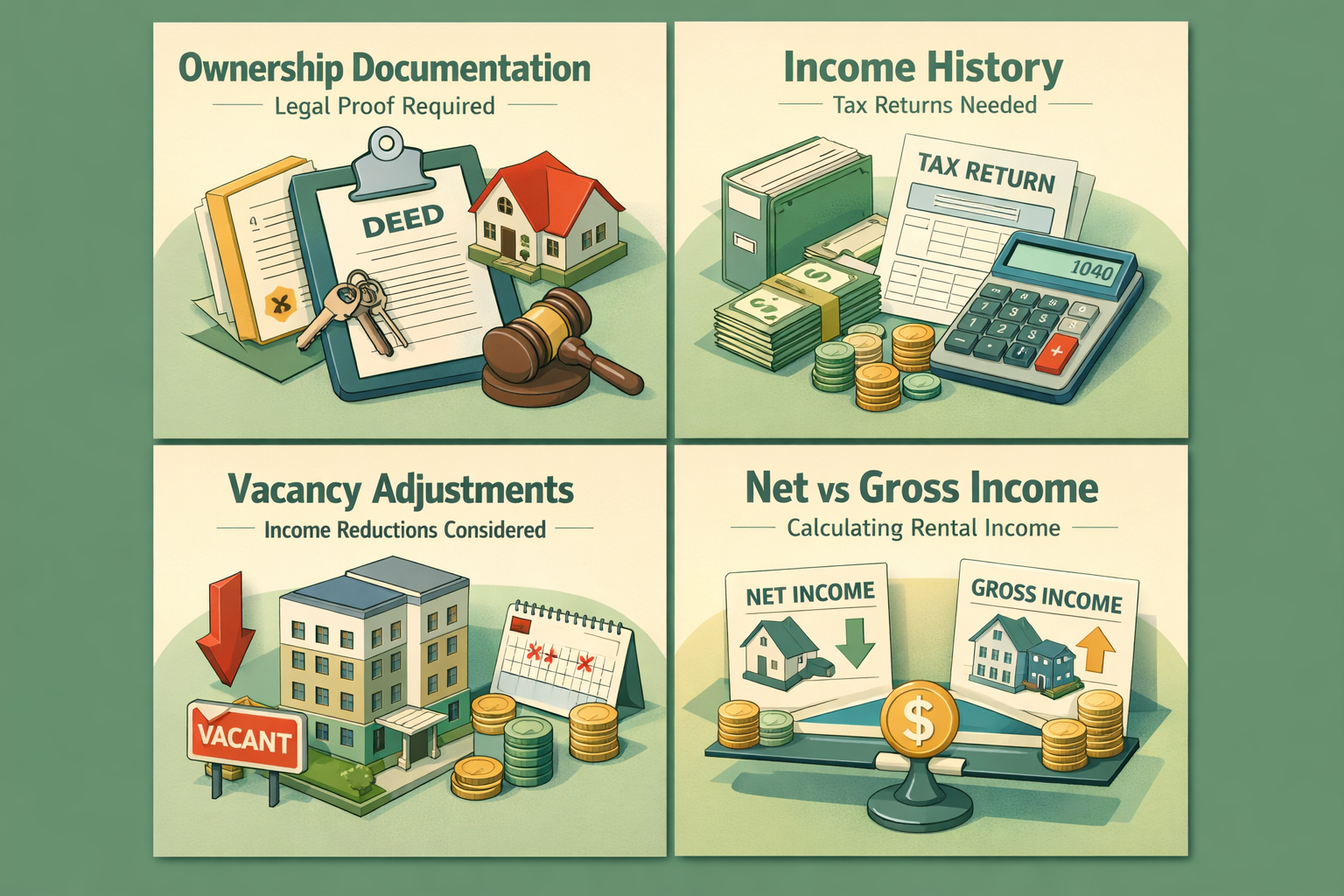
- Ownership documentation: You'll generally need to prove legal ownership through a recorded deed, probate documents, or a trust transfer. Without clear title in your name, lenders may not count the income at all.
- Income history: Lenders often want to see at least one to two years of rental income history on your federal tax returns, typically via Schedule E. If the property was recently inherited and hasn't yet appeared on your returns, some lenders may require a current signed lease and a professional appraisal confirming market rental value.
- Vacancy and expense adjustments: Most lenders apply a vacancy factor — often around 25% — to the gross rental income before counting it toward your qualifying income. They may also subtract documented operating expenses reported on Schedule E.
- Net rental income vs. gross: Lenders typically use net rental income after mortgage payments, taxes, insurance, and depreciation adjustments are factored in. If the inherited property carries no mortgage, this can actually work in your favor.
It's worth noting that policies can vary meaningfully between lenders. Some jumbo lenders — particularly portfolio lenders — may apply their own proprietary guidelines that are more or less flexible than standard agency overlays.
Documentation You'll Need to Support Your Application
Documentation is the cornerstone of any successful jumbo loan application, and it becomes even more important when your income includes inherited rental property. Lenders need a clear, verifiable paper trail that supports every dollar you're claiming as qualifying income.
Here's what you may need to gather:
- Federal tax returns (two years): Schedule E from your IRS Form 1040 is the primary document used to verify rental income and expenses. If the inherited property has only recently come into your possession, you may have limited tax history to show.
- Probate or estate transfer documents: These establish that the property was legally transferred to you and help lenders confirm the timeline of ownership.
- Current lease agreements: A signed, active lease agreement can help demonstrate that the property is currently generating income, especially if your tax returns don't yet reflect a full year of ownership.
- Property appraisal or rental market analysis: Some lenders may require a current appraisal to verify the property's value and a rental market analysis (sometimes called a Form 1007 or Single-Family Comparable Rent Schedule) to confirm that the rent charged aligns with market rates.
- Bank statements showing rental deposits: Twelve to twenty-four months of bank statements that clearly show regular rental deposits can add another layer of credibility to your income claim.
- Property management records (if applicable): If a property manager handles the rental, their statements can corroborate your income figures.
Being proactive about assembling these documents before you apply can significantly reduce delays and improve your chances of a smooth approval process.
Debt-to-Income Ratio Challenges and How to Address Them
One of the most common hurdles in how to qualify for a jumbo loan with inherited rental property income is the debt-to-income (DTI) ratio. Jumbo lenders typically prefer a DTI of 43% or lower, and some may want to see it at 38% or below for large loan amounts. Your DTI compares your total monthly debt obligations — including the proposed new mortgage payment — against your gross monthly income.
Here's where inherited rental income can be both helpful and complicated. On the positive side, net rental income from a mortgage-free inherited property can meaningfully boost your qualifying for large mortgage income. On the challenging side, if the rental income is reduced after vacancy adjustments and expense deductions, the net figure may be lower than you expect.
Strategies that may help manage your DTI include:
- Paying down existing debts: Reducing credit card balances, auto loans, or student loans before applying can lower your monthly obligations and improve your DTI ratio.
- Making a larger down payment: A bigger down payment reduces the loan amount and therefore the monthly mortgage payment that factors into your DTI calculation.
- Maximizing documented rental income: Ensuring your lease agreements are current and your rental rates reflect market value can help maximize the income figure lenders use.
- Exploring non-QM or portfolio jumbo products: Some lenders offer non-qualified mortgage (non-QM) products that use alternative income documentation methods, such as bank statement loans or asset depletion models, which may allow more flexible DTI thresholds.
Credit Score and Reserve Requirements for Jumbo Borrowers
Beyond income, jumbo lenders place considerable weight on credit quality and financial reserves. These factors signal to lenders that you're a low-risk borrower capable of managing a large loan obligation over time.
Credit score expectations: Most jumbo lenders typically require a minimum credit score of 700 to 720, though some may set the bar at 740 or higher, particularly for loan amounts well above the conforming limit. Borrowers with scores in the 760 or above range may access more competitive interest rates and more flexible underwriting terms.
Cash reserve requirements: One aspect of jumbo lending that surprises many borrowers is the reserve requirement. Lenders often want to see twelve to twenty-four months of mortgage payments held in liquid or semi-liquid assets after closing. This gives lenders confidence that you could continue making payments even if your income were temporarily disrupted.
Importantly, the value of your inherited rental property itself may be counted toward reserves in some cases, particularly if it carries no debt and holds demonstrable equity. However, policies vary, so it's worth discussing this directly with your loan officer. Retirement accounts, investment portfolios, and savings accounts are the most commonly accepted reserve assets.
If your reserves are limited, working with a financial advisor to optimize asset positioning before applying could be a worthwhile step. Lenders generally look at a financial snapshot from the past two to three months of statements, so strategic planning ahead of application time may make a difference.
Working With the Right Lender for Rental Income Scenarios
Not all lenders are equally comfortable with complex income scenarios involving inherited rental properties. Choosing the right lending partner can make a significant difference in both your approval odds and the terms you receive.
Portfolio lenders — institutions that keep loans on their own books rather than selling them to the secondary market — often have more flexibility in how they evaluate non-traditional income sources like inherited rental income. They can apply common sense underwriting rather than strictly adhering to agency guidelines.
Private banks and wealth management mortgage divisions are another option worth exploring. These lenders frequently work with high-net-worth borrowers and may be more accustomed to evaluating complex asset and income structures, including trusts, estates, and inherited real estate holdings.
When you're evaluating lenders, consider asking these questions:
- How do you calculate qualifying income from inherited rental properties?
- What documentation will you require if the property was inherited within the past year?
- Do you offer any non-QM or portfolio jumbo products that allow for alternative income documentation?
- How do you handle rental income that isn't yet reflected on tax returns?
Getting clear answers upfront can save you time and prevent unpleasant surprises late in the underwriting process. A mortgage broker with experience in jumbo loans with rental income scenarios may also be able to match you with lenders who specialize in these types of transactions.
●Conclusion
Understanding how to qualify for a jumbo loan with inherited rental property income is genuinely achievable with the right preparation and the right lending partner. The key is treating your inherited property like the financial asset it is — documenting ownership clearly, establishing a verifiable income history, and presenting your full financial picture in an organized, professional way. Jumbo lenders are looking for confidence that you can manage a large obligation responsibly, and inherited rental income can absolutely contribute to that story when it's properly documented and well-supported. Whether you're buying a luxury primary residence or expanding your real estate portfolio, taking these steps thoughtfully can put you in a strong position to succeed. If you're ready to explore your options, connecting with a knowledgeable mortgage professional who understands complex income scenarios is a great place to start.