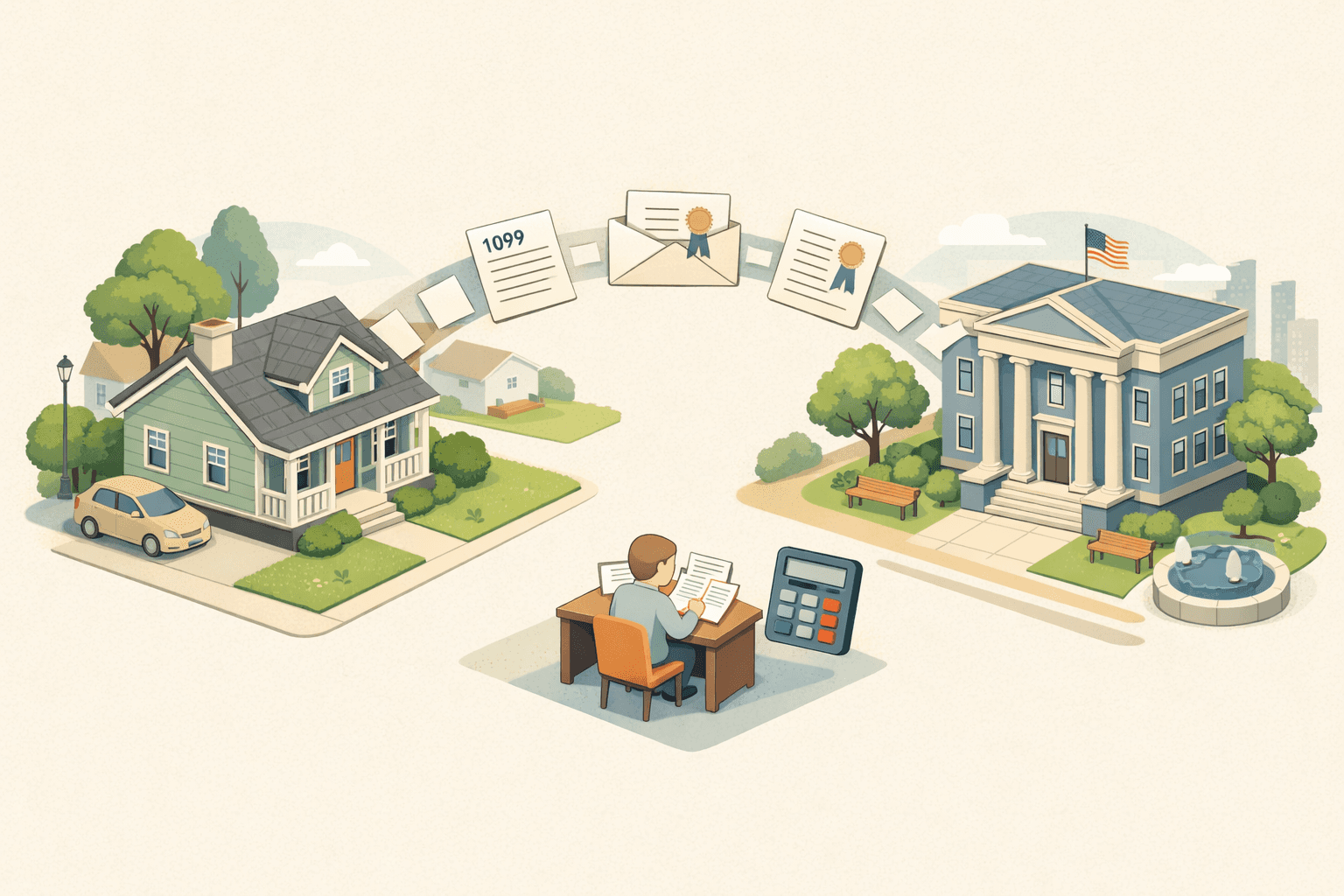
If you're a freelancer who also receives a retirement pension, qualifying for a mortgage may feel more complicated than it needs to be. Lenders don't just look at how much you earn — they look at how you earn it, how consistent it is, and how it stacks up against your monthly debt obligations. Understanding how to calculate DTI with freelance 1099 income and retirement pension is one of the most important steps you can take before applying for a home loan. Whether you're a first-time homebuyer, a seasoned homeowner looking to refinance, or a real estate investor exploring new financing, this guide will walk you through the process clearly and confidently.
What Is DTI and Why It Matters for Mortgage Approval
Your debt-to-income ratio (DTI) is one of the most critical factors lenders evaluate when you apply for a mortgage. Simply put, it's the percentage of your gross monthly income that goes toward paying your monthly debts. Lenders use this number to gauge whether you can comfortably manage a new mortgage payment alongside your existing financial obligations.
There are typically two forms of DTI that mortgage underwriters review:
- Front-end DTI: This covers only your proposed housing expenses — principal, interest, taxes, and insurance (PITI) — divided by your gross monthly income.
- Back-end DTI: This includes all monthly debt obligations — housing costs plus car loans, student loans, credit card minimums, and any other recurring debts — divided by your gross monthly income.
Most conventional loan programs prefer a back-end DTI of 43% or lower, though some programs may allow higher ratios with compensating factors like strong credit or significant cash reserves. FHA loans may also permit slightly higher DTI thresholds under certain conditions. Knowing where you stand before you apply could save you significant time and stress.
How Lenders View Freelance 1099 Income for DTI Purposes
Freelance income — reported on IRS Form 1099 — is considered self-employment income by most mortgage lenders. This means it's treated differently than a traditional W-2 paycheck. Because freelance earnings can fluctuate month to month, lenders typically require a longer income history and a more detailed analysis before they'll count it toward your qualifying income.
Here's what lenders generally look for when evaluating freelance income DTI calculation:
- Two-year history: Most lenders want to see at least two years of self-employment income documented through federal tax returns (typically IRS Form 1040, along with Schedule C for sole proprietors).
- Net income, not gross: For freelancers, lenders usually use your net income after business deductions — not the gross amount shown on your 1099s. This is a critical distinction, because business write-offs that reduce your tax burden can also reduce your qualifying income.
- Income averaging: Lenders often average your net self-employment income over 24 months to arrive at a stable monthly figure. If your income is declining year over year, the lender may use the lower year's figure or decline to count it at all.
- Year-to-date profit and loss: Some lenders may request a current-year profit and loss (P&L) statement, especially if your tax returns are outdated.
It's worth noting that aggressive tax deductions — while beneficial for reducing your tax bill — may significantly lower the income figure lenders will use. This is one of the more nuanced challenges freelancers face when applying for a freelance income DTI calculation.
Including Retirement Pension Income in Your DTI Calculation
Retirement pension income is generally viewed more favorably by mortgage lenders than freelance income, because it tends to be predictable, consistent, and well-documented. A retirement pension mortgage application can benefit significantly from this stable income stream — but there are still rules about how it's counted.
When lenders evaluate pension income, they typically look for the following:
- Proof of continuance: Lenders generally want confirmation that pension income will continue for at least three years from the mortgage closing date. Award letters, pension statements, or benefit verification letters are commonly used for this purpose.
- Gross monthly pension amount: Unlike freelance income, pension income is typically counted at its gross (pre-tax) amount, which can strengthen your qualifying income profile.
- Tax considerations: Some pension income may be fully or partially taxable. If a borrower can demonstrate that pension income is non-taxable (such as certain VA disability benefits or some public employee pensions), lenders may "gross up" that income by a factor — commonly around 25% — to reflect its true economic value.
Combining a stable monthly pension with documented freelance earnings creates a blended income picture. While this combination can be powerful, it also requires careful documentation to ensure both income sources are verified and accepted by the underwriter. If you're planning a retirement pension mortgage, understanding how these income types interact is essential.
Step-by-Step: How to Calculate DTI With Freelance 1099 Income and Retirement Pension
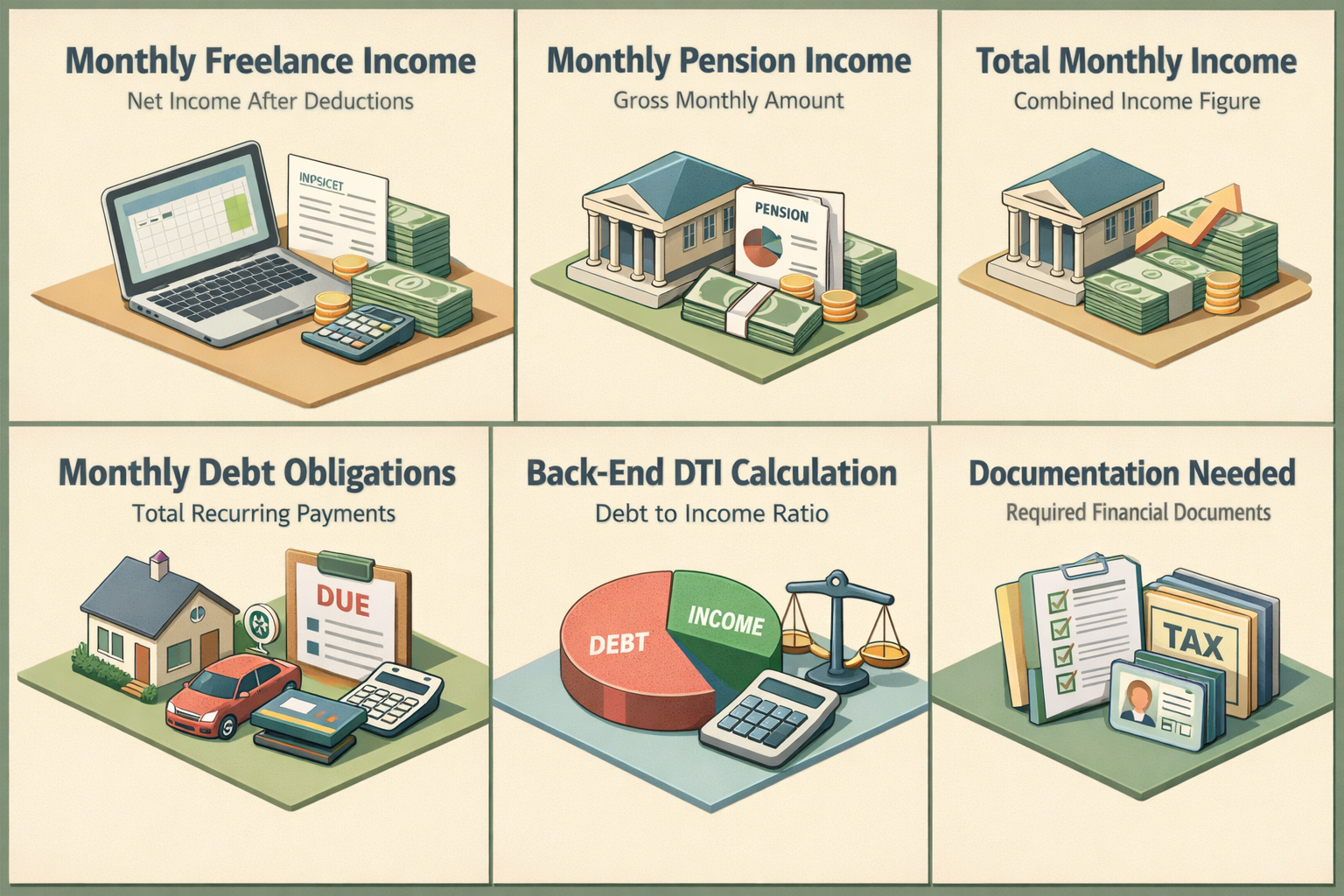
Now let's walk through the actual process of how to calculate DTI with freelance 1099 income and retirement pension so you can estimate your ratio before speaking with a lender.
Step 1: Determine Your Monthly Freelance Net Income
Pull your last two years of federal tax returns. Look at your net self-employment income after deductions on Schedule C (or Schedule E if applicable). Add the two years together and divide by 24 to get a monthly average. For example, if your net self-employment income was $48,000 in Year 1 and $54,000 in Year 2, your average monthly freelance income would be ($48,000 + $54,000) ÷ 24 = $4,250 per month.
Step 2: Add Your Monthly Pension Income
Identify your gross monthly pension payment from your award letter or benefit statement. If it's non-taxable, check with your lender about applying a gross-up factor. For this example, let's say your pension pays $2,200 per month (gross, taxable).
Step 3: Calculate Combined Gross Monthly Income
Add both figures together: $4,250 (freelance) + $2,200 (pension) = $6,450 per month in qualifying income.
Step 4: Add Up Your Monthly Debt Obligations
List all recurring monthly debt payments: proposed mortgage payment (PITI), car loan, credit card minimums, student loans, etc. Suppose your proposed mortgage payment is $1,500, your car loan is $350, and your minimum credit card payments total $150. That's $2,000 per month in total obligations.
Step 5: Divide to Get Your Back-End DTI
Divide total monthly debts by gross monthly income: $2,000 ÷ $6,450 = approximately 31%. That's a healthy DTI ratio that most conventional lenders would view favorably.
Keep in mind, this is a simplified illustration. Your actual qualifying income may differ based on the lender's specific guidelines, your tax return details, and whether your income trend is stable or declining.
Common Documentation Lenders May Request for Mixed Income Borrowers
When your income comes from multiple sources — particularly a mix of freelance 1099 earnings and retirement pension — expect your lender to request a comprehensive documentation package. Being prepared ahead of time can help speed up the underwriting process and reduce back-and-forth delays.
Here's what you may need to gather:
- Two years of signed federal tax returns (IRS Form 1040 with all schedules, especially Schedule C or Schedule SE)
- 1099 forms from all clients for the past two tax years
- IRS transcripts — some lenders require IRS-issued tax transcripts to verify the returns you submit match what was filed
- Current-year profit and loss statement if your most recent tax return is older than a few months
- Pension award letter or benefit verification statement showing the monthly amount and continuance terms
- Bank statements (typically two to three months) to verify income deposits and cash flow
- Business license or client contracts as evidence of ongoing freelance work
Organizing these documents early not only helps your lender underwrite your file more efficiently — it also demonstrates financial responsibility, which can work in your favor during the approval process.
Strategies to Improve Your DTI Before Applying for a Mortgage
If your DTI is higher than lenders prefer, there are several steps you might consider taking before submitting a mortgage application. Improving your ratio — even modestly — could meaningfully change your loan options and interest rate.
- Pay down existing debts: Reducing or eliminating high-balance credit cards or installment loans lowers your monthly obligations, which directly reduces your back-end DTI.
- Increase documented income: If your freelance income has grown recently, consider waiting until you can show a full two-year average that reflects your higher earnings. Alternatively, if your business is structured as an S-corp or LLC, speak with a tax advisor about optimizing how income is reported without over-deducting.
- Avoid taking on new debt: Opening new credit accounts or taking out car loans before applying for a mortgage can increase your monthly obligations and push your DTI higher.
- Consider a larger down payment: A bigger down payment reduces your loan amount, which lowers your proposed monthly mortgage payment — and therefore your front-end DTI.
- Explore non-QM loan programs: Some lenders offer non-qualified mortgage (non-QM) products designed specifically for self-employed borrowers and those with complex income. These programs may use bank statements or alternative documentation in place of tax returns, which could result in a higher qualifying income figure.
It may also be helpful to work with a mortgage professional who has experience with mixed-income borrowers. They can identify the most favorable loan programs and help you present your income in the strongest possible way. Understanding mortgage qualification requirements in advance gives you the best chance of a successful application.
●Conclusion
Understanding how to calculate DTI with freelance 1099 income and retirement pension is a meaningful step toward homeownership or refinancing success. While the process is more involved than it is for traditional W-2 borrowers, it's absolutely achievable with the right preparation, documentation, and guidance. Your pension provides lenders with stability, and your freelance income — when properly documented — demonstrates earning power. Together, they can form a compelling financial profile.
At LoanWise, we work with borrowers of all income types, including freelancers, retirees, and those with blended income streams. If you're ready to explore your mortgage options or want a personalized DTI review, connect with one of our lending specialists today. Your path to the right loan starts with the right conversation.