
Navigating the US mortgage market can feel complicated for anyone — but when your retirement income comes from abroad and you're eyeing a high-value American property, the process takes on an entirely different level of complexity. Many international retirees and foreign nationals dream of owning a home in the United States, whether as a primary residence, a vacation retreat, or an investment property. The challenge is that jumbo loans — mortgages that exceed the conforming loan limits set by the Federal Housing Finance Agency — come with stricter qualification standards than conventional financing. And when your income originates from a foreign pension, government retirement plan, or overseas investment account, lenders need additional reassurance before they'll approve such a large loan. The good news? It's entirely possible to qualify for a jumbo loan with foreign retirement income and US property as collateral. You just need to understand what lenders require and how to present your financial picture clearly.
What Makes Jumbo Loans Different From Conventional Mortgages
Before diving into income documentation strategies, it helps to understand what sets jumbo loans apart. In most parts of the United States, the conforming loan limit for a single-family home sits above $700,000, with higher thresholds in certain high-cost areas. Any mortgage that exceeds these limits is considered a jumbo loan and is not backed by government-sponsored enterprises like Fannie Mae or Freddie Mac.
Because jumbo loans aren't government-insured, lenders carry the full risk of the loan on their own books. That means they tend to apply tighter underwriting standards across the board. Borrowers typically need stronger credit scores, larger down payments, lower debt-to-income ratios, and more robust financial reserves compared to conventional borrowers.
For international retirees with foreign retirement income, these standards can feel even more demanding. Lenders must verify that your income is stable, consistent, and likely to continue — which is straightforward for a domestic Social Security recipient but requires more legwork when the income flows from a foreign government pension or international retirement account.
Understanding How Lenders View Foreign Retirement Income and International Assets
When you apply for a jumbo loan, lenders want to see that your income is reliable and will continue for a reasonable period — typically at least three years. Foreign retirement income, such as payments from a national pension system, a private overseas annuity, or a government-sponsored retirement fund, can meet this standard if it's properly documented.
Lenders generally treat foreign retirement income similarly to domestic pension income, provided you can demonstrate the source, amount, and regularity of the payments. What makes this tricky is that documentation from foreign institutions may not follow US formats, and not all lenders are equipped to evaluate international financial records.
International assets also play an important role in jumbo loan qualification. Even if your monthly income appears modest relative to the loan amount, significant liquid assets held in foreign bank accounts or investment portfolios could help satisfy lender reserve requirements. Many jumbo lenders require borrowers to show anywhere from six to twenty-four months of mortgage payments in reserve, and international accounts may count toward that threshold if the funds are verifiable and accessible.
It's worth noting that not all lenders accept foreign-sourced assets or income with the same flexibility. Borrowers in this situation may benefit most from working with portfolio lenders or non-QM (non-qualified mortgage) lenders, who set their own underwriting criteria and often have more experience evaluating international financial profiles.
Key Documentation You'll Need to Prepare for Jumbo Loan Approval
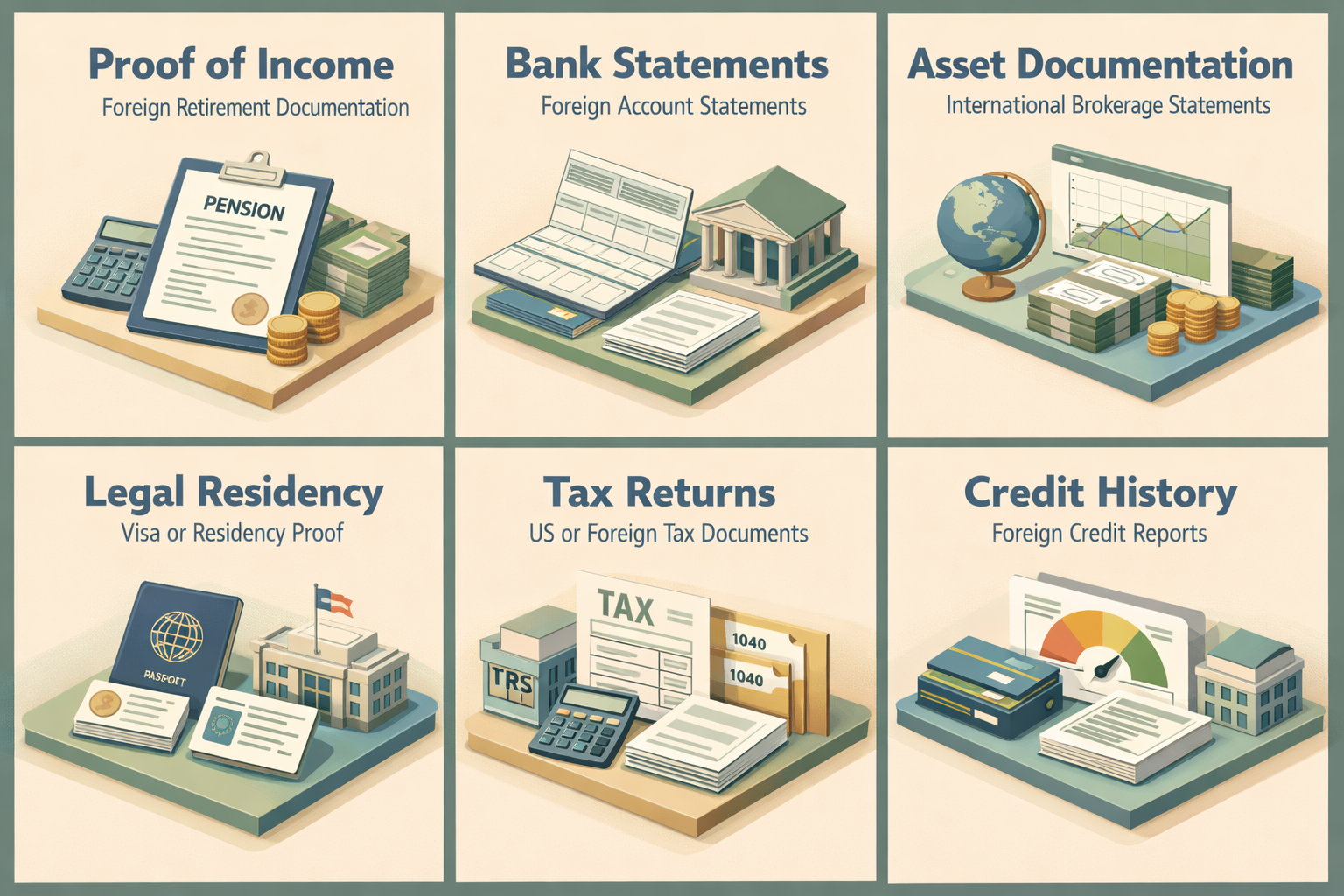
Documentation is everything when it comes to qualifying for a jumbo loan with foreign retirement income. Lenders need to verify your income, assets, and identity — and when those elements are rooted in another country's financial system, the paperwork requirements can be more extensive than usual.
Here's a general list of what you may be asked to provide:
- Proof of foreign retirement income: This could include award letters from a national pension authority, official statements from a foreign retirement fund, or signed and translated income verification letters from the issuing institution.
- Bank statements from foreign accounts: Lenders typically want to see twelve to twenty-four months of statements showing regular income deposits. These may need to be translated into English and converted to US dollar equivalents.
- Asset documentation: Statements from international brokerage accounts, foreign real estate holdings (if used as qualifying assets), and any US-based financial accounts you hold.
- Proof of legal residency or visa status: Your immigration status in the United States affects your loan eligibility. Some jumbo lenders work with foreign nationals holding specific visa types, while others may require permanent residency.
- US tax returns or foreign tax filings: If you file US tax returns, lenders will want to review them. If your income is only reported abroad, you may need to provide equivalent foreign tax documents.
- Credit history documentation: If you lack a robust US credit history, some lenders may accept foreign credit reports or use alternative credit-scoring methods.
Working with a mortgage professional who specializes in international borrowers or non-QM lending can help you anticipate which documents your specific lender will need.
How Credit Score and Down Payment Requirements Apply to International Borrowers
Jumbo loans typically require stronger credit profiles than conventional loans. While exact minimums vary by lender, a credit score of 700 or higher is commonly expected, with some lenders preferring scores above 720 or even 740 for the most competitive rates. For international borrowers who may not have established a long US credit history, this can present an obstacle.
Fortunately, there are a few strategies that might help. Some portfolio lenders and non-QM lenders use alternative credit evaluation methods, such as reviewing payment histories from foreign credit bureaus, rental payment records, or utility payment histories. Building even a modest US credit footprint — through a secured credit card or a US bank account held over several years — can also help establish a creditworthiness track record before you apply.
Down payment expectations for jumbo loans tend to run higher than conventional mortgages as well. Many jumbo lenders require at least 20% down, and for foreign nationals or borrowers with international income, some lenders may ask for 25% to 30% or more. A larger down payment reduces the lender's risk and can make it meaningfully easier to gain approval, even if other parts of your financial profile are unconventional by US standards.
The upside here is that if you're a retiree with substantial accumulated wealth — even if that wealth is held internationally — a strong down payment combined with verifiable asset reserves can often compensate for income that's harder to document in a traditional way.
Choosing the Right Lender for Your Jumbo Loan With Foreign Retirement Income and US Property
This is arguably the most important step in the entire process. Not every lender is willing or able to underwrite a jumbo loan for a borrower whose income comes primarily from foreign retirement sources. Conventional banks and mortgage lenders that sell their loans to the secondary market often follow strict agency guidelines that don't accommodate international income documentation as easily.
Portfolio lenders — financial institutions that keep loans on their own balance sheets rather than selling them — typically have more flexibility in how they assess borrower qualifications. They can create custom underwriting decisions based on the full picture of your financial health, rather than relying solely on standardized income formulas.
Non-QM lenders are another strong option. These lenders specialize in borrowers who don't fit neatly into traditional qualification boxes, including self-employed individuals, foreign nationals, and retirees with complex income structures. Non-QM jumbo products may use asset depletion methods, bank statement income, or foreign income analysis to determine your qualifying income — approaches that can be especially helpful when your retirement income comes from abroad.
When shopping for a lender, consider asking these questions upfront:
- Do you work with borrowers who have foreign retirement income?
- Can you accept bank statements from international financial institutions?
- Do you offer non-QM or portfolio jumbo loan products?
- What documentation will you need for income sourced outside the United States?
- What are your minimum reserve requirements, and can international assets count toward them?
Getting clear answers early can save significant time and help you find a lender who's genuinely a good fit for your profile.
Asset Depletion and Alternative Income Methods That May Strengthen Your Application
One of the most useful tools available to retirees — including those with international retirement income — is the asset depletion method of income calculation. Under this approach, lenders take the total value of your eligible liquid assets and divide them over a set period (often 60 to 360 months, depending on the lender) to arrive at a monthly qualifying income figure.
For example, if you hold $1.5 million in verifiable liquid assets and the lender uses a 240-month divisor, that could translate to $6,250 per month in qualifying income — even if your actual monthly pension payments are lower. This method can be particularly powerful for retirees who have accumulated significant wealth over their careers, regardless of where those assets are held.
It's important to note, however, that not all lenders accept foreign assets under the asset depletion calculation, and those that do may apply a haircut — reducing the asset value by a certain percentage before performing the calculation, to account for currency risk or transfer restrictions. Discussing this specifically with your lender early in the process is essential.
Another alternative is to position any US-based income streams you might have — such as Social Security benefits if you're a US citizen or eligible resident, US rental income from investment properties, or dividends from US brokerage accounts — as primary qualifying income, with your foreign retirement income serving as supplemental support. This layered approach might make your application stronger and more straightforward to underwrite.
●Conclusion
Learning how to qualify for a jumbo loan with foreign retirement income and US property isn't always a simple process, but it's far from impossible. The key is understanding that lenders are looking for confidence — confidence that your income is stable, your assets are verifiable, and your financial commitments are manageable. When you present a thorough, well-documented application and work with a lender experienced in international borrower profiles, the path to approval becomes much clearer.
Whether you're planning to purchase a luxury retirement home in Florida, a vacation property in California, or an investment property in a growing US market, the strategies outlined here can help you put your best foot forward. Start by gathering your income and asset documentation early, explore non-QM and portfolio lenders who specialize in complex income situations, and don't hesitate to work with a mortgage professional who understands the nuances of jumbo loan qualification with foreign retirement income and international assets. With the right preparation and the right team beside you, your US property goals are well within reach.