
Buying a high-value home after a divorce is absolutely possible — but it does come with a few extra steps. If you're wondering how to qualify for a jumbo loan with a divorce decree, you're not alone. Many homebuyers and homeowners emerging from a divorce find themselves navigating a complex mix of changed income, divided assets, and new financial obligations. Jumbo loans — mortgages that exceed conforming loan limits set by the Federal Housing Finance Agency (FHFA) — carry stricter underwriting standards than conventional loans, which means lenders will look closely at your full financial picture. The good news is that with the right preparation and documentation, qualifying is very achievable. This guide walks you through everything you need to know.
What Makes Jumbo Loans Different from Conventional Mortgages
Before diving into the divorce-specific details, it helps to understand what separates jumbo loans from standard home financing. A jumbo mortgage is any loan that exceeds the conforming loan limit, which in most U.S. markets is set at $766,550 for a single-family home in 2024, though higher-cost areas may have elevated limits. Because jumbo loans can't be purchased by Fannie Mae or Freddie Mac, lenders take on the full risk themselves.
That added risk means lenders typically apply tighter qualification criteria. You might expect:
- Higher credit score requirements — many lenders look for a score of 700 or above, with some preferring 720 or higher
- Lower debt-to-income (DTI) ratios — often 43% or below, though some lenders may allow up to 45% with strong compensating factors
- Larger down payments — typically ranging from 10% to 20% or more depending on the loan amount
- Substantial cash reserves — lenders may require anywhere from 6 to 18 months of mortgage payments held in liquid assets
- Thorough income documentation — W-2s, tax returns, and bank statements are commonly required
Understanding these benchmarks sets the stage for knowing exactly how divorce-related financial changes could affect your eligibility — and how to address them proactively.
How a Divorce Decree Affects Your Mortgage Application
When you apply for a jumbo mortgage after a divorce, lenders will want to review your divorce decree and, in some cases, your marital settlement agreement. These legal documents outline the division of assets, liabilities, and any ongoing financial obligations like alimony or child support. Here's how each element typically plays into the underwriting process:
Alimony and Spousal Support
If you receive alimony, it can often be counted as qualifying income — but there are conditions. Most lenders require that the support payments have been received consistently for a defined period (often six months to a year) and that they're documented to continue for at least three years. Your divorce decree must clearly state the payment amount and duration. If you pay alimony, that obligation is typically treated as a monthly debt, which increases your DTI ratio and reduces your borrowing power.
Child Support Income and Obligations
Child support follows similar rules to alimony when it comes to income qualification. If you receive it, it may be counted as stable income if it's documented, consistent, and expected to continue for the required period. If you're the paying party, it's factored into your monthly debt obligations. Both scenarios require clear documentation from the divorce decree.
Asset Division and Down Payment Sources
A divorce settlement may result in a lump-sum asset transfer — such as proceeds from a home sale or a retirement account distribution. These funds could potentially be used toward a down payment on a new jumbo purchase. However, lenders will typically want a clear paper trail showing where the funds originated. Providing your divorce decree and settlement agreement helps verify that the money is legitimately yours and not a gift or undisclosed loan.
Income Verification After Divorce: What Lenders Want to See
One of the most important parts of understanding how to qualify for a jumbo loan with a divorce decree is knowing how lenders will evaluate your post-divorce income. Your financial profile may look very different from when you were married, and jumbo lenders will assess income stability carefully.
Employment Income
If you're a W-2 employee, your qualification process may be relatively straightforward. Lenders will typically request two years of tax returns, recent pay stubs, and employer verification. Even if your household income dropped after the divorce, a steady employment history can work in your favor.
Self-Employment and Non-Traditional Income
If you're self-employed or receive income from rental properties or investments, be prepared to provide additional documentation. Lenders may average your income over two years using your tax returns, which could be impacted by business write-offs. In some cases, a non-QM (non-qualified mortgage) jumbo loan — which uses alternative income verification methods like bank statements — may be worth exploring if traditional documentation doesn't fully reflect your earning capacity.
Combining Income Sources
Post-divorce borrowers may rely on a combination of employment income, alimony, child support, investment returns, or rental income. Lenders will want to see documentation for each source. Organizing these in advance — with clean records and copies of your divorce decree — can make the underwriting process smoother and faster.
Managing Debt After a Jumbo Mortgage Divorce Settlement
A jumbo mortgage divorce settlement often results in one spouse taking on shared debts while the other is released from them. However, from a lender's perspective, if your name still appears on a debt — such as a joint credit card or a former marital home's mortgage — it may still count against your DTI ratio, even if your ex-spouse is now responsible for payments under the decree.
This is a critical point that catches many borrowers off guard. To protect your qualifying ability, consider the following strategies:
- Request removal from joint accounts — ask creditors to formally release you from joint liabilities or request that your ex refinance the marital home into their name only
- Document payment responsibility clearly — if your ex is required by the decree to make payments on a shared account, some lenders may be willing to exclude that debt from your DTI if you can show 12 months of on-time payment history made by your ex
- Pay down high-balance debts — reducing outstanding balances before applying can improve your DTI and credit utilization ratio
- Avoid taking on new debt — hold off on financing large purchases until after your jumbo loan closes
Working closely with a mortgage professional who has experience with post-divorce lending scenarios can help you identify which debts affect your application and how to best address them.
Credit Score Considerations for Post-Divorce Jumbo Borrowers
Divorce can sometimes leave a mark on your credit, particularly if joint accounts were mismanaged or if the separation process led to missed or late payments. Since jumbo lenders often have higher credit score thresholds than conventional loan programs, rebuilding and protecting your credit is essential.
Here are some steps that may help strengthen your application before applying:
- Check your credit reports from all three major bureaus and dispute any errors or inaccurate joint account data
- Keep credit card balances low relative to your credit limits — a utilization rate below 30% is generally favorable
- Establish individual credit accounts in your name only, if you previously relied primarily on joint accounts
- Maintain a consistent payment history — even one or two late payments can have a noticeable effect on jumbo loan eligibility
- Avoid closing old accounts — the length of your credit history is a positive factor, so keeping older accounts open (even if unused) may help
It may take several months to see meaningful credit improvement, so beginning this process well before you plan to qualify for a jumbo loan is a smart move.
Documentation Checklist: Preparing Your Jumbo Loan Application After Divorce
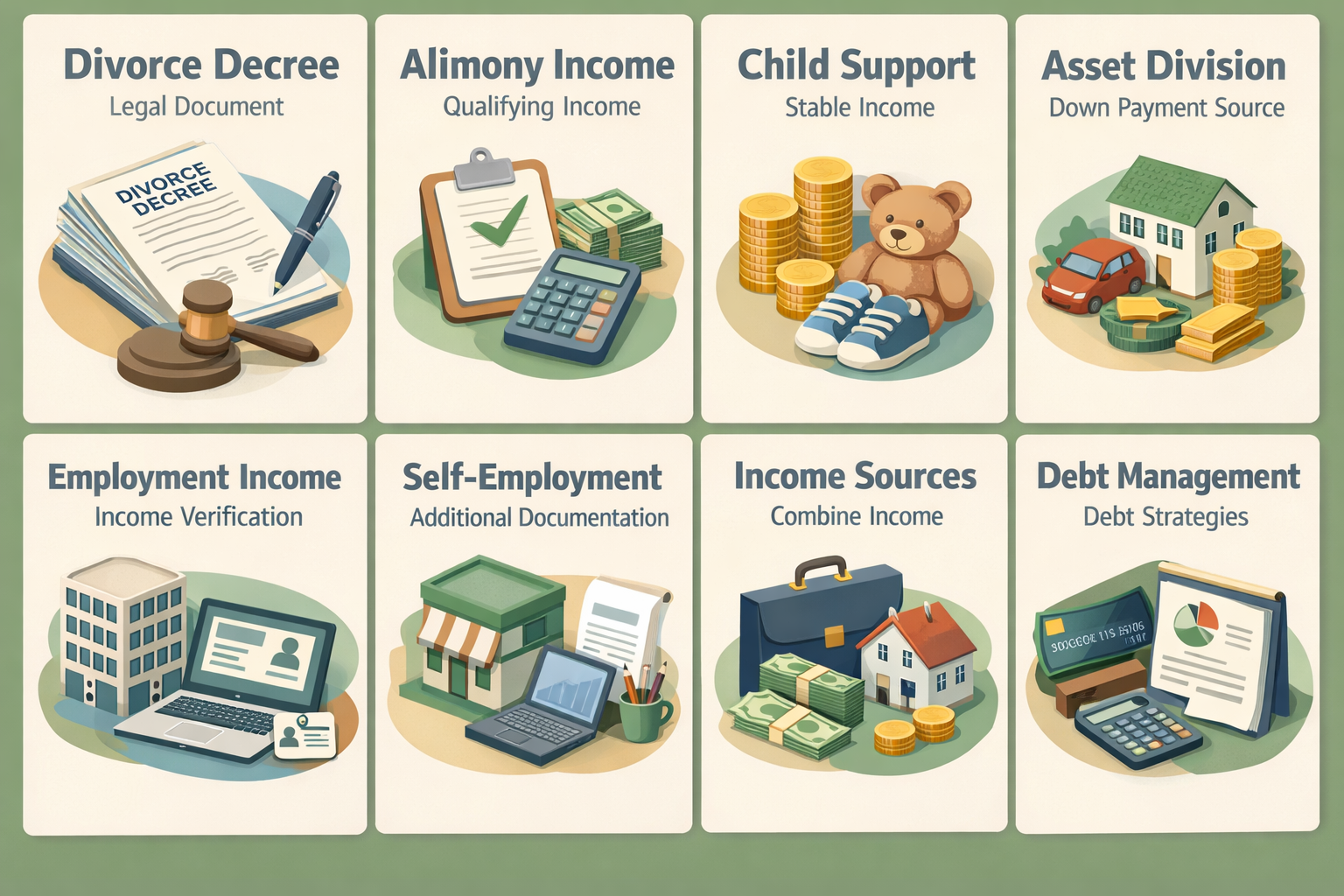
Organization is one of your strongest tools when applying for a jumbo loan after a divorce. Because jumbo lenders perform more detailed underwriting than conventional lenders, having your paperwork in order upfront can significantly reduce delays. Here's a practical checklist of documents you may need:
- Finalized divorce decree — the complete, court-signed document outlining asset division, support obligations, and liability responsibilities
- Marital settlement agreement — if separate from the decree, this may outline property transfers and financial arrangements in more detail
- Two years of federal tax returns — personal and business returns if self-employed
- Recent pay stubs — typically the most recent 30 days
- Bank and investment account statements — usually the last two to three months, covering all accounts used for down payment and reserves
- Documentation of alimony or child support — payment history, bank records showing receipt, and the relevant sections of your decree
- Evidence of asset transfers — if divorce settlement funds are being used for the down payment, provide a paper trail linking those funds to the decree
- Mortgage or rental payment history — demonstrating housing payment consistency strengthens your profile
Being proactive with documentation signals to lenders that you're financially organized and ready for the responsibilities of a jumbo mortgage.
●Conclusion
Navigating how to qualify for a jumbo loan with a divorce decree may feel overwhelming at first, but it's a well-traveled path for many homebuyers and homeowners who want to start fresh with a new home. The key is understanding how divorce-related income, debts, and assets are interpreted by jumbo lenders — and taking deliberate steps to present your finances in the strongest possible light. From documenting alimony and child support to clearing joint debts and building individual credit, each action you take moves you closer to approval. At LoanWise, we work with borrowers in all kinds of financial situations, including those rebuilding after a jumbo mortgage divorce settlement. If you're ready to explore your options, connect with one of our experienced mortgage advisors today and take the first step toward your next home.