
Buying a high-value home is an exciting milestone, but for freelancers and independent contractors, the path to financing it can feel more complex than it does for traditionally employed borrowers. If you're wondering how to qualify for a jumbo loan with 1099 income from freelance work, you're not alone. Millions of self-employed professionals earn well above the national average, yet face additional scrutiny when applying for large mortgage loans. The good news is that qualification is absolutely possible with the right preparation, documentation, and understanding of what lenders expect. This guide walks you through everything you need to know.
What Makes Jumbo Loans Different from Conventional Mortgages
A jumbo loan is a mortgage that exceeds the conforming loan limits set by the Federal Housing Finance Agency (FHFA). In most parts of the United States, any loan above $766,550 — as of recent guidelines — is considered a jumbo loan, though limits can be higher in certain high-cost areas. Because these loans are too large to be purchased or guaranteed by Fannie Mae or Freddie Mac, lenders take on significantly more risk.
That added risk means lenders tend to apply stricter qualification standards across the board. For borrowers with traditional W-2 employment, this typically means higher credit score requirements, larger down payments, and more thorough income verification. For freelancers and 1099 earners, the requirements can feel even more demanding — but they're not insurmountable.
Understanding what sets jumbo loans apart helps you approach the application process with realistic expectations. Rather than viewing the higher bar as a barrier, think of it as a checklist you can systematically work through to demonstrate your financial strength.
Why 1099 Income Adds Complexity to Jumbo Loan Qualification
Lenders prefer income that is stable, predictable, and well-documented. Salaried employees typically receive a consistent paycheck, which makes their income easy to verify. Freelancers, on the other hand, often experience income that varies from month to month, client to client, or project to project. This variability is one of the main reasons lenders scrutinize 1099 income more carefully.
Another layer of complexity comes from how self-employed individuals report their earnings. Many freelancers take advantage of legal tax deductions to reduce their taxable income — which is a smart financial strategy. However, it can significantly lower the income figure that appears on your tax returns, which is often the primary document lenders use to assess your earnings. If your reported net income after deductions looks modest on paper, it may not reflect your actual earning capacity.
Additionally, lenders typically want to see a consistent track record of self-employment income over at least two years. A single strong year may not be enough. They're looking for evidence that your freelance income is sustainable and likely to continue, not just a one-time spike.
None of these challenges are deal-breakers. They simply mean that as a jumbo loan qualification 1099 freelance income applicant, you'll need to be more organized and proactive in how you present your financial profile.
Core Qualification Requirements Lenders Typically Look For
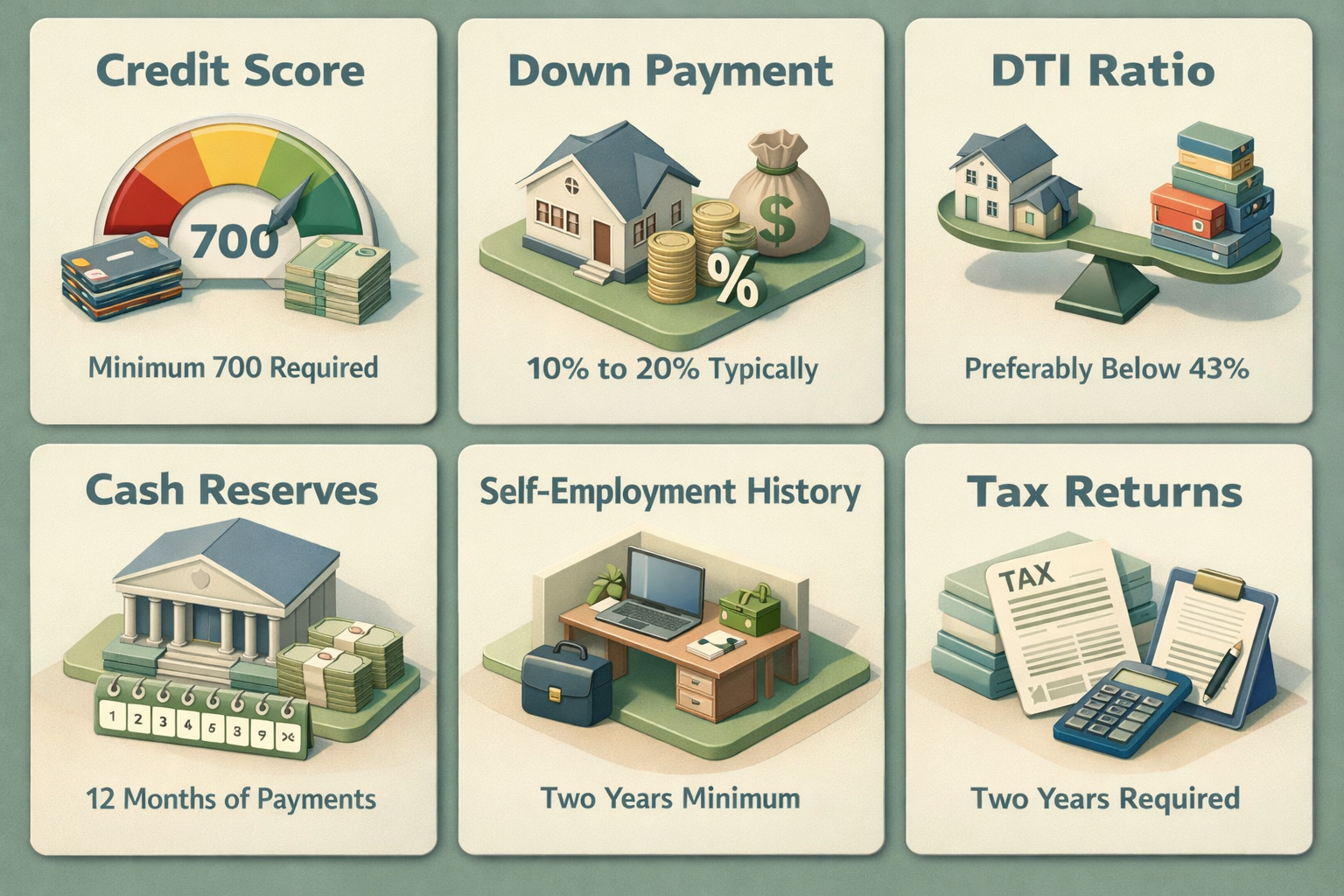
While specific requirements vary by lender, there are several benchmarks that commonly apply when you're seeking jumbo loan qualification with 1099 freelance income. Being aware of these upfront allows you to assess where you stand and address any gaps before you apply.
- Credit Score: Jumbo loan lenders generally expect a credit score of at least 700, and many prefer scores of 720 or higher. A strong credit history signals responsible financial behavior and reduces perceived lending risk.
- Down Payment: Most jumbo loan programs require a down payment of at least 10% to 20%, though some lenders may require more depending on the loan amount and borrower profile. A larger down payment can also help offset concerns about income variability.
- Debt-to-Income Ratio (DTI): Lenders typically prefer a DTI ratio at or below 43%, though some jumbo programs may allow slightly higher ratios for exceptionally qualified borrowers. A lower DTI demonstrates that your monthly obligations are manageable relative to your income.
- Cash Reserves: Because jumbo loans carry higher risk, lenders often require borrowers to have substantial liquid reserves — sometimes 12 months or more of mortgage payments held in savings, investment, or retirement accounts.
- Self-Employment History: A minimum of two years of consistent self-employment income is typically required, verified through federal tax returns, profit and loss statements, and sometimes bank statements.
Meeting these benchmarks doesn't guarantee approval, but it puts you in a strong position to compete for jumbo financing even with non-traditional income sources.
How to Qualify for a Jumbo Loan with 1099 Income from Freelance Work: Documentation Essentials
Documentation is the cornerstone of a successful jumbo loan application for freelancers. The more clearly and completely you can demonstrate your income and financial stability, the stronger your application will be. Here's what lenders commonly request:
- Two Years of Federal Tax Returns: Both personal and business returns (if applicable) are typically required. Lenders will look at your Schedule C or Schedule E to understand net income after business deductions.
- 1099 Forms: Copies of all 1099-NEC or 1099-MISC forms from clients provide a clear picture of your gross earnings from each source.
- Year-to-Date Profit and Loss Statement: A current P&L statement, ideally prepared or reviewed by a licensed CPA, shows your ongoing income and expenses for the current year.
- Bank Statements: Twelve to twenty-four months of personal and business bank statements may be requested to verify consistent cash flow and deposits that align with your reported income.
- Business License or Client Contracts: These documents help establish the legitimacy and continuity of your freelance business, which supports the case that your income will continue.
- CPA Letter: Some lenders request a letter from your accountant confirming the nature, history, and ongoing viability of your self-employment.
Organizing these documents well in advance of your application can meaningfully speed up the underwriting process and reduce the likelihood of delays or additional information requests.
Alternative Loan Programs That May Work Better for Freelancers
If traditional jumbo loan underwriting doesn't align with your financial situation, it's worth exploring non-QM (non-qualified mortgage) loan products, which are specifically designed to accommodate borrowers with non-traditional income profiles. These programs are increasingly common among lenders who specialize in working with self-employed individuals, real estate investors, and high-net-worth borrowers.
One popular option is the bank statement loan, where lenders use 12 to 24 months of bank deposits rather than tax returns to calculate qualifying income. This can be a significant advantage for freelancers whose net taxable income is low due to business deductions, but whose actual cash flow is strong.
Another option is an asset depletion or asset dissipation loan, where lenders calculate a theoretical monthly income based on your total liquid assets. For example, a borrower with $2 million in savings might qualify for jumbo loan financing based on a calculated draw-down of those assets over a set period, even without showing traditional income.
These programs may carry slightly higher interest rates than conventional jumbo loans, and terms can vary significantly by lender. However, for the right borrower, they offer a practical pathway to high-value home financing without requiring income documentation that doesn't reflect your true financial picture.
Strategies to Strengthen Your Jumbo Loan Application as a Freelancer
Beyond gathering documents, there are several proactive steps freelancers can take to improve their chances of approval and potentially secure more favorable loan terms.
Work with a CPA who understands mortgage lending. If you're planning to apply for a jumbo loan in the next one to two years, consider reviewing your tax strategy with an accountant who's familiar with mortgage qualification. In some cases, it may make sense to adjust deductions temporarily to show a higher net income on paper — though this should always be weighed against your broader tax planning goals.
Reduce existing debt before applying. Paying down credit card balances, auto loans, or other recurring obligations can lower your DTI ratio and free up more room in your budget for a jumbo mortgage payment. Even modest reductions can make a meaningful difference in how lenders evaluate your application.
Build and maintain a healthy cash reserve. Lenders find comfort in borrowers who have significant liquid assets beyond the down payment. Maintaining 12 to 24 months of reserves in accessible accounts can help offset concerns about income variability.
Avoid large financial changes before and during the application. Opening new lines of credit, making large purchases, or changing the structure of your business can raise red flags during underwriting. Stability is a signal lenders value highly.
Choose the right lender. Not all lenders have equal experience working with self-employed borrowers. Seeking out lenders or mortgage brokers who specialize in jumbo loans for freelancers and 1099 earners could make the process significantly smoother. It helps to qualify for financing with a lender who understands your unique income profile.
●Conclusion
Learning how to qualify for a jumbo loan with 1099 income from freelance work may take more preparation than a standard mortgage application, but it's a well-traveled path for self-employed high earners who approach the process strategically. From understanding lender requirements and organizing your documentation to exploring non-QM alternatives and working with the right professionals, each step you take brings you closer to financing the home you've worked hard to afford. At LoanWise, we're here to help you navigate every stage of the process with clarity and confidence. Reach out to a lending specialist today to explore your options and get a personalized assessment of your jumbo loan eligibility.