
Navigating the world of property financing can feel overwhelming, especially when your situation involves something as specialized as fractional ownership in a timeshare. Many prospective buyers are surprised to learn that how to qualify for a conventional loan with fractional ownership in a timeshare is a question with a nuanced answer — one that depends heavily on lender guidelines, the type of ownership structure involved, and your personal financial profile. Whether you're a real estate investor exploring vacation property opportunities or a homebuyer considering a shared-use arrangement, understanding the rules upfront can save you significant time and frustration. This article breaks down everything you need to know about conventional loan fractional ownership, timeshare property mortgage qualification, and the steps you can take to position yourself for success.
Understanding Fractional Ownership and How It Differs From Traditional Timeshares
Before diving into loan qualification, it's important to understand what fractional ownership actually means — and how it differs from a standard timeshare arrangement. In a traditional timeshare, a buyer typically purchases the right to use a property for a set period each year, often one or two weeks. This usage right is generally not considered real property in the legal sense, which is a critical distinction for mortgage purposes.
Fractional ownership, on the other hand, typically involves purchasing an actual deeded share of a property. For example, four buyers might each own a 25% interest in a vacation home, sharing both the costs and the usage schedule. Because this arrangement can involve a legitimate ownership stake in real estate, it may open the door to certain financing options that a standard timeshare would not.
However, not all fractional ownership structures are created equal. Some are deeded, meaning the buyer holds a recorded interest in the property title. Others are non-deeded, functioning more like a right-to-use agreement. Lenders draw a sharp line between these two categories, and conventional loan programs are far more likely to consider deeded fractional interests for financing purposes.
- Deeded fractional ownership: Buyer holds a recorded title interest in real property — may be eligible for certain conventional loan considerations.
- Non-deeded timeshare or right-to-use: Buyer holds usage rights only — typically ineligible for conventional mortgage financing.
- Points-based systems: Ownership converted into a points currency — generally treated like a non-deeded interest by most lenders.
Why Conventional Lenders Are Cautious About Timeshare and Partial Ownership Loans
Conventional loans — those that conform to Fannie Mae or Freddie Mac guidelines — are subject to strict property eligibility standards. These standards exist to protect both the lender and, ultimately, the investors who purchase mortgage-backed securities on the secondary market. Timeshares and fractional properties often raise several red flags in this framework.
First, there's the issue of marketability. Lenders need confidence that if they ever had to foreclose on a property, they could sell it and recover their investment. Timeshare resale markets are notoriously difficult, and properties with fractional interests can be harder to liquidate than single-owner homes. This limited marketability is a primary reason conventional loan programs are cautious about this property type.
Second, there's the challenge of valuation. Standard appraisal methods are designed for single-family homes, condominiums, and multi-unit properties with clear comparable sales. Fractional interests are harder to appraise accurately because comparable sales data for partial ownership stakes is often limited or nonexistent in many markets.
Third, the legal complexity of shared ownership arrangements — including shared maintenance obligations, usage agreements, and homeowners' association structures — can create underwriting complications that many conventional lenders prefer to avoid. It's worth noting that most major conventional loan programs, including those backed by Fannie Mae and Freddie Mac, generally exclude standard timeshares from eligibility, though certain deeded fractional properties may be evaluated on a case-by-case basis depending on the lender and the specific ownership structure.
How to Qualify for a Conventional Loan With Fractional Ownership in a Timeshare: Core Requirements
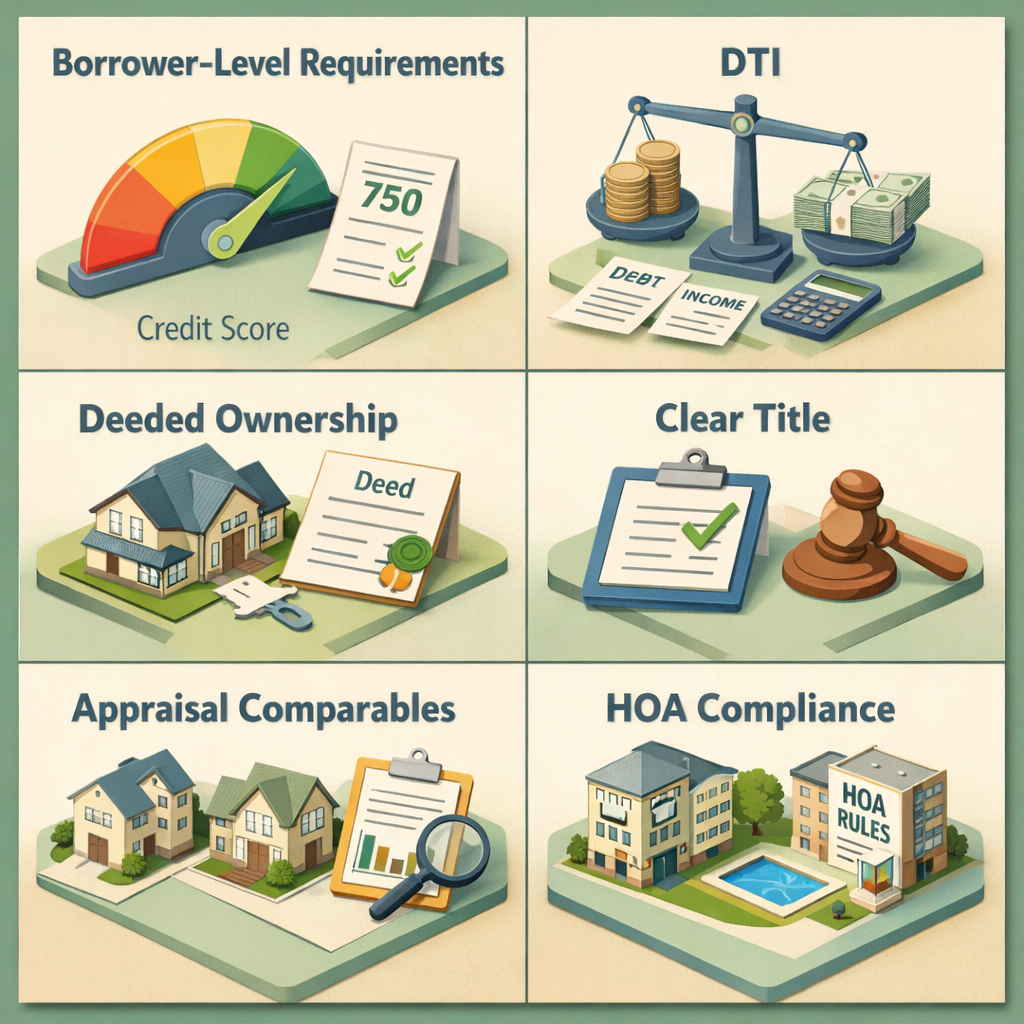
If you're seriously exploring how to qualify for a conventional loan with fractional ownership in a timeshare, the path forward requires meeting both borrower-level and property-level requirements. Here's a closer look at each dimension.
Borrower-Level Financial Requirements
On the borrower side, conventional loan standards typically apply regardless of the property type. You'll generally need to demonstrate strong creditworthiness, stable income, and a manageable debt load. Most conventional programs look for:
- Credit score: A minimum score of around 620 is often cited as the baseline for conventional loan eligibility, though higher scores typically unlock better rates and terms.
- Debt-to-income ratio (DTI): Lenders generally prefer a DTI at or below 43% to 45%, though some programs may allow higher ratios with compensating factors.
- Down payment: Conventional loans may require anywhere from 5% to 20% or more depending on the loan type and property classification. Investment or vacation properties typically require larger down payments.
- Reserves: Lenders may require documented cash reserves, particularly for second homes or investment properties — categories that fractional ownership properties might fall into.
- Employment and income documentation: Consistent income history, typically spanning at least two years, is usually required to verify repayment ability.
Property-Level Eligibility Considerations
Meeting borrower requirements is only half the equation. The property itself must also meet lender and agency standards. For a fractional ownership arrangement to have any chance of conventional financing, the property typically needs to:
- Involve a deeded, recorded ownership interest in real property — not merely usage rights.
- Be legally transferable and have a clear title that can be encumbered by a mortgage lien.
- Have sufficient comparables available for a credible appraisal.
- Comply with any applicable homeowners' association or project approval requirements set by the lender or agency.
Even when all these conditions are met, approval is far from certain. Lenders retain the discretion to decline financing for property types they deem too risky or outside their standard underwriting guidelines.
Exploring Alternative Financing Paths for Partial Ownership Loan Scenarios
Given the challenges of securing conventional financing a timeshare or fractional property, many buyers find themselves exploring alternative lending options. While these may not carry the same favorable terms as a conventional mortgage, they can provide a viable path to ownership for the right borrower.
Personal Loans
For lower-priced timeshare interests, an unsecured personal loan may be an option. Because personal loans don't require the property as collateral, they sidestep many of the property eligibility concerns that complicate mortgage financing. The trade-off is typically a higher interest rate and shorter repayment term compared to a traditional mortgage.
Home Equity Loans or HELOCs
If you already own a primary residence with significant equity, you might consider tapping that equity through a home equity loan or home equity line of credit (HELOC) to finance a fractional property purchase. This approach keeps the financing tied to your existing home — a property that lenders are comfortable with — rather than the more complex fractional interest.
Developer or In-House Financing
Many timeshare and fractional ownership developers offer their own financing programs. These can be convenient, but they often come with higher interest rates and less favorable terms than institutional lenders. It's important to read the fine print carefully and compare the total cost of financing before committing.
Portfolio Lenders and Non-QM Programs
Some smaller banks, credit unions, and specialty lenders hold loans in their own portfolios rather than selling them on the secondary market. These portfolio lenders aren't bound by Fannie Mae or Freddie Mac guidelines, giving them more flexibility to finance non-standard property types. Non-QM (non-qualified mortgage) programs may also offer options for borrowers in unique ownership situations, though these typically come with stricter terms or higher rates.
How Existing Timeshare Obligations May Affect Your Mortgage Qualification
Even if you're not trying to finance a timeshare itself, owning one could affect your ability to qualify for a mortgage on another property. This is an important consideration for homebuyers and real estate investors who currently hold timeshare interests.
Timeshare maintenance fees, special assessments, and any associated loan payments are typically counted as recurring debt obligations by mortgage underwriters. These payments get factored into your debt-to-income ratio, which can reduce the loan amount you qualify for on a primary home or investment property.
Additionally, if you financed a timeshare purchase and carry an outstanding balance, that loan will appear on your credit report and be included in your overall debt picture. For borrowers who are already near the upper limit of an acceptable DTI, these obligations could tip the scales unfavorably.
Here are a few strategies that may help manage the impact of timeshare obligations on your broader mortgage eligibility:
- Pay off any existing timeshare loans before applying for a new mortgage, if possible.
- Keep timeshare maintenance fees current to avoid derogatory marks on your credit report.
- Work with a knowledgeable loan officer who understands how to properly document and account for shared ownership obligations in the underwriting process.
- Consider consulting a real estate attorney if you're unsure how your fractional ownership agreement will be interpreted by lenders.
Strengthening Your Financial Profile Before Applying
Whether you're pursuing a conventional loan or an alternative financing option for a fractional property, strengthening your overall financial profile is always a smart move. Lenders across all program types reward borrowers who present lower risk, and there are concrete steps you can take to improve your position.
Improve Your Credit Score
Review your credit reports from all three major bureaus and dispute any inaccurate information. Pay down revolving credit balances to reduce your credit utilization ratio, and avoid opening new credit accounts in the months before applying for a loan. Even modest improvements in your credit score could meaningfully impact your rate and approval odds.
Reduce Your Debt Load
If your DTI is elevated, work on paying down existing debts before applying. Focus first on high-interest revolving balances, as eliminating these can have a relatively quick impact on your monthly obligation picture. Reducing debt not only improves your DTI but also demonstrates financial discipline to potential lenders.
Build Your Cash Reserves
Lenders feel more comfortable extending credit to borrowers who have meaningful cash reserves beyond their down payment. Aim to have several months' worth of mortgage payments in liquid savings. For vacation or investment properties — categories that fractional ownership often falls into — lenders may require even more substantial reserves.
Document Your Income Thoroughly
Gather two years of tax returns, recent pay stubs, W-2s or 1099s, and bank statements. If you're self-employed or have variable income, be prepared to provide additional documentation. Clear, complete income documentation reduces underwriting uncertainty and can speed up the approval process.
Working With the Right Lending Partner for Specialty Property Financing
Perhaps the most important factor in successfully navigating conventional loan fractional ownership questions is choosing the right lending partner. Not every lender has experience with non-standard property types, and working with one who lacks that expertise could result in unnecessary delays, incorrect denials, or missed financing opportunities.
When evaluating lenders for a fractional or timeshare-related financing situation, consider asking the following questions:
- Have you previously financed deeded conventional loan fractional ownership properties?
- Do you offer portfolio loan products that fall outside standard agency guidelines?
- How do you treat timeshare maintenance fees and obligations in your DTI calculations?
- Are there specific project approval requirements I need to be aware of for my type of property?
A lender who can answer these questions confidently and clearly is far more likely to help you find a workable solution than one who is unfamiliar with the nuances of partial ownership financing. Mortgage brokers who work with multiple lenders may also be valuable partners here, as they can shop your scenario across a wider range of programs and products.
It's also worth connecting with a HUD-approved housing counselor or real estate attorney if your situation is particularly complex. These professionals can provide guidance on title, legal obligations, and the broader implications of your ownership structure — all of which can influence your financing options.
●Conclusion
Understanding how to qualify for a conventional loan with fractional ownership in a timeshare isn't a simple matter — it requires careful attention to both borrower qualifications and property eligibility standards. Conventional loan programs backed by Fannie Mae and Freddie Mac generally do not accommodate standard timeshare interests, but deeded fractional ownership situations may offer more options depending on the specific structure and lender. For many borrowers, alternative financing paths — such as portfolio loans, home equity products, or personal loans — may ultimately be the most practical route. Regardless of which direction you pursue, building a strong financial profile, understanding how your ownership obligations affect your DTI, and partnering with an experienced lender are all essential steps. At LoanWise, we're here to help you explore your financing options with clarity and confidence — because every borrower's situation deserves a thoughtful, informed approach.