
Purchasing a property with a documented history of ground movement is one of the more complex journeys a homebuyer can take. Many buyers discover this issue mid-transaction and wonder whether financing is even an option. The good news is that it often is — but it requires careful preparation, the right professional support, and a clear understanding of how lenders assess risk. This guide walks you through everything you need to know about how to get a mortgage for a home with a documented history of subsidence, from initial eligibility checks to closing strategies that work in your favor.
Understanding What Subsidence Means for Property Value and Risk
Subsidence refers to the downward movement or sinking of the ground beneath a property. It can be caused by a range of factors, including shrinking clay soils during dry periods, tree root activity drawing moisture from the ground, old mine workings beneath the land, leaking drains, or natural geological shifts. When a property has a documented history of this type of ground movement, it means there's a formal record — often from previous insurance claims, structural surveys, or local authority searches — confirming that movement has occurred in the past.
For lenders, this history raises two primary concerns: the potential for ongoing structural damage and the difficulty of insuring and reselling the property if the loan goes into default. Even if repairs were completed years ago, lenders may still treat the property as higher risk than a standard home. This doesn't automatically disqualify you from financing, but it does change the process significantly.
It's important to distinguish between active subsidence and historic subsidence. Active subsidence means the ground is still moving and the problem hasn't been resolved. Historic subsidence means movement occurred in the past but has since been stabilized, often with underpinning, drainage repairs, or tree removal. Lenders and surveyors treat these two situations very differently, and the distinction will shape your entire mortgage application strategy.
Why Subsidence Home Mortgage Eligibility Depends on More Than Credit Score
When it comes to subsidence home mortgage eligibility, your credit score and income are still important — but they're only part of the picture. Lenders also evaluate the physical condition and structural integrity of the property itself. In fact, many mainstream lenders will decline a mortgage offer not because of the borrower's financial profile, but because their underwriting guidelines prohibit lending on properties with certain types of structural risk.
Standard high-street lenders often have conservative policies around ground movement. Some may decline outright if the property has any mention of subsidence in its history, regardless of whether the issue was resolved. Others may agree to lend but subject to specific conditions, such as a structural engineer's report confirming stability, evidence of completed remediation works, or confirmation that buildings insurance is available and in place.
This is why working with a mortgage broker who specializes in non-standard or specialist properties can be especially valuable. These brokers understand which lenders have more flexible policies and can match your application to the right underwriter from the start. Approaching lenders without this guidance could lead to multiple hard credit inquiries and rejections that further complicate your situation.
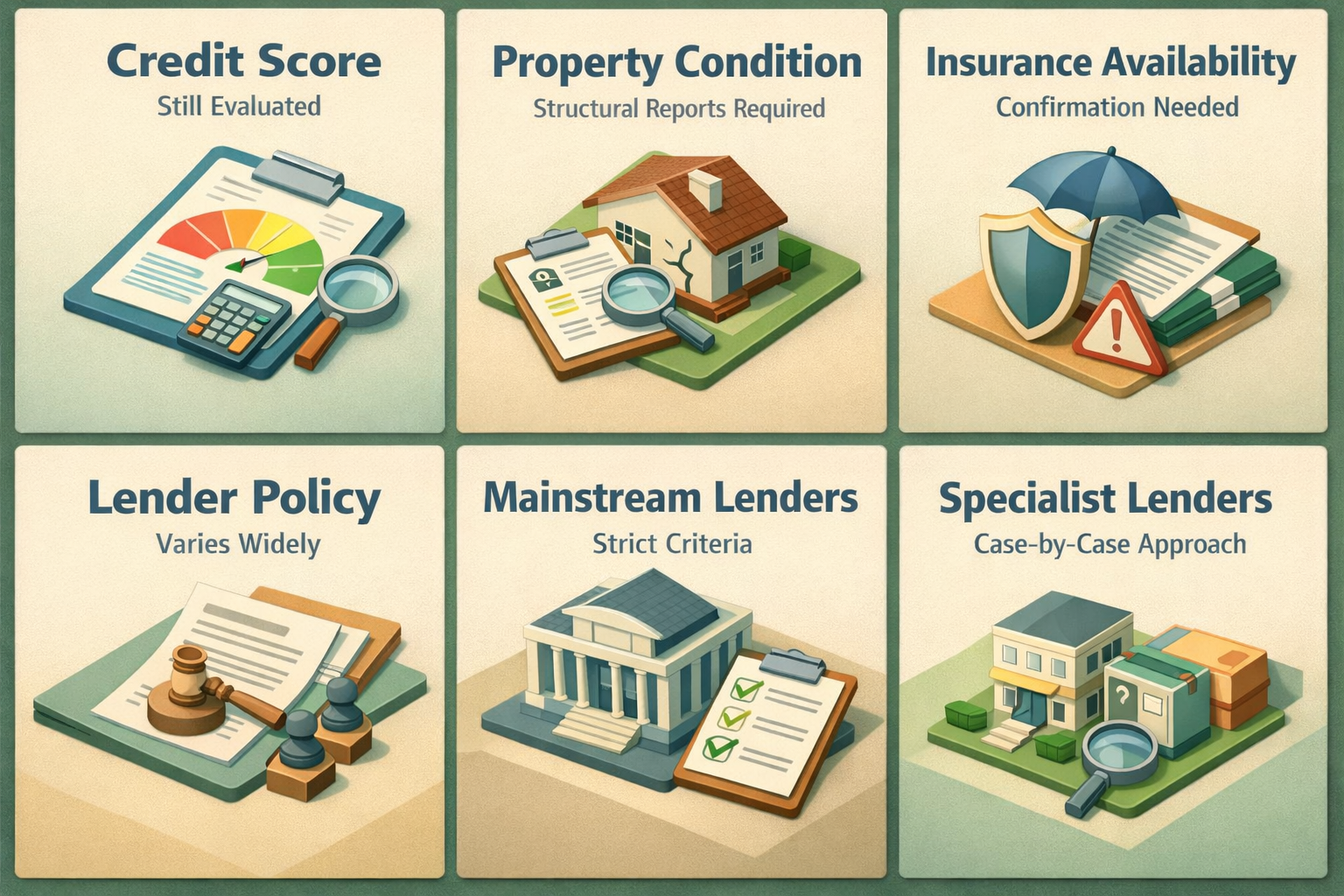
- Credit score and income: Still evaluated as with any mortgage application
- Property condition: Structural reports and evidence of stabilization are often required
- Insurance availability: Lenders typically require confirmation that buildings insurance can be obtained
- Lender policy: Varies widely — specialist lenders may be more willing to consider your mortgage eligibility
The Role of Geological Surveys in Meeting Mortgage Requirements
One of the most critical steps when pursuing a mortgage on a property with ground movement issues is commissioning a thorough professional survey. Geological survey mortgage requirements vary by lender, but most will expect at minimum a full structural survey — also known as a Level 3 Building Survey — rather than a basic valuation or homebuyer report.
A Level 3 survey goes deep into the property's construction, condition, and any visible defects. When subsidence is part of the property's history, the surveyor will look for signs of ongoing movement, assess any remediation work that was carried out, and provide an opinion on whether the issue appears to be resolved. This report becomes a key document in your mortgage application and may be reviewed directly by the lender's underwriters.
In some cases, the lender may also request a specific structural engineer's report prepared by a chartered engineer with expertise in ground movement. This report goes a step further than a general survey, analyzing the cause of original movement, the adequacy of any repairs, and the likelihood of recurrence. If the engineer concludes that the property is now stable and the risk of future movement is low, this significantly strengthens your mortgage case.
Additionally, a ground investigation report — sometimes called a soil investigation — may be recommended, especially where the cause of subsidence was geological rather than drainage-related. This type of assessment involves physical testing of the soil beneath the property and provides data on load-bearing capacity and soil composition. While not always required, it can be persuasive evidence for cautious lenders.
Navigating Lender Policies for Unstable Soil Properties
Understanding lender policies for unstable soil properties is essential before you submit any application. The landscape of lender attitudes toward subsidence properties is not uniform. While some mainstream banks may decline immediately, a range of specialist mortgage lenders and building societies take a more case-by-case approach, particularly when the borrower can demonstrate that remediation was completed and the property is now stable.
Here's a general overview of how lenders tend to approach these applications:
- Mainstream high-street lenders: Often have strict criteria and may decline applications where subsidence is mentioned, especially if it's recent or the cause is unclear.
- Specialist mortgage lenders: More likely to assess the full picture, including survey reports and insurance availability, before making a decision.
- Building societies: Some smaller building societies take a manual underwriting approach and may be willing to consider properties with historic subsidence on a case-by-case basis.
- Portfolio lenders: These lenders hold loans on their own books rather than selling them on the secondary market, which can give them more flexibility in their underwriting decisions.
It's also worth noting that loan-to-value (LTV) ratios may be affected. Even if a lender agrees to finance a subsidence property, they might limit the LTV to a lower percentage than they'd offer on a standard home — meaning you could be required to put down a larger deposit. This is because the lender wants additional equity as a buffer against the perceived risk of reduced resale value.
Interest rates on these mortgages may also be slightly higher than average to reflect the additional risk. Borrowers should budget accordingly and factor these potential differences into their overall purchase calculations.
Buying a House with Ground Movement Issues: Steps to Strengthen Your Application
If you're serious about buying a house with ground movement issues, a proactive approach can make a meaningful difference to your chances of mortgage approval. Lenders respond well to borrowers who've done their homework and can present a clear, well-documented case. Here are the most effective steps to take before and during your application:
- Request full disclosure from the seller: Ask for all documentation related to the subsidence history, including insurance claim records, previous survey reports, structural engineer certificates, and details of any underpinning or remediation work.
- Commission a Level 3 structural survey early: Don't wait until you're deep into the process. Getting an independent survey done early helps you understand the true condition of the property and prepares you for lender questions.
- Confirm buildings insurance availability: Contact specialist insurers before making an offer if possible. Knowing that insurance is available — and at what premium — removes one of the lender's key objections.
- Work with a specialist mortgage broker: A broker with experience in non-standard properties can identify suitable lenders and present your application in the most favorable light.
- Be prepared to offer a larger deposit: A lower LTV reduces the lender's risk exposure. If you can put down more than the minimum, it may open up more lender options.
- Get a structural engineer's sign-off: If underpinning or other remediation was done, a current structural engineer's certificate confirming the work is satisfactory is a powerful document to include in your application file.
Patience is also important here. These applications tend to take longer than standard ones because lenders may need additional time to review technical reports. Building a complete documentation package upfront can help reduce delays and back-and-forth requests.
Insurance Considerations That Affect Your Mortgage Approval
Buildings insurance is a non-negotiable requirement for virtually every mortgage lender. On a standard property, obtaining this cover is straightforward. On a property with a documented subsidence history, it can be considerably more complex — and this complexity directly affects your mortgage prospects.
Some mainstream insurers may decline to cover a property with a subsidence history, or they may exclude subsidence-related claims from the policy entirely. Lenders will typically not accept a policy with a subsidence exclusion because it leaves them exposed to the very risk they're most concerned about. This means you'll likely need to turn to specialist insurers who are experienced in covering non-standard properties.
Specialist buildings insurance for subsidence-affected properties does exist, but premiums may be notably higher than for standard homes. It's wise to obtain at least two or three quotes from different specialist providers so you can present the lender with evidence that appropriate coverage is both available and in place. Some lenders may even ask to see the insurance policy documents before they issue a formal mortgage offer.
If the property has an existing insurance policy that has been in continuous force since the original subsidence claim — and which includes subsidence cover — this is actually a very positive sign. It means the risk has already been assessed and accepted by an insurer. In this scenario, the challenge becomes ensuring that coverage can be transferred to you or renewed in your name on completion.
●Conclusion
Learning how to get a mortgage for a home with a documented history of subsidence is genuinely achievable with the right preparation and professional support. While it's true that mainstream lenders may be hesitant, specialist lenders, flexible building societies, and portfolio underwriters offer real pathways to financing these properties. The key is building a strong, evidence-based application — one backed by thorough surveys, structural engineer reports, confirmed insurance coverage, and a clear record of any remediation work completed.
At LoanWise, we understand that every property tells a different story. If you're exploring your financing options for a non-standard home, speaking with an experienced mortgage specialist can help you understand which lenders are most likely to consider your situation and what steps will give your application the strongest possible foundation. Don't let a complex property history stop you from moving forward — with the right guidance, the path to homeownership is often more accessible than it first appears.