Buying a home is one of the most exciting milestones in life, but for many prospective homebuyers, a less-than-perfect credit score can feel like a major roadblock. If you've been wondering how to get a conventional loan with bad credit score, you're not alone. Millions of Americans carry credit blemishes from past financial hardships, and the question of whether homeownership is still within reach is a very real one. The good news is that while conventional loans do carry stricter credit requirements than some government-backed programs, your options may be broader than you think. This guide breaks down what lenders look for, where the credit thresholds typically stand, and what practical steps you can take to move closer to approval.
What Is a Conventional Loan and Why Does Credit Matter So Much
A conventional loan is a home mortgage that isn't backed or insured by a federal government agency such as the FHA, VA, or USDA. Instead, these loans are typically sold to government-sponsored enterprises like Fannie Mae and Freddie Mac, which set specific eligibility guidelines that lenders must follow. Because there's no government guarantee protecting the lender from default risk, conventional loans tend to have stricter qualification standards — and credit score plays a central role in that evaluation.
When a lender reviews your mortgage application, your credit score is one of the first things they examine. It signals how reliably you've managed debt in the past and helps predict how likely you are to repay your mortgage on time. A higher score generally means lower perceived risk, which can translate into better interest rates and loan terms. A lower score, on the other hand, may raise flags for lenders and could result in higher rates, stricter conditions, or outright denial — depending on how low the score falls.
Understanding this relationship between credit and conventional lending is the first step toward making a strategic plan to get approved, even if your score isn't where you'd like it to be right now.
Conventional Mortgage Minimum Credit Score: What the Numbers Look Like
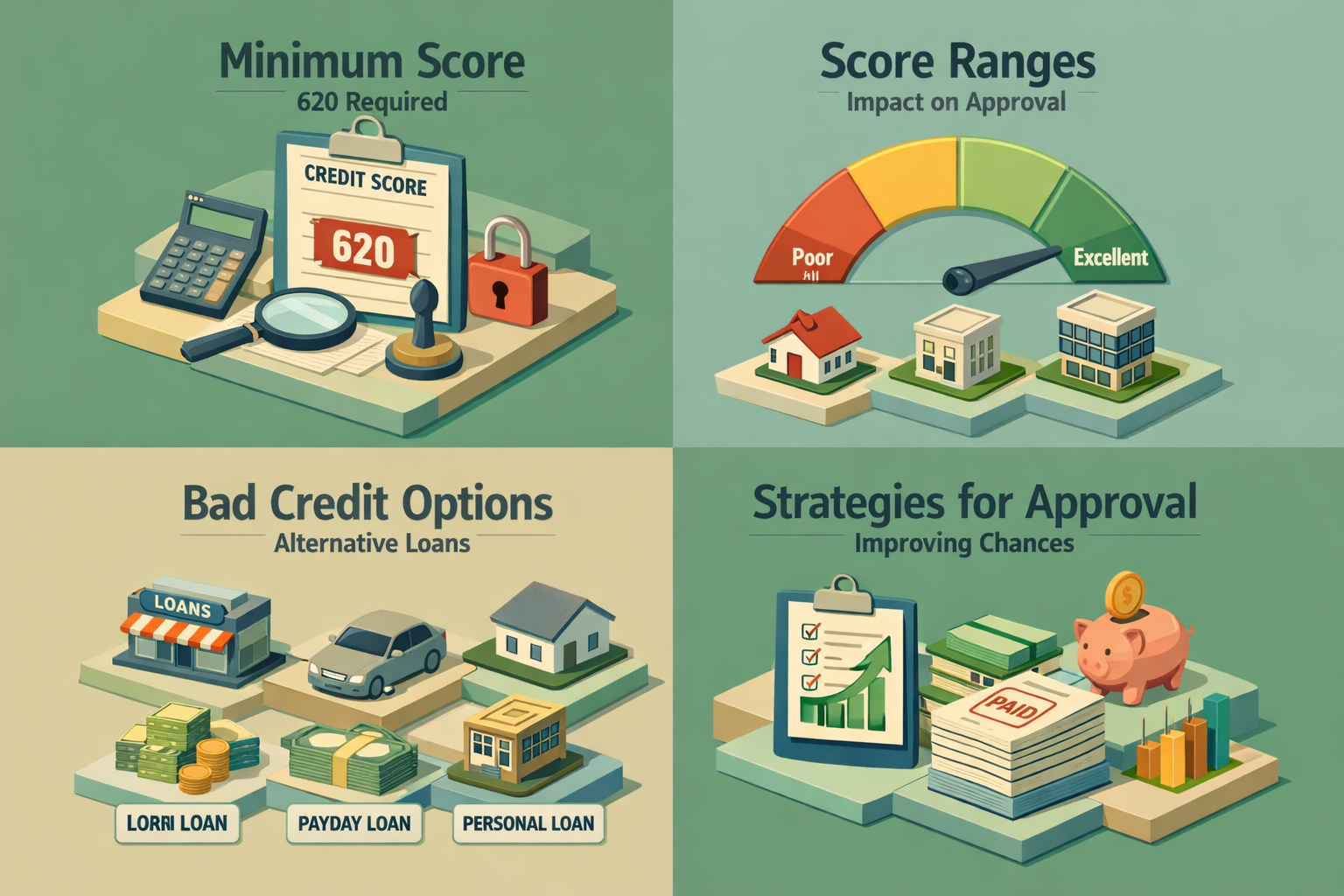
So what does the conventional mortgage minimum credit score actually look like in practice? Generally speaking, most conventional loan programs require a minimum FICO score of around 620. This threshold is commonly associated with conforming loans that meet Fannie Mae and Freddie Mac guidelines. However, it's important to understand that 620 is typically a floor, not a guarantee of approval.
Here's a general breakdown of how credit score ranges may affect your conventional loan prospects:
- 740 and above: Borrowers in this range are often considered low-risk and may qualify for the most competitive interest rates and loan terms available.
- 680–739: Still considered a solid credit profile. Most conventional loan products may be accessible, though rates could be slightly higher than the top tier.
- 620–679: This is the range where approval becomes more nuanced. You may qualify for a conventional loan, but lenders might require a larger down payment, lower debt-to-income ratio, or additional documentation.
- Below 620: Most conventional loan programs become very difficult to qualify for at this level. Lenders may be unwilling to approve a conventional mortgage, and borrowers in this range are often directed toward government-backed alternatives.
It's worth noting that individual lenders can set their own overlays — additional requirements on top of the baseline guidelines. So while one lender might accept a 620 score, another might require 640 or higher for the same loan type. Shopping around with multiple lenders remains one of the most practical ways to find a program that fits your current credit profile.
Bad Credit Home Loan Options to Consider Alongside Conventional Financing
If your credit score currently falls below the conventional loan threshold, don't lose hope. There are several bad credit home loan options that may bridge the gap while you work on strengthening your profile — or that may serve as the right long-term solution depending on your circumstances.
FHA Loans
FHA loans are insured by the Federal Housing Administration and are widely considered the most accessible mortgage option for borrowers with lower credit scores. Borrowers with a score as low as 580 may qualify with as little as 3.5% down, while those with scores between 500 and 579 might still be eligible with a 10% down payment, though individual lender requirements may vary. The trade-off is that FHA loans require mortgage insurance premiums for the life of the loan in many cases, which adds to your monthly cost.
VA Loans
If you're a veteran, active-duty service member, or an eligible surviving spouse, VA loans may offer a compelling path to homeownership with more flexible credit standards. The VA itself doesn't set a minimum credit score, though individual lenders typically establish their own minimums, often around 580–620. VA loans also come with the significant benefit of no required down payment in most cases.
USDA Loans
For buyers in eligible rural or suburban areas, USDA loans offer another government-backed pathway with potentially flexible credit considerations. These loans are designed to support low-to-moderate income borrowers and typically don't require a down payment, though income and geographic eligibility limits apply.
Non-QM Loans
Non-qualified mortgage (Non-QM) loans are products that fall outside the standard guidelines of conventional financing. They may accommodate borrowers with lower credit scores, unconventional income sources, or recent credit events. These loans often come with higher interest rates and may require larger down payments, but they can serve as a viable stepping stone for borrowers who don't yet fit the conventional mold.
How to Get a Conventional Loan With Bad Credit Score: Strategies That May Help
Even if your credit score is on the lower end of the conventional range, there are several strategies that could meaningfully improve your chances of approval. Understanding how to get a conventional loan with bad credit score often comes down to compensating factors — elements of your financial profile that offset the perceived risk of a lower credit score.
Make a Larger Down Payment
One of the most effective compensating factors is a larger down payment. While conventional loans can allow as little as 3% down for some borrowers, putting down 10%, 15%, or even 20% reduces the lender's exposure and may make them more willing to work with a conventional loan with bad credit score. A 20% down payment also eliminates the need for private mortgage insurance (PMI), which can lower your monthly payment significantly.
Lower Your Debt-to-Income Ratio
Your debt-to-income (DTI) ratio — the percentage of your gross monthly income that goes toward debt payments — is another major factor lenders evaluate. A lower DTI can help offset a weaker credit score. Paying down existing debts before applying, or increasing your income, may improve this ratio and strengthen your application.
Add a Co-Borrower
If you have a spouse, family member, or trusted partner with a stronger credit profile, applying jointly could improve your eligibility. Lenders typically evaluate the credit scores and financial profiles of all borrowers on the application, and a co-borrower with excellent credit may help bring the overall risk assessment down to an acceptable level.
Demonstrate Strong Reserves
Lenders often look favorably on borrowers who have significant cash reserves — money in savings or investment accounts beyond the down payment and closing costs. Having several months' worth of mortgage payments in reserve signals financial stability and may partially offset a lower credit score in the lender's eyes.
Improving Credit for Conventional Loan Approval: A Practical Roadmap
If your credit score isn't quite where it needs to be, improving credit for conventional loan qualification is a realistic and worthwhile goal. The timeline can vary depending on your specific situation, but many borrowers see meaningful improvement within six to twelve months of implementing consistent credit-building habits.
Review Your Credit Reports for Errors
Start by pulling your credit reports from all three major bureaus — Equifax, Experian, and TransUnion. You're entitled to a free report from each bureau annually through AnnualCreditReport.com. Review them carefully for inaccuracies such as accounts you don't recognize, incorrect balances, or late payments that were actually made on time. Disputing and correcting errors can sometimes result in a quick score improvement.
Pay Down Revolving Balances
Credit utilization — how much of your available revolving credit you're using — is one of the most influential factors in your credit score. Keeping your utilization below 30% is generally recommended, but lower is often better. Paying down credit card balances before applying for a mortgage could provide a noticeable boost to your score.
Avoid Opening New Credit Accounts
Each time you apply for new credit, a hard inquiry is recorded on your report, which can temporarily lower your score. In the months leading up to your mortgage application, try to avoid opening new credit cards, financing large purchases, or taking on additional loans. Keeping your credit profile stable signals responsibility to mortgage lenders.
Make Every Payment on Time
Payment history is the single largest factor in most credit scoring models. Even one missed payment can have a significant negative impact. Setting up automatic payments or calendar reminders for all bills — not just credit cards — can help ensure your payment history remains clean and continues to build in your favor.
Finding the Right Lenders for Low Credit Score Mortgages
Not all lenders approach credit risk the same way, which is why finding the right match matters. Some lenders for low credit score mortgages specialize in working with borrowers who have imperfect credit histories and may offer more flexible underwriting or portfolio loan products that don't follow standard Fannie Mae and Freddie Mac guidelines.
Here are a few tips for finding a lender willing to work with your situation:
- Work with a mortgage broker: Brokers have access to a wide network of lenders and can help match your credit profile to the most suitable loan products available. They can also negotiate on your behalf and identify programs you might not find on your own.
- Explore community banks and credit unions: These institutions sometimes offer more personalized underwriting and may be more willing to consider the full context of your financial story rather than relying solely on automated scoring systems.
- Request loan estimates from multiple lenders: Comparing offers isn't just about finding the lowest rate — it's also about identifying which lenders are genuinely willing to approve your application and on what terms. Multiple mortgage inquiries within a short window are typically treated as a single inquiry for scoring purposes, so shopping around generally won't significantly hurt your score.
- Be transparent about your credit history: When speaking with lenders, be upfront about past credit challenges. Providing context — such as a job loss, medical emergency, or divorce — may help a lender view your application more holistically.
Remember, getting pre-qualified or pre-approved by multiple lenders before making an offer on a home can save you considerable time and frustration.
●Conclusion
Navigating homeownership with a less-than-perfect credit score takes patience, planning, and the right information — but it's far from impossible. Whether you're working toward the conventional mortgage minimum credit score threshold or exploring bad credit home loan options in the meantime, the key is to take deliberate, informed steps. Start by understanding where your credit stands today, identify the compensating factors you can strengthen, and connect with lenders who have experience working with borrowers in similar situations. At LoanWise, we're here to help you find a path to homeownership that fits your real financial life — not just the ideal one. Ready to explore your options? Reach out to a LoanWise mortgage specialist today and let's start building your path forward.