
Going through a divorce is one of life's most challenging transitions — and figuring out your housing situation right after can add even more stress. Whether you're buying a new home on your own or refinancing an existing one, understanding how to calculate mortgage affordability with recent divorce settlement income and assets is a critical first step. Lenders look at your financial picture differently after a major life change like this, so it pays to know what to expect before you apply. The good news is that with the right preparation, qualifying for a mortgage after divorce is very much achievable.
Why Divorce Changes Your Mortgage Qualification Picture
When a marriage ends, so does the combined financial strength that once supported a household. Your income, debts, assets, and credit profile may all look very different to a lender post-divorce. Where two incomes once supported one mortgage, you're now working with a single income stream — which directly affects how much home you can afford.
Lenders evaluate affordability primarily through two key ratios: your front-end debt-to-income (DTI) ratio, which compares your proposed housing costs to your gross monthly income, and your back-end DTI ratio, which measures all monthly debt obligations against your income. Most conventional loan programs prefer a back-end DTI of 43% or lower, though some programs may allow higher ratios depending on compensating factors.
Divorce often introduces new monthly obligations — like child support payments or spousal support — that didn't exist before. These obligations are counted as debts by lenders, which can reduce the loan amount you qualify for. On the other hand, if you're receiving alimony or child support, that income can work in your favor, provided you can document it properly. Understanding how these moving pieces interact is the foundation of calculating your post-divorce mortgage affordability.
How Lenders Treat Divorce Settlement Income and Assets
One of the most important things to understand when figuring out mortgage after divorce settlement income is how lenders classify what you receive. Not all divorce-related funds are treated equally, and the documentation you provide plays a significant role in what counts toward qualification.
Alimony and Spousal Support as Qualifying Income
If your divorce decree requires your ex-spouse to pay you alimony or spousal support, lenders may count this as qualifying income — but typically only if you can show that payments have been received consistently for a set period (often six months) and that they're expected to continue for at least three years. You'll likely need to provide your divorce decree and recent bank statements showing the deposits to verify this income.
Child Support Payments
Child support received can also be treated as qualifying income under similar conditions. The payments must be documented in a legal agreement and shown to be stable and ongoing. Keep in mind that child support you pay to an ex-spouse is counted as a monthly debt obligation, which can reduce your qualifying loan amount.
Lump-Sum Settlement Funds
A lump-sum settlement — such as cash received from the division of marital assets — is generally treated as an asset rather than income. This means it could help with your down payment or cash reserves, but it won't typically boost your qualifying income the way regular support payments might. Lenders will want to see where these funds came from, so having a clear paper trail from your settlement agreement is important.
Step-by-Step: How to Calculate Mortgage Affordability With Recent Divorce Settlement
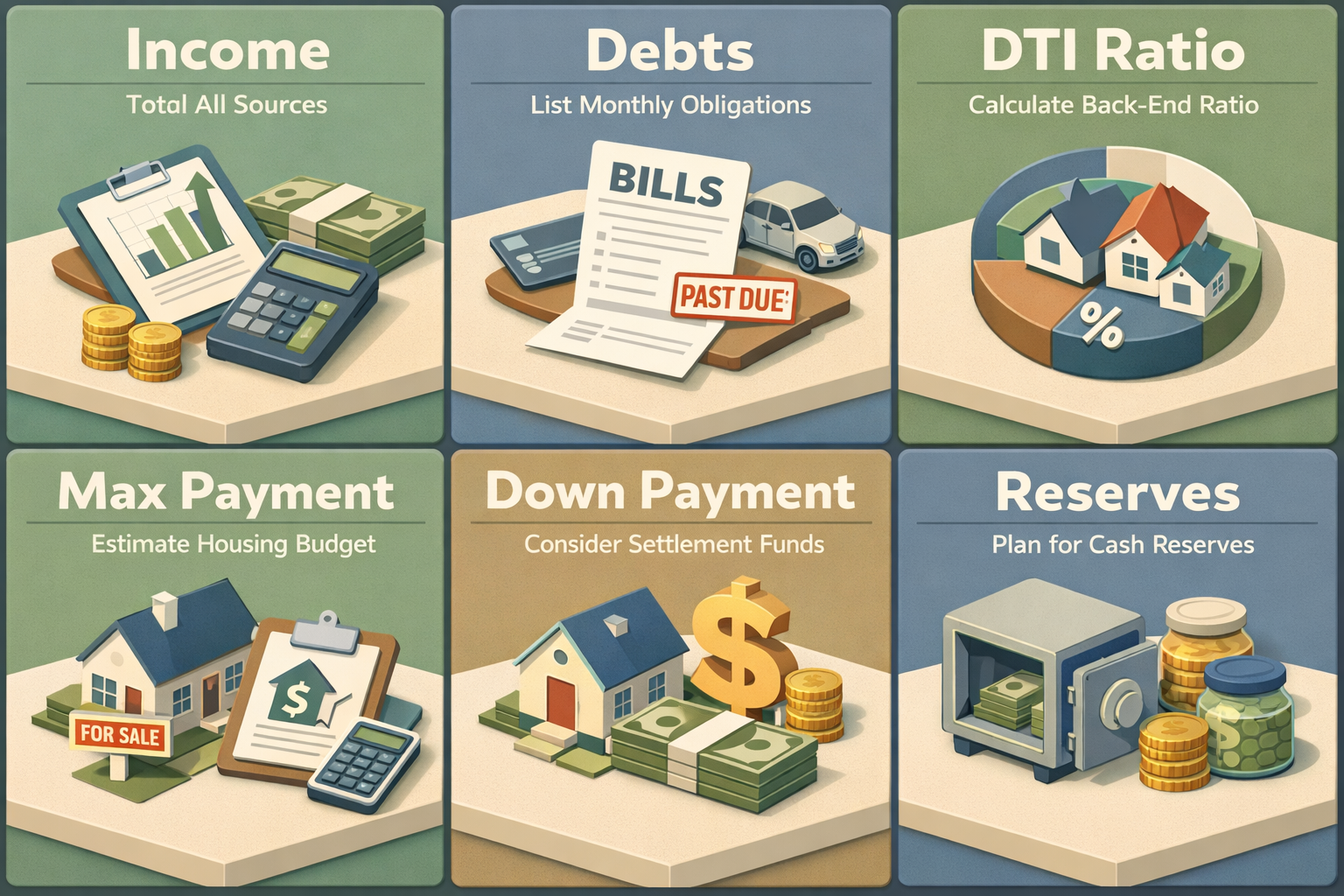
Now that you understand how lenders view your post-divorce finances, let's walk through a practical framework for how to calculate mortgage affordability with recent divorce settlement figures in hand. This process helps you set realistic expectations before you speak to a lender.
Step 1 — Add Up Your Gross Monthly Income
Start by totaling all sources of verifiable monthly income. This may include your salary or wages, self-employment income (typically averaged over two years), alimony received (if it meets lender requirements), child support received, rental income, and any investment or retirement distributions. Be conservative — lenders will verify every source, so include only what you can document.
Step 2 — Calculate Your Monthly Debt Obligations
List every recurring monthly debt payment you currently carry. This includes car loans, student loans, credit card minimum payments, any alimony you pay, and child support you pay. Add these up to get your total monthly debt load.
Step 3 — Apply the DTI Formula
Divide your total monthly debts by your gross monthly income to get your back-end DTI ratio. For example, if your gross monthly income is $5,000 and your monthly debts total $1,500, your DTI is 30% — well within typical lender guidelines. Most lenders look for a back-end DTI below 43%, though some loan types may allow up to 50% with strong compensating factors.
Step 4 — Estimate Your Maximum Monthly Housing Payment
Using your income and an acceptable DTI threshold, you can work backward to estimate the maximum monthly mortgage payment a lender might approve. Subtract your existing monthly debts from the maximum allowable debt load (based on the DTI limit) to find your available housing budget. For instance, if 43% of $5,000 equals $2,150 in allowable monthly debts, and you already carry $800 in other debts, you may have up to $1,350 available for housing costs.
Step 5 — Factor In Down Payment and Reserves
Your down payment size affects both your loan amount and whether you'll need private mortgage insurance (PMI). A larger down payment — potentially funded by your settlement — can lower your monthly payment and improve your approval odds. Lenders may also require cash reserves after closing, so plan accordingly.
Loan Programs Worth Considering After a Divorce
The right loan program depends on your credit score, income stability, down payment funds, and how recently the divorce was finalized. Here's a look at options that may work well for borrowers in your situation.
Conventional Loans
Conventional loans backed by Fannie Mae or Freddie Mac are widely available and flexible. They typically require a minimum credit score around 620, though better scores earn better rates. If you're putting down at least 20%, you can avoid PMI entirely — which is helpful if you're managing a tighter budget post-divorce.
FHA Loans
FHA loans are insured by the Federal Housing Administration and are known for more lenient credit requirements. They may be a good fit if your credit took a hit during the divorce process. However, FHA loans do require mortgage insurance premiums regardless of down payment size, which adds to your monthly costs.
VA Loans
If you're a qualifying veteran or active-duty service member, a VA loan may offer significant advantages — including no down payment requirement and no private mortgage insurance. Eligibility depends on your service record, not your marital status, so a divorce doesn't disqualify you.
Refinancing an Existing Mortgage
If you're keeping the marital home, you may need to refinance to remove your ex-spouse from the mortgage. This process requires you to qualify for the loan on your own — which brings all the affordability calculations above into play. It's important to ensure your income alone can support the new loan before agreeing to keep the property in a settlement.
How Your Credit Score Affects Affordability After Divorce
Your credit score plays a major role in both your ability to qualify and the interest rate you'll receive. Divorce can sometimes impact credit indirectly — for example, if joint accounts were mismanaged during the separation, or if one spouse stopped paying shared debts. Before applying for a mortgage after divorce settlement, pull your credit reports and review them carefully.
If your credit score dropped during or after the divorce, it's worth taking time to rebuild it before applying. Strategies that may help include paying all bills on time, reducing credit card balances, and disputing any errors on your report. Even a modest improvement in your score could move you into a better rate tier and meaningfully reduce your monthly payment.
Keep in mind that joint accounts from your marriage may still appear on your report until they're formally closed or transferred. Lenders may ask you to explain any recent changes in your credit profile, so being transparent and having your divorce decree ready can help smooth the process.
Common Mistakes to Avoid When Applying for a Mortgage Post-Divorce
Even well-prepared borrowers can run into trouble if they overlook a few key pitfalls. Here are some common mistakes to watch out for:
- Applying too soon without documentation: If you've just finalized your divorce, your settlement income may not yet meet lender seasoning requirements. Give support payments time to establish a track record before applying.
- Forgetting about joint debts: If your name is still on a joint mortgage or other debt from the marriage, lenders will count that payment against you — even if your ex-spouse is responsible for paying it under the divorce agreement. Get your name off joint obligations whenever possible before applying.
- Underestimating the full cost of homeownership: Post-divorce, you're likely managing household expenses alone. Factor in property taxes, insurance, maintenance, and utilities when determining what you can truly afford — not just the mortgage payment itself.
- Not shopping multiple lenders: Different lenders may treat post-divorce income and assets differently. It's worth getting quotes from several lenders to find the one most experienced with borrowers in your situation.
- Making large financial moves before closing: Avoid opening new credit accounts, making large purchases, or moving significant amounts of money around after you've applied. These actions can disrupt the underwriting process.
●Conclusion
Buying or refinancing a home after a divorce is absolutely possible — it just requires a clear-eyed look at your new financial reality. By understanding how to calculate mortgage affordability with recent divorce settlement income and assets, you put yourself in a far stronger position to approach lenders with confidence. Take the time to gather your documentation, review your credit, and map out your monthly income and debts before you apply. If you're ready to take the next step, speaking with an experienced mortgage advisor at LoanWise can help you explore the loan programs that fit your unique situation and get you into the home you deserve.