
Buying a home during retirement — or while working part-time on the side — is more common than many people realize. Whether you're collecting a pension, earning money through freelance work, or doing both, you may be wondering if a mortgage is even within reach. The good news is that lenders don't require a traditional nine-to-five paycheck to approve a home loan. What they do require is a clear, documented picture of your income. Understanding how to calculate mortgage affordability with pension income and part-time gig earnings is the first step toward making a confident, informed decision about homeownership. This guide walks you through what lenders look for, how they calculate qualifying income, and how you can prepare your finances for a successful mortgage application.
Why Non-Traditional Income Sources Matter in Mortgage Lending
The mortgage landscape has evolved significantly. Today, lenders recognize that borrowers come from a wide range of financial backgrounds. Retirees, semi-retired individuals, and those who supplement fixed income with gig work represent a growing segment of homebuyers and refinancers. However, the way lenders evaluate income for these borrowers differs from standard W-2 employment.
When a lender reviews your application, their primary concern is your ability to repay the loan consistently over time. That means they want to see income that is stable, verifiable, and likely to continue. Pension income and gig earnings can both meet these standards — but only when properly documented and correctly calculated.
It's worth noting that different loan programs — such as conventional, FHA, and jumbo loans — may have slightly different rules for how non-traditional income is counted. Knowing which program fits your situation could make a meaningful difference in your approval outcome.
How Lenders Evaluate Pension and Retirement Income for a Home Loan
Pension income is generally considered one of the more reliable forms of retirement income from a lender's perspective. Unlike employment income that could end with a layoff, a pension is typically a fixed, predictable payment that continues for the lifetime of the retiree. This makes it attractive to mortgage underwriters.
To count pension income toward mortgage qualification with retirement income, lenders typically require:
- Award letters or benefit statements from your pension administrator showing the monthly or annual payment amount
- Bank statements confirming the deposits are being received regularly
- Documentation confirming the income will continue for at least three years into the loan term, depending on the loan program
Social Security income, annuity payments, and distributions from retirement accounts such as IRAs or 401(k)s may also be counted alongside pension income, depending on how they're structured and whether they can be verified as ongoing. If you're drawing from investment accounts, some lenders use an asset depletion method to convert those assets into a monthly income figure for qualifying purposes.
It's important to note that lenders may gross up certain non-taxable income — such as some Social Security benefits — by a percentage to reflect its equivalent taxable value. This can actually increase your qualifying income and may improve your mortgage affordability estimate.
Understanding How Part-Time Gig Earnings Factor Into Your Qualifying Income
Gig income — whether from ridesharing, freelancing, consulting, or online platforms — can be counted toward your mortgage qualification, but lenders typically apply stricter documentation standards than they do for salaried employees. This is because gig income can fluctuate significantly from month to month, making it harder for underwriters to project a reliable future income stream.
Here's what lenders commonly look for when evaluating part-time gig income:
- A two-year history of self-employment or gig work, usually demonstrated through two years of federal tax returns (1040s), including any Schedule C or Schedule SE filings
- Consistency or growth in earnings over those two years — lenders may average the income across both years, and if income declined, they might use the lower year's figure
- Profit, not gross revenue — for self-employed or gig workers, lenders generally look at net income after deducting business expenses, which may be lower than total earnings
- 1099 forms from platforms or clients, along with bank statements showing deposits
One common challenge for gig workers is that legitimate business deductions — which reduce your tax bill — also reduce the income lenders count toward your qualifying total. This is a trade-off worth discussing with a mortgage professional before you file your taxes, as certain deductions could inadvertently lower your mortgage eligibility.
How to Calculate Mortgage Affordability with Pension Income and Part-Time Gig Earnings Step by Step
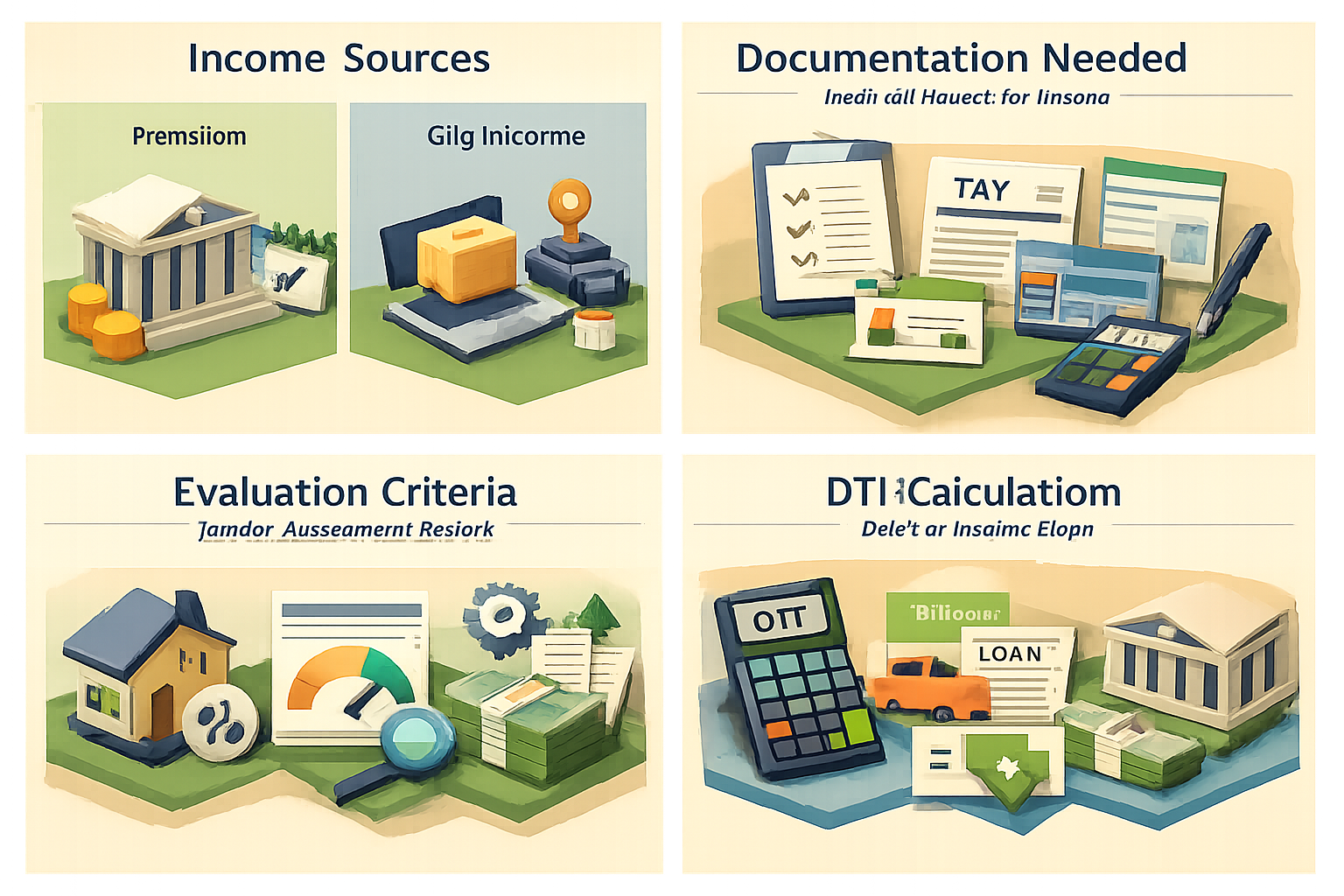
Knowing how to calculate mortgage affordability with pension income and part-time gig earnings starts with understanding the debt-to-income ratio, or DTI. This is the primary tool lenders use to measure whether your income is sufficient to support a new mortgage payment alongside your existing financial obligations.
Here's a simplified breakdown of how the calculation typically works:
- Step 1 — Add up your qualifying monthly income. Start with your gross monthly pension payment. Then add any other verifiable income sources: Social Security, annuity distributions, and your averaged monthly net gig income from the past two years.
- Step 2 — Calculate your monthly debt obligations. Include your proposed mortgage payment (principal, interest, taxes, and insurance), plus any existing monthly debts such as car loans, credit card minimum payments, and student loans.
- Step 3 — Divide total monthly debts by total monthly income. This gives you your DTI ratio. For example, if your monthly debts total $2,000 and your qualifying income is $5,000 per month, your DTI would be 40%.
- Step 4 — Compare against lender thresholds. Many conventional loan programs prefer a DTI below 43–45%, though some lenders may allow higher ratios with compensating factors like strong credit or a larger down payment. FHA loans may allow slightly higher DTIs in certain cases.
Keep in mind that a lower DTI gives you more borrowing power and could qualify you for better interest rates. If your DTI is higher than desired, paying down existing debts or increasing your verified income documentation may help improve your position.
Documentation Tips to Strengthen Your Mortgage Application
One of the most effective things you can do before applying for a mortgage is organize your financial documents thoroughly. Lenders will likely request a range of paperwork, and having everything ready can speed up the process and signal that you're a prepared, serious borrower.
For pension and retirement income, consider gathering:
- The most recent pension award letter or annual benefit statement
- Twelve to twenty-four months of bank statements showing consistent deposits
- Social Security award letters if applicable
- Documentation of any IRA or 401(k) distributions, including rollover or withdrawal schedules
For part-time gig income, you'll likely need:
- Two years of complete federal tax returns with all schedules
- Year-to-date profit and loss statement if you operate as a sole proprietor
- 1099 forms from all gig platforms or clients
- Bank statements showing business deposits
Working with a mortgage professional who has experience in mortgage qualification with retirement income and self-employed borrowers can be especially helpful. They can identify which income sources are most favorable to document, and they may know which loan programs are most accommodating for your specific financial profile.
Credit Scores, Down Payments, and Other Factors That Affect Your Buying Power
While income is a central part of mortgage affordability, it's not the only factor. Your credit score and down payment also play a significant role in determining not just whether you qualify, but what interest rate and loan terms you may be offered.
A strong credit score — typically 700 or above — could help offset income complexity for pension and gig earners. Lenders may view a borrower with a high credit score and a consistent payment history as lower risk, which might give them more flexibility in how they evaluate non-traditional income sources.
A larger down payment can also work in your favor. Putting down 20% or more may eliminate the need for private mortgage insurance (PMI) and could reduce your monthly payment, which in turn lowers your DTI ratio. For borrowers with mixed income sources, this kind of financial cushion may help tip the scales during underwriting.
Additionally, your overall asset picture matters. Lenders want to see that you have enough in reserves to cover several months of mortgage payments after closing. Retirement savings accounts, brokerage accounts, and savings balances can all be counted toward reserves, though lenders may apply a percentage discount to retirement accounts to account for early withdrawal penalties if applicable.
Loan Programs That May Work Well for Pension and Gig Income Borrowers
Not all mortgage programs handle non-traditional income the same way. Exploring your options across different program types could open doors you might not have expected.
Conventional loans backed by Fannie Mae or Freddie Mac often have clear guidelines for counting retirement income, asset depletion, and self-employment income. They can be a solid starting point for borrowers with good credit and moderate down payments.
FHA loans may offer more flexibility around credit scores and DTI ratios, making them worth exploring if your qualifying income is on the lower end. However, FHA loans do require mortgage insurance premiums for the life of the loan in many cases, which adds to monthly costs.
Non-QM (non-qualified mortgage) loans are worth considering for borrowers who don't fit neatly into standard lending boxes. These programs may allow bank statement income verification, asset-based income calculations, or other alternative documentation methods. They could be particularly useful for gig workers whose tax returns show lower net income due to business deductions.
Jumbo loans are relevant for borrowers purchasing higher-priced homes. They typically come with stricter income and credit requirements, but some jumbo lenders may have more underwriting flexibility for high-net-worth retirees with significant assets.
Speaking with a knowledgeable loan officer about which program aligns best with your income profile is a practical first step before submitting an application.
●Conclusion
Navigating the mortgage process with pension income and part-time gig earnings may feel complex, but it's far from impossible. Lenders have pathways designed for borrowers with diverse, non-traditional income streams — and with the right preparation, many retirees and semi-retired individuals successfully qualify for home loans every year. The key is understanding how your income is calculated, what documentation lenders expect, and which loan programs are built to accommodate your financial situation. If you're ready to take the next step, consider connecting with a LoanWise mortgage specialist who can walk you through your options and help you build the strongest possible application based on your unique income picture.