
Cryptocurrency mining has grown into a legitimate income source for thousands of Americans. But when it comes to buying a home, miners often run into a frustrating wall: traditional lenders weren't built with crypto in mind. If you're wondering how to calculate mortgage affordability with income from cryptocurrency mining, you're not alone — and the good news is that it's very much possible with the right preparation and the right lender. This guide walks you through how lenders evaluate variable and non-traditional income, what documentation you'll likely need, and how to estimate what you may qualify for.
Why Crypto Mining Income Creates Unique Mortgage Challenges
Most mortgage underwriting guidelines were designed around predictable, salaried employment. Cryptocurrency mining income is anything but predictable. It fluctuates based on coin prices, network difficulty, electricity costs, and hardware performance. For a lender, this kind of variability introduces risk — and managing risk is at the heart of every lending decision.
That said, lenders don't automatically disqualify crypto miners. Instead, they look for patterns of consistency and sustainability. The challenge is that crypto income doesn't arrive in the form of a traditional W-2 or a steady direct deposit. It may come as converted cash in your bank account, as taxable self-employment earnings on a Schedule C, or sometimes as unreported income that lenders can't use at all.
Understanding where you stand before you apply is the first step. If your mining income has been consistent over at least one to two years and you've reported it properly on your tax returns, you may have a stronger case than you think. The key is demonstrating to underwriters that this income is real, recurring, and likely to continue.
How Lenders Define and Document a Crypto Income Mortgage
When lenders evaluate a crypto income mortgage application, they're essentially asking one core question: is this income reliable enough to support a long-term loan? To answer that, they typically require documentation that goes beyond what a salaried borrower would provide.
Here's what many lenders may ask for when you're applying with mining income:
- Two years of federal tax returns — This is often the baseline. Lenders want to see that your mining income has been reported consistently and that it hasn't been declining year over year.
- Profit and loss statements — Especially if you operate your mining as a business, a CPA-prepared P&L can help establish your net income after deducting expenses like electricity and equipment.
- Bank statements — Showing that mining proceeds are regularly converted to U.S. dollars and deposited strengthens your paper trail.
- Business registration documents — If you've formalized your mining operation as an LLC or sole proprietorship, this can lend credibility to your income claim.
- Crypto exchange account statements — Some lenders may request transaction history from exchanges like Coinbase or Kraken to verify the source and consistency of income.
It's worth noting that not all lenders accept crypto income at all. Conventional loans backed by Fannie Mae or Freddie Mac have historically been conservative on this front. Non-QM (non-qualified mortgage) lenders, however, may be more flexible and are often better equipped to handle variable or self-employment income structures common among miners.
Using a Variable Income Mortgage Calculator to Estimate Your Budget
One of the most practical tools at your disposal is a variable income mortgage calculator. Unlike standard calculators that simply plug in a fixed salary, a variable income mortgage calculator helps you account for income that changes month to month — which is exactly the situation most crypto miners face.
Here's how to use one effectively:
- Average your income over 24 months. Most lenders will use a 24-month average of your reported mining income. Add up your total reported income over that period and divide by 24 to get a monthly figure.
- Subtract business expenses. If you deducted electricity, hardware, and other costs on your taxes, lenders will likely use your net income — not gross. This can significantly reduce your qualifying amount.
- Apply the debt-to-income (DTI) ratio. Lenders typically prefer a DTI ratio of 43% or lower. Divide your monthly debt payments (including the proposed mortgage) by your monthly qualifying income. The result should ideally fall under that threshold.
- Factor in housing costs. Your mortgage payment estimate should include principal, interest, property taxes, homeowners insurance, and any HOA fees.
For example, if your 24-month average net mining income is $6,000 per month and your other debts total $500 per month, a lender using a 43% DTI cap might allow a maximum monthly housing payment of roughly $2,080. Plug those numbers into a variable income mortgage calculator to see what loan amount and home price that payment might support at current interest rates.
Keep in mind that this is an estimate. Actual qualification depends on your credit score, loan type, down payment, and the specific lender's guidelines.
How to Calculate Mortgage Affordability With Income From Cryptocurrency Mining Step by Step
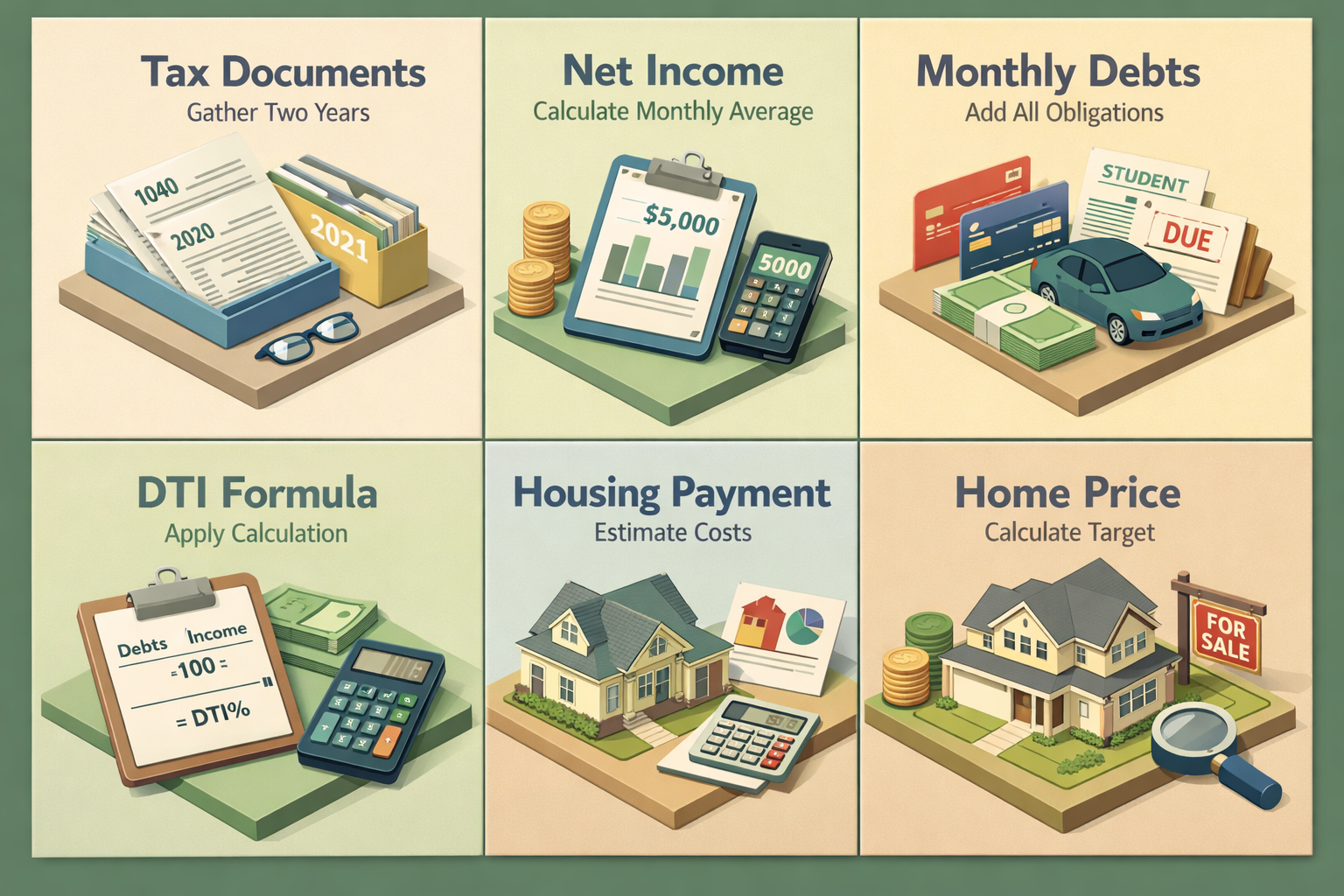
Let's walk through a practical framework for understanding how to calculate mortgage affordability with income from cryptocurrency mining. This process mirrors what many underwriters go through when reviewing your file.
Step 1: Gather Your Tax Documents
Pull your last two years of federal tax returns. Look at your Schedule C (if you mine as a self-employed individual) or Schedule 1 if mining is reported as other income. Add up your net income from both years and divide by 24 to get a monthly average.
Step 2: Calculate Your Net Monthly Income
If your tax returns show $90,000 in net mining income over two years, your qualifying monthly income would be approximately $3,750. Remember, lenders use net income after deductions — not your gross coin earnings before expenses.
Step 3: Determine Your Monthly Debt Obligations
Add up all recurring monthly debt payments: car loans, student loans, credit card minimums, and any other installment debt. This figure goes into your DTI calculation.
Step 4: Apply the DTI Formula
Use the formula: (Monthly Debts + Proposed Mortgage Payment) ÷ Gross Monthly Income = DTI Ratio. Aim to keep this at or below 43%, though some non-QM lenders may allow up to 50% in certain circumstances.
Step 5: Estimate Your Home Purchase Price
Once you know your maximum monthly housing payment, use a mortgage calculator with current interest rates to back into a loan amount. Then add your down payment to estimate a target home price. Don't forget to account for closing costs, which typically range from 2% to 5% of the loan amount.
What Real Estate Investors Should Know About Cryptocurrency Investment Property Loans
Real estate investors who earn income from mining face an added layer of complexity when pursuing a cryptocurrency investment property loan. Investment properties are already considered higher risk by lenders, which means underwriting standards are typically stricter and interest rates may be higher compared to a primary residence loan.
For investors, here are some additional considerations:
- Larger down payments may be required. Investment property loans often require 20% to 25% down, sometimes more. If you're converting crypto assets to fund the down payment, lenders will want to see a clear paper trail showing the source of funds.
- Reserve requirements tend to be higher. Lenders may require you to demonstrate several months of mortgage payments in liquid reserves. Crypto held in a wallet may not count unless it's been converted to U.S. dollars and held in a verifiable account.
- Rental income can help your DTI. If you're purchasing a property that generates rental income, some lenders may allow you to count a portion of that projected rent when calculating your debt-to-income ratio — which could offset the limitations of variable mining income.
- Non-QM and portfolio lenders may be your best path. Traditional agency loans are unlikely to accommodate complex income structures for investment properties. A portfolio lender or non-QM specialist who understands variable income may offer more flexibility.
Working with a mortgage broker who has experience in non-traditional income lending can make a meaningful difference when navigating these scenarios. They can often match you with lenders who are actively seeking borrowers with alternative income profiles. If you're considering a cryptocurrency investment property loan, understanding lender expectations early can save significant time.
Tips for Strengthening Your Mortgage Application as a Crypto Miner
Even if your income profile is unconventional, there are practical steps you can take to improve your chances of approval and potentially qualify for better loan terms.
- Report your income consistently. Unreported crypto income cannot be used to qualify for a mortgage. Make sure you've been filing taxes on your mining income for at least two years before you apply.
- Keep your crypto and personal finances separate. A dedicated business bank account for your mining operation makes it easier for lenders to trace income sources and verify consistency.
- Maintain a strong credit score. Your credit history remains one of the most influential factors in any mortgage decision. A score above 700 — and ideally above 740 — can help offset the perceived risk of variable income.
- Build liquid reserves. Convert a portion of your crypto earnings to cash and maintain several months of mortgage payments in a savings or checking account. This shows lenders you can handle payment obligations even during a slow mining period.
- Work with a CPA familiar with crypto taxation. Accurate, well-organized tax returns prepared by a knowledgeable accountant can make your file look far more credible to an underwriter.
- Consider a larger down payment. Putting more money down reduces the lender's risk and can sometimes open doors to loan programs that might otherwise be unavailable.
●Conclusion
Navigating a mortgage application with cryptocurrency mining income takes preparation, patience, and the right professional guidance. Understanding how to calculate mortgage affordability with income from cryptocurrency mining is genuinely within reach if you approach it systematically — averaging your reported net income, calculating your DTI carefully, and documenting everything thoroughly. Whether you're purchasing a primary residence or exploring a cryptocurrency investment property loan, there are lenders and loan programs that may be able to work with your unique financial profile. The key is knowing where to look and presenting your income story as clearly and credibly as possible. At LoanWise, we're here to help you find the right path forward — reach out today to speak with a lending specialist who understands variable income and non-traditional borrowers.