
Buying a home is one of the most exciting milestones in life — but it can also feel overwhelming when your income doesn't fit the traditional nine-to-five mold. If you're a freelancer, rideshare driver, or independent contractor who also receives alimony, you might be wondering whether a mortgage is even within reach. The good news is that it absolutely can be. Understanding how to calculate mortgage affordability with gig economy income and alimony is the first step toward turning that dream into a reality. Lenders do have guidelines for non-traditional earners, and with the right preparation, you may be in a stronger financial position than you realize.
Why Non-Traditional Income Sources Create Unique Lending Challenges
Traditional mortgage underwriting was built around borrowers who receive consistent, salaried paychecks from a single employer. When your income comes from platforms like Uber, Etsy, Upwork, or freelance contracts — or when a portion of it arrives monthly as alimony — lenders need to work a little harder to verify what you actually earn.
That's not necessarily a bad thing. It just means the documentation requirements differ, and the income calculation methods may vary depending on the loan program you're applying for. Lenders generally want to see stability, continuity, and a reasonable expectation that your income will continue for at least the next three years.
Gig workers often face fluctuating monthly earnings, which makes it harder for underwriters to pin down a reliable monthly figure. Similarly, alimony payments — while potentially substantial — come with their own verification requirements and time constraints. Understanding both of these income streams in detail will help you approach the mortgage process with confidence.
How Lenders Typically Evaluate Gig Economy Earnings for a Home Loan
When it comes to gig income, most lenders follow guidelines set by conventional loan programs such as Fannie Mae and Freddie Mac, or government-backed options like FHA loans. These programs generally require that self-employment or gig income be documented for a minimum of two years before it can be used to qualify for a mortgage.
Here's how lenders typically calculate usable gig income:
- Tax returns (IRS Form 1040): Lenders will usually average your net self-employment income from the past two years. If your income increased from year one to year two, lenders may use the average. If it declined, they may use the lower figure or require additional explanation.
- Schedule C or Schedule SE: These tax forms detail your business profit and loss. Lenders look at net income after allowable deductions — not gross revenue.
- Bank statements: Some lenders, particularly those offering non-QM (non-qualified mortgage) products, may allow 12 to 24 months of bank statements as an alternative to tax returns. This can be helpful if your write-offs significantly reduced your taxable income.
- 1099 forms: These serve as supporting documentation to verify the sources and consistency of your gig earnings.
It's worth noting that business deductions — while helpful at tax time — can actually reduce the income figure lenders use for qualification purposes. If you've been aggressively writing off expenses, your qualifying income on paper may be lower than what you actually deposit into your bank account each month. A mortgage professional can help you model different scenarios before you apply.
Using a Gig Income Mortgage Calculator to Estimate Your Buying Power
Before you sit down with a lender, it's smart to run your own numbers. A gig income mortgage calculator can help you estimate how much home you might be able to afford based on your average net self-employment income. While online tools vary in sophistication, most will ask you to input your monthly income, existing debts, estimated interest rate, and desired loan term.
Here's a simplified framework for calculating your mortgage affordability manually:
- Step 1 — Determine your average monthly income: Add your net self-employment income from your last two tax returns and divide by 24. This gives you your average monthly qualifying income.
- Step 2 — Add any eligible alimony income: If you receive alimony and it meets lender requirements (more on this below), add the monthly alimony amount to your average gig income total.
- Step 3 — Apply the debt-to-income (DTI) ratio guideline: Most conventional lenders prefer your total monthly debt payments — including your projected mortgage payment — to stay at or below 43% to 45% of your gross monthly income. FHA loans may allow slightly higher DTI ratios in some cases.
- Step 4 — Back into the mortgage payment: Multiply your total qualifying monthly income by the maximum DTI percentage, then subtract your existing monthly debt obligations. The remaining figure is roughly what you may be able to put toward a mortgage payment.
- Step 5 — Estimate the loan amount: Use a standard mortgage payment calculator to work backward from your maximum monthly payment to arrive at an estimated loan amount, factoring in current interest rates.
Keep in mind that taxes, homeowner's insurance, and HOA fees also factor into your monthly housing costs. Working with a licensed mortgage advisor who understands gig income can help you run these numbers accurately and avoid surprises at the time of application.
Alimony Mortgage Qualification: What You Need to Know
Alimony — also known as spousal support — can be a meaningful contributor to your mortgage qualification, but only if it meets certain lender criteria. Understanding the rules around alimony mortgage qualification is essential before you rely on this income source in your application.
Here's what lenders typically look for when considering alimony as qualifying income:
- Documentation of the divorce decree or separation agreement: Lenders need to verify the terms of your alimony arrangement, including the payment amount and duration.
- Proof of receipt: Bank statements showing consistent alimony deposits over the past 6 to 12 months are typically required. Some lenders may want a full year of payment history.
- Remaining duration: Most lenders require that alimony payments are expected to continue for at least three years from the mortgage closing date. If payments are set to end within three years, lenders may not be able to count that income toward your qualification.
- Consistency: Irregular or sporadic alimony payments may raise red flags. Lenders want to see a reliable, predictable income stream.
One important nuance: you are not required to disclose alimony income if you don't want it considered in your application. However, if excluding it means you won't qualify for the loan amount you need, then providing thorough documentation becomes well worth the effort.
It's also worth knowing that if you are the one paying alimony rather than receiving it, that monthly obligation will count as a debt and reduce your qualifying income in the DTI calculation. Be transparent with your lender about this from the start.
How to Calculate Mortgage Affordability With Gig Economy Income and Alimony Together
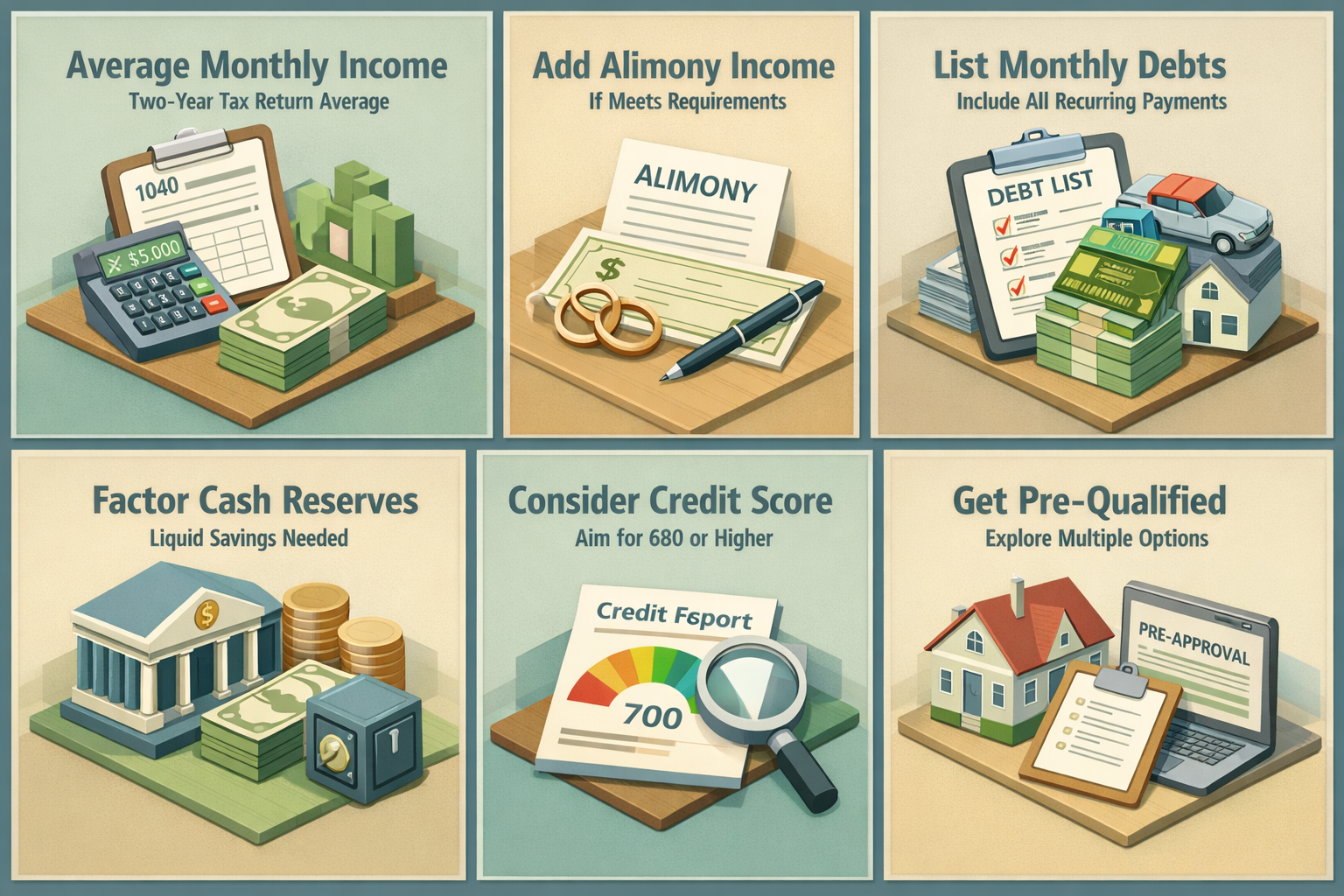
Combining these two income sources requires a methodical approach. Here's how to bring everything together when you're figuring out how to calculate mortgage affordability with gig economy income and alimony as part of a single application:
- Calculate your average net gig income: Use your two-year tax return average as described earlier. If you've only been doing gig work for one year, some lenders may still consider it, though qualification could be more challenging.
- Add verified alimony income: If your alimony meets the three-year continuance requirement, add that monthly figure to your average gig income to arrive at a combined monthly qualifying income.
- List all monthly debt obligations: Include car payments, student loans, credit card minimums, and any other recurring debts. This total, combined with your anticipated mortgage payment, should ideally fall within your lender's DTI threshold.
- Factor in cash reserves: Lenders often want to see that you have enough liquid savings to cover several months of mortgage payments. For self-employed borrowers, some lenders may require more reserves than they would for salaried applicants.
- Consider your credit score: A strong credit profile can offset some of the complexity around non-traditional income. Aim for a score of 680 or higher for conventional loans, though FHA programs may accept lower scores.
Every lender overlays these variables slightly differently, so getting pre-qualified with a few different mortgage professionals can reveal a wider range of options than you might expect.
Loan Programs That May Work Well for Gig Workers and Alimony Recipients
Not all mortgage programs treat gig income and alimony the same way. Knowing your options can open doors you didn't know existed.
Conventional Loans
Conventional loans backed by Fannie Mae or Freddie Mac follow well-defined guidelines for self-employed borrowers and alimony income. If you can document two years of gig earnings and meet standard DTI and credit requirements, this could be a straightforward path.
FHA Loans
FHA loans are insured by the Federal Housing Administration and may offer more flexibility in certain areas, including higher DTI allowances and lower minimum credit scores. They can be a good fit for first-time homebuyers with non-traditional income profiles, though they do require mortgage insurance premiums.
Non-QM (Non-Qualified Mortgage) Loans
Non-QM loans operate outside traditional underwriting guidelines and may allow for bank statement income documentation instead of tax returns. This can be particularly helpful for gig workers whose tax write-offs have reduced their qualifying income on paper. These loans may come with higher interest rates, so it's important to weigh the trade-offs carefully.
Bank Statement Loans
A subset of non-QM lending, bank statement loans use 12 to 24 months of personal or business bank deposits to calculate your qualifying income. This approach may paint a more accurate picture of your actual cash flow than tax returns alone.
Speaking with a lender who specializes in self-employed and non-traditional borrowers can help you identify which program aligns best with your unique financial situation.
Documentation Strategies to Strengthen Your Mortgage Application
Preparation is everything when your income profile is complex. Here are some practical steps that may significantly improve your chances of a smooth approval:
- File taxes on time and accurately: Lenders rely heavily on tax returns. Consistent, timely filing with accurate income reporting builds credibility and may make the underwriting process faster.
- Maintain a dedicated business bank account: Keeping gig income separate from personal spending makes it easier for underwriters to trace and verify your earnings.
- Organize your alimony payment records: Keep copies of your divorce decree, any court modifications, and 12 months of bank statements showing consistent deposits.
- Write a letter of explanation if needed: If your income fluctuated significantly between years, a clear, professional explanation letter can reassure underwriters and prevent unnecessary delays.
- Work with a CPA familiar with self-employment: A knowledgeable accountant can help you balance tax efficiency with mortgage qualification, especially as you plan for an upcoming home purchase.
- Consider timing your application strategically: If your most recent tax year showed a strong income year, applying sooner rather than later may work in your favor before the next filing cycle affects your averages.
The mortgage process rewards borrowers who come prepared. The more organized and transparent your documentation is, the smoother your path to approval is likely to be.
●Conclusion
Navigating a home purchase with gig economy income and alimony is genuinely achievable — it just requires a bit more planning and the right guidance. By understanding how to calculate mortgage affordability with gig economy income and alimony, organizing your documentation, and exploring the full range of loan programs available to you, you're already ahead of the curve. Whether you're a freelancer ready to put down roots or a recently divorced homebuyer looking for a fresh start, LoanWise is here to help you connect with the right lending solutions for your unique situation. Reach out to a mortgage specialist today and take the first step toward the home you deserve.