
Buying a home is one of the most meaningful financial steps a person can take — and it's a goal that's very much within reach for people who rely on disability income, part-time employment, or both. However, understanding how to calculate mortgage affordability with disability income and part-time job earnings can feel complicated, especially when lenders seem to speak a different language. The good news is that lenders are generally permitted to consider these income types when evaluating your mortgage application. What matters most is how well-documented and consistent your income is. This article walks you through the key concepts, calculations, and strategies you'll need to move forward with confidence.
Why Disability Income and Part-Time Earnings Count Toward a Mortgage
Many homebuyers assume that only traditional, full-time W-2 employment counts when applying for a mortgage. That's a common misconception. Lenders are generally required under fair lending guidelines to consider all legal and verifiable sources of income when reviewing a mortgage application. This includes Social Security Disability Insurance (SSDI), Supplemental Security Income (SSI), long-term disability benefits from private insurers, and income from part-time jobs.
What lenders care about most is whether your income is stable, consistent, and likely to continue. Disability benefits that have been received for a demonstrated period and are expected to continue are typically treated similarly to regular employment income. Part-time job income may also be counted, though lenders often want to see a history of at least one to two years in the same position or field before fully factoring it in.
The Equal Credit Opportunity Act (ECOA) prohibits lenders from discriminating against applicants based on the source of their income, which means a lender cannot reject your application simply because your income comes from disability benefits. Understanding this legal protection is an important first step in approaching the mortgage process with confidence.
Breaking Down the Affordability Calculation: What the Numbers Mean
When lenders determine how much of a mortgage you can afford, they rely primarily on two ratios: the front-end ratio and the back-end ratio, both of which fall under the broader umbrella of your debt-to-income ratio (DTI).
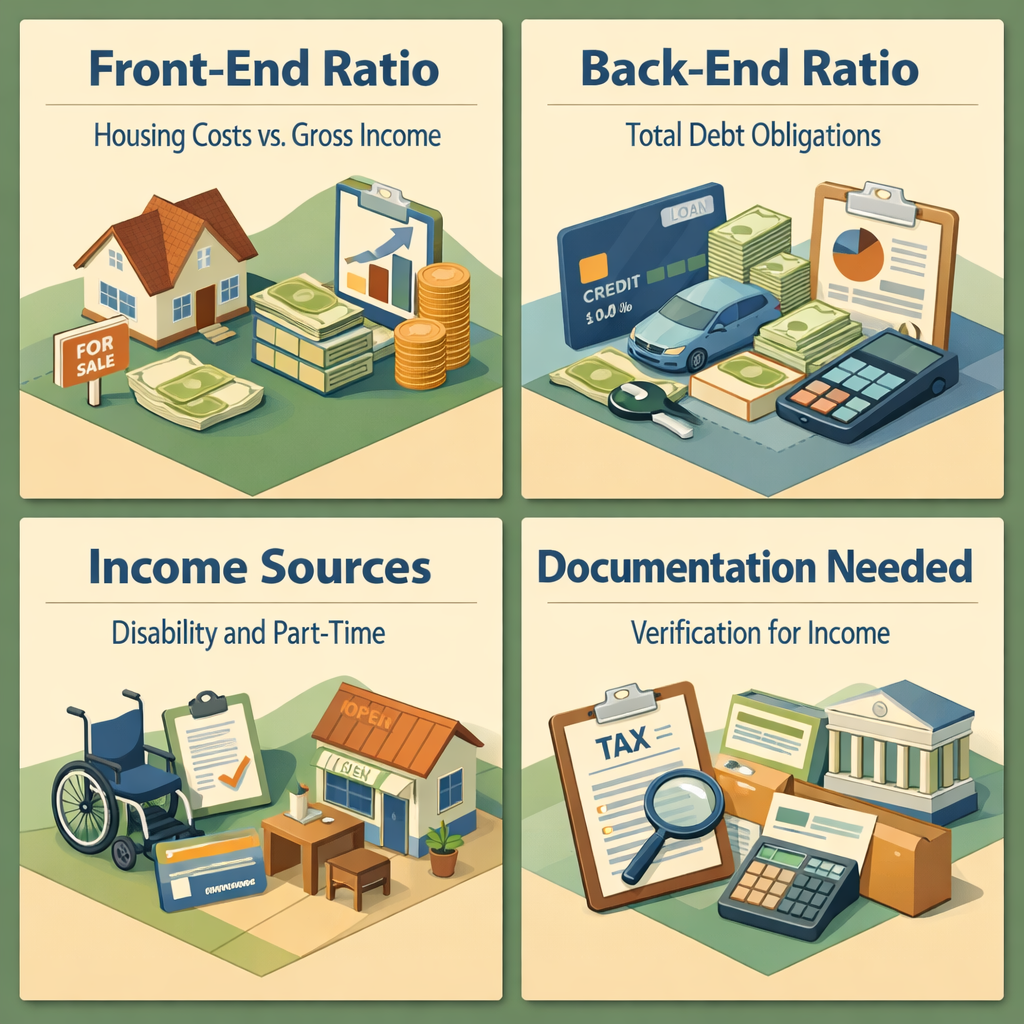
Front-End Ratio: Housing Costs vs. Gross Income
The front-end ratio measures how much of your gross monthly income goes toward housing expenses. This typically includes your estimated mortgage payment (principal and interest), property taxes, homeowners insurance, and any applicable HOA fees. Most conventional loan programs prefer this ratio to be no higher than 28% of your gross monthly income, though some government-backed programs may allow slightly more flexibility.
For example, if your total gross monthly income — combining disability benefits and part-time wages — is $3,500, then your target maximum housing cost would be approximately $980 per month ($3,500 x 0.28).
Back-End Ratio: Total Debt Obligations
The back-end ratio accounts for all monthly debt payments, including housing. This covers credit card minimum payments, auto loans, student loans, and any other recurring obligations. Most lenders prefer this number to stay below 43% of gross monthly income, though certain loan programs may permit higher ratios under specific conditions.
Using the same example above, a 43% back-end cap would allow up to approximately $1,505 per month in total debt obligations. Subtract your existing monthly debts from this figure to estimate how much room remains for a mortgage payment.
How Lenders Verify and Document Disability Income Sources
Documentation is everything in the mortgage process, and disability income is no exception. To use disability benefits as qualifying income, you'll typically need to provide paperwork that confirms the source, amount, and expected continuity of those benefits.
- Social Security award letter: This is one of the most commonly accepted documents for SSDI or SSI income. It shows your monthly benefit amount and confirms your eligibility status.
- Benefit verification letter: Available through the Social Security Administration, this letter confirms your current benefit amount and can be requested online or by phone.
- Private disability insurance policy documentation: If your disability income comes from a private employer or insurance plan, you may need to provide the policy documents along with recent benefit statements.
- Bank statements: Most lenders will want to see regular, consistent deposits that match your stated income over a period of typically 12 to 24 months.
One critical factor for many programs is whether the disability income is expected to continue for at least three years from the date of application. Some lenders may require documentation confirming this, such as a statement from the Social Security Administration or your private insurer. If the continuity of benefits cannot be confirmed, the lender may treat the income more cautiously or exclude it from qualifying calculations.
How to Calculate Mortgage Affordability With Disability Income and Part-Time Job Earnings Together
Now let's look at a practical, step-by-step approach to understanding how to calculate mortgage affordability with disability income and part-time job wages combined. This process helps you arrive at a realistic home price range before you ever speak with a lender.
Step 1: Calculate Your Total Gross Monthly Income
Add up all verifiable income sources. For disability income, use the gross monthly benefit amount shown on your award letter. For part-time employment, lenders typically average your income over 24 months if you've held the job for that long, or over the time employed if it's been less than two years. Divide your total annual part-time earnings by 12 to get a monthly figure.
Example: $1,200/month in SSDI + $1,400/month average from part-time work = $2,600 gross monthly income.
Step 2: Apply the Front-End Ratio
Multiply your gross monthly income by 0.28 (or the guideline for your target loan program). This gives you a rough ceiling for monthly housing costs.
$2,600 x 0.28 = $728/month maximum housing payment.
Step 3: Factor in Your Existing Debts
Multiply gross income by 0.43 (back-end ratio), then subtract your current monthly debt payments to find your available mortgage payment budget.
$2,600 x 0.43 = $1,118. If you have $300/month in existing debts, your available mortgage payment budget may be approximately $818/month.
Step 4: Estimate a Home Price Range
Use an online mortgage calculator to work backward from your maximum monthly payment to a home purchase price, factoring in current interest rates, your estimated down payment, property taxes, and insurance. This gives you a targeted price range to take into your home search.
Loan Programs That May Work Best for Buyers With These Income Types
Certain mortgage programs may be more accommodating for borrowers whose primary income includes disability benefits and part-time wages. Here's a look at a few worth exploring with a qualified lender:
FHA Loans
FHA loans, backed by the Federal Housing Administration, typically allow higher DTI ratios and lower down payments than conventional loans. They can be a strong option for borrowers with moderate income levels and credit scores starting around 580. Disability income and part-time earnings are generally acceptable qualifying income under FHA guidelines.
Conventional Loans With Fannie Mae or Freddie Mac Guidelines
Both Fannie Mae and Freddie Mac explicitly allow disability income as a qualifying income source. Freddie Mac's HomeOne and Fannie Mae's HomeReady programs, for example, are designed with income flexibility in mind and may permit income from multiple part-time jobs or non-traditional sources in certain cases.
USDA Loans
For buyers in eligible rural or suburban areas, USDA loans offer no-down-payment options and may be accessible to borrowers with lower incomes, including those on disability. Income limits apply, so it's worth checking whether your combined income falls within the qualifying thresholds for your area.
VA Loans
If you are a veteran or active-duty service member who also receives disability compensation from the Department of Veterans Affairs, VA disability income is typically counted as qualifying income. VA loans are known for their flexible underwriting and no down payment requirement.
Strengthening Your Application: Credit, Savings, and Lender Strategy
Beyond income, lenders look at a full financial picture. Here are some strategies that may help homebuyers with disability income and part-time earnings position themselves more favorably:
- Build and maintain strong credit: Your credit score is one of the most influential factors in mortgage approval and interest rate offers. Paying bills on time, keeping credit card balances low, and avoiding new debt in the months before applying can all help strengthen your profile.
- Save for a meaningful down payment: A larger down payment reduces your loan-to-value ratio, which can make approval easier and may help you access better interest rates. Even modest savings over time can make a difference.
- Reduce existing debts: Paying down credit cards or installment loans before applying lowers your back-end DTI ratio, potentially opening the door to a larger mortgage or better terms.
- Work with a lender experienced in non-traditional income: Not all lenders handle disability and part-time income the same way. Seeking out a mortgage professional who regularly works with borrowers with varied income types can make the process smoother and more productive.
- Get pre-approved before house hunting: A pre-approval letter shows sellers you're a serious buyer and gives you a clear picture of what you can afford based on your specific income profile.
Common Questions Homebuyers Ask About Disability and Part-Time Income
Does receiving disability income affect my interest rate?
Generally, the source of your income does not directly affect your mortgage interest rate. Rates are primarily influenced by your credit score, loan-to-value ratio, loan type, and broader market conditions. A borrower on disability with a strong credit profile may qualify for a mortgage at the same competitive rates as any other borrower.
What if my part-time income is recent or inconsistent?
Lenders typically prefer to see at least 12 to 24 months of consistent part-time employment before fully counting that income. If your part-time work is newer or varies significantly, lenders may average your earnings conservatively or require additional documentation. Being upfront with your lender about your employment history helps set accurate expectations.
Can I use both disability income and part-time wages to meet income thresholds for down payment assistance programs?
In many cases, yes. Down payment assistance programs often consider all verifiable household income when determining eligibility. However, program rules vary widely by state and program sponsor, so it's worth confirming directly with the program administrator or a HUD-approved housing counselor.
Will a lender ask about my medical condition?
Lenders are generally not permitted to inquire about the nature of your disability. They may ask for documentation confirming that your benefits are ongoing, but the specifics of your medical situation are typically protected under fair lending laws.
●Conclusion
Understanding how to calculate mortgage affordability with disability income and part-time job earnings is a practical and empowering exercise. It helps you walk into the lending process with realistic expectations, the right documentation, and a clear sense of your buying power. While every borrower's situation is unique, the core principles remain the same: lenders want to see stable, documented, and continuous income — regardless of its source. By knowing your DTI ratios, choosing the right loan program, and working with an experienced mortgage professional, homeownership is a very achievable goal. At LoanWise, we're here to help you navigate every step of the journey with clarity and confidence. Reach out today to connect with a mortgage specialist who understands your unique financial picture.