If you're going through or have recently gone through a divorce, buying a home may feel like a moving target. One of the most common questions homebuyers in this situation ask is: how does alimony affect what I can borrow? The answer depends on whether alimony is something you receive or something you pay — and lenders treat both scenarios very differently. Understanding how to calculate mortgage affordability with alimony payments can make the difference between getting approved and walking away frustrated. In this guide, we'll break down exactly how lenders view alimony, what documentation you'll need, and how to position yourself for the strongest possible mortgage application.
What Lenders Mean When They Talk About Alimony
Alimony — sometimes called spousal support or maintenance — is a court-ordered financial arrangement between former spouses. In the context of mortgage lending, alimony is treated as a financial factor that directly impacts your debt-to-income ratio (DTI), which is one of the most important metrics lenders use to decide how much you can borrow.
Lenders generally look at alimony in one of two ways:
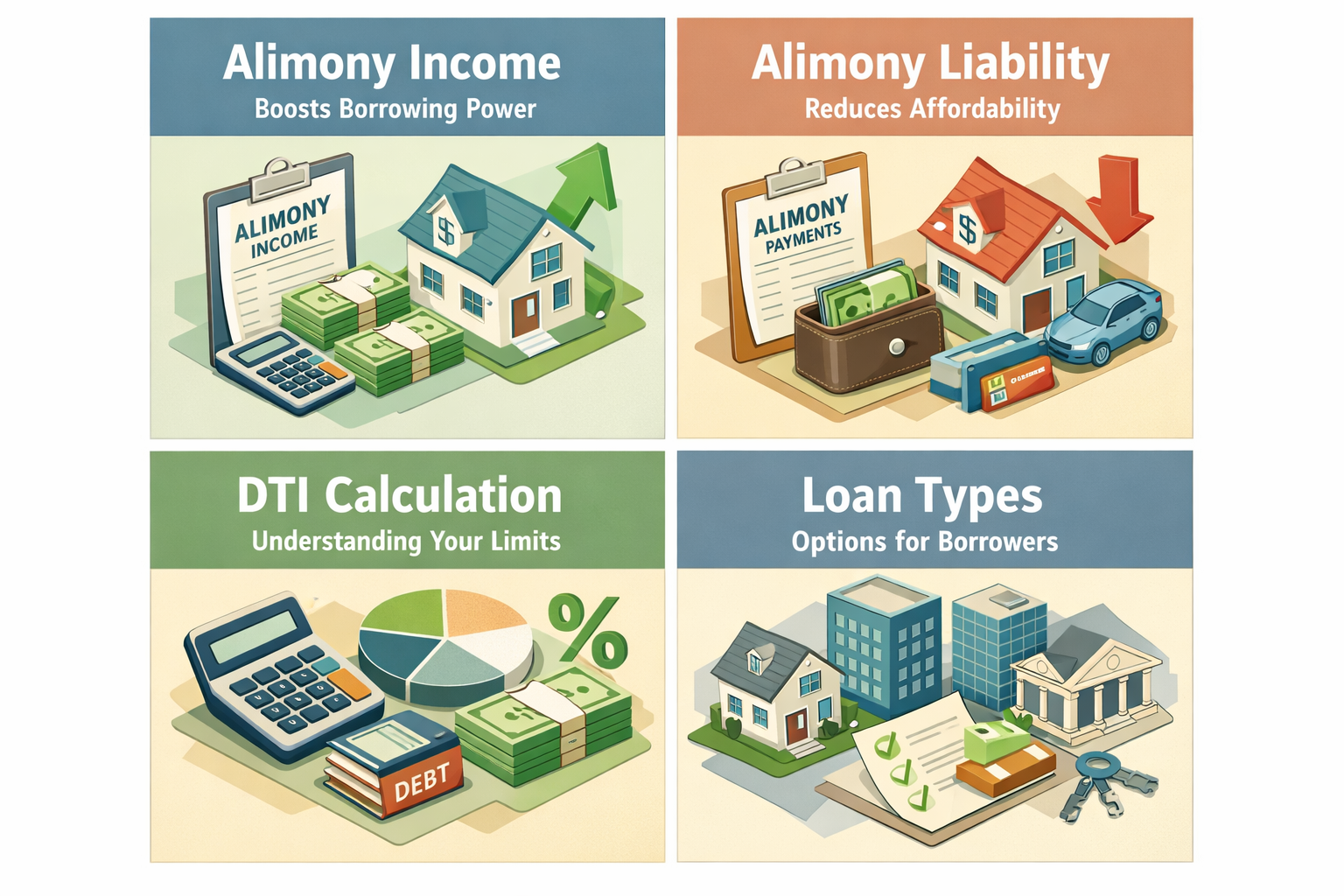
- As income: If you receive alimony, lenders may count it as qualifying income — boosting your borrowing power.
- As a liability: If you pay alimony, lenders typically count it as a monthly debt obligation — reducing how much home you can afford.
It's important to understand that not all lenders handle alimony the same way, and loan programs such as conventional, FHA, VA, and USDA each have their own guidelines. That's why working with a knowledgeable mortgage professional is so valuable in these situations.
How Alimony Income Can Strengthen Your Mortgage Application
If you're the spouse receiving alimony, you may be able to use that income to qualify for a larger mortgage. However, lenders typically require that the alimony income meet a few key conditions before they'll count it toward your qualifying income.
Consistency and Continuity Requirements
Most lenders follow guidelines that require alimony income to have a documented history of receipt — often for a minimum of six to twelve months — and must be expected to continue for at least three years from the date of your mortgage application. If your divorce decree shows that alimony payments are set to stop within a few years, a lender may reduce or exclude that income from your qualification entirely.
Documentation You'll Need to Provide
To use alimony as qualifying income for alimony income mortgage qualification, you'll typically need to provide:
- A fully executed divorce decree or separation agreement specifying the payment amount and duration
- Bank statements showing consistent deposits over a recent period (often six to twelve months)
- Proof that payments are being received reliably, such as canceled checks or direct deposit records
The more organized and thorough your documentation, the smoother your application process is likely to be. Gaps in payment history or inconsistent amounts could raise flags with an underwriter.
How Alimony Payments Affect Your Debt-to-Income Ratio
If you're the spouse paying alimony, things work a little differently. In this case, alimony is counted as a recurring monthly obligation, much like a car loan or student loan payment. This directly increases your total monthly debt load and reduces how much mortgage payment you can comfortably carry.
Understanding the DTI Calculation
Your debt-to-income ratio is calculated by dividing your total monthly debt obligations by your gross monthly income. For example:
- If your gross monthly income is $7,000
- And your total monthly debts — including alimony, car payments, and minimum credit card payments — add up to $2,100
- Your DTI would be 30%
Most conventional loan programs prefer a DTI at or below 43%, though some lenders may allow higher ratios under certain conditions. FHA loans can sometimes accommodate higher DTI ratios depending on compensating factors like strong credit scores or significant cash reserves.
Where Alimony Sits in the DTI Formula
Alimony payments are generally included in the back-end DTI, which accounts for all monthly debts — not just housing costs. This means even a modest alimony obligation could meaningfully lower the mortgage payment a lender is willing to approve. Understanding this formula is central to learning how to calculate mortgage affordability with alimony payments accurately.
Step-by-Step: Estimating Your Home Buying Power With Alimony
Working through a simple affordability estimate can help you set realistic expectations before you speak with a lender. Here's a practical approach to get started:
Step 1 — Calculate Your Gross Monthly Income
Add up all verified monthly income sources. If you receive alimony, include it here — provided it meets the continuity requirements mentioned earlier. Other sources may include wages, self-employment income, rental income, or retirement distributions.
Step 2 — List All Monthly Debt Obligations
Write down every recurring debt payment, including:
- Alimony payments (if you're the paying spouse)
- Child support (if applicable)
- Auto loans
- Student loans
- Minimum credit card payments
Step 3 — Apply the DTI Threshold
Multiply your gross monthly income by the lender's maximum DTI threshold. If a lender allows up to 43% DTI, and your income is $6,500 per month, your maximum allowable total debt — including your new mortgage payment — would be approximately $2,795 per month. Subtract your existing monthly debts to find the maximum mortgage payment you may qualify for.
Step 4 — Work Backward to a Loan Amount
Once you know your estimated maximum monthly payment, use a mortgage calculator to determine the loan amount that corresponds to that payment based on current interest rates and your estimated loan term. This gives you a ballpark figure for how much home buying power you might realistically be able to purchase.
Loan Program Differences That Could Work in Your Favor
Not every mortgage program handles alimony the same way, and knowing which loan type might be most beneficial to your situation could open more doors.
Conventional Loans
Conventional loans backed by Fannie Mae and Freddie Mac have specific guidelines around alimony income and obligations. Generally, alimony paid is included as a monthly liability in the DTI calculation. Alimony received may be counted as income if proper documentation is provided and the income meets continuity requirements.
FHA Loans
FHA loans, backed by the Federal Housing Administration, may offer more flexibility on DTI ratios compared to conventional options. This could be advantageous if your alimony obligations push your DTI higher than conventional lenders prefer. FHA loans also tend to be accessible to borrowers with lower credit scores, which can be helpful during the financial transition of a divorce.
VA Loans
For eligible veterans and service members, VA loans offer competitive benefits including no down payment requirements. VA guidelines also evaluate alimony in the context of residual income — meaning the focus is on what you have left over after all expenses, rather than just a simple DTI ratio. This may work in your favor depending on your financial picture.
USDA Loans
USDA loans are designed for eligible rural and suburban homebuyers and have income limits that apply to the household. If you're receiving alimony, that income would typically be counted as part of your household income for eligibility purposes, which is worth factoring into your planning.
Common Mistakes to Avoid When Applying With Alimony
Navigating a mortgage application after a divorce comes with some unique pitfalls. Being aware of these ahead of time can save you time, stress, and potentially your loan approval.
- Failing to disclose alimony obligations: Some borrowers are tempted to omit alimony payments from their application, hoping it won't be discovered. Lenders will likely find these obligations during the credit and public records review process. Full transparency is always the better path.
- Not documenting alimony income properly: If you receive alimony, simply stating it on your application isn't enough. You need the supporting documentation lenders require to verify and use that income.
- Assuming your divorce decree is sufficient: While a divorce decree establishes the legal obligation, lenders also want to see actual proof that payments are being made or received consistently.
- Applying too soon after a divorce: If you've only recently begun receiving alimony, you may not yet have the payment history lenders require. In some cases, it may make sense to wait until you have a more established track record.
- Ignoring the impact on your credit profile: Divorce can sometimes lead to changes in credit utilization, joint account closures, or missed payments during a difficult period. Take time to review and strengthen your credit before applying.
Tips to Strengthen Your Mortgage Application as a Divorced Homebuyer
Even with alimony in the picture, there are meaningful steps you can take to improve your chances of qualifying for the home you want.
Build a Strong Credit History
If your credit took a hit during the divorce, focus on rebuilding it before you apply. Pay all bills on time, keep credit card balances low relative to your limits, and avoid opening new credit accounts right before applying for a mortgage qualification.
Reduce Other Monthly Debts
Since alimony obligations may already be adding to your DTI, paying down other debts — like auto loans or credit cards — can help free up room in your debt ratio for a larger mortgage payment.
Save for a Larger Down Payment
A larger down payment reduces the loan amount you need to borrow, which lowers your required monthly mortgage payment and makes qualification easier. It may also help you avoid private mortgage insurance (PMI) on conventional loans.
Work With a Lender Experienced in Post-Divorce Scenarios
Not all loan officers have deep experience handling applications that involve alimony, divorce decrees, and split finances. Seeking out a lender who understands these nuances can make your experience significantly smoother and may help you find loan options you didn't know were available.
●Conclusion
Understanding how to calculate mortgage affordability with alimony payments is an essential step for any homebuyer navigating life after divorce. Whether alimony is helping you qualify by boosting your income or creating a hurdle by increasing your monthly obligations, the key is knowing exactly how lenders evaluate it — and preparing accordingly. With the right documentation, the right loan program, and a clear picture of your debt-to-income ratio, homeownership is very much within reach. At LoanWise, we're here to help you work through the details and find a financing path that fits your unique situation. Reach out to one of our mortgage specialists today to get started.