
Buying a home is one of the most exciting milestones in life — but figuring out how much you can actually afford can feel complicated, especially when your income doesn't come from a single paycheck. If you receive alimony and earn extra money through a side hustle, you might be wondering whether lenders will count all of it. The good news is that many lenders, including those offering FHA loans, do allow non-traditional income sources to be included in your application. Understanding how to calculate mortgage affordability with alimony income and side hustle earnings could open the door to a home loan that truly fits your financial life.
Why Non-Traditional Income Sources Matter in Home Financing
The modern workforce looks very different from what it did a generation ago. Many homebuyers today juggle multiple income streams — a freelance design business on weekends, a rideshare driving shift in the evenings, or a monthly alimony payment following a divorce settlement. These income sources are real, they're consistent for many people, and they absolutely can factor into your mortgage qualification.
Lenders care about one core question: Can this borrower reliably repay the loan? To answer that, they look at your gross monthly income and measure it against your monthly debt obligations. This ratio — called your debt-to-income ratio (DTI) — is one of the most important numbers in any mortgage decision. If your non-traditional income streams are documented and stable, they may help lower your DTI and increase the loan amount you qualify for.
That said, not every dollar you earn automatically counts. Lenders apply specific rules about which income sources are eligible, how long they must have been received, and what paperwork is required to verify them. The rules can vary by loan program, lender, and income type, so it's worth understanding the details before you apply.
How Lenders Evaluate Alimony as Qualifying Income
Alimony — sometimes called spousal support — is money received from a former spouse as part of a legal separation or divorce agreement. The encouraging news for borrowers is that alimony is generally considered an eligible income source for mortgage qualification, provided it meets certain criteria.
Most lenders, including FHA-approved lenders, typically require that your alimony income meet these general conditions:
- Continuity: The payments must be expected to continue for at least three years from the date of your mortgage application. If your alimony agreement is set to expire within that window, many lenders may not be able to count it as qualifying income.
- Documented legal agreement: You'll need to provide a copy of your divorce decree, separation agreement, or court order that clearly states the payment amount and terms.
- Proof of receipt: Bank statements showing consistent deposits, or sometimes a 12-month payment history, are typically required to verify that payments are actually being made.
One important note: lenders cannot legally require you to disclose alimony income if you don't want to use it to qualify. However, if you choose to include it, you must be prepared to document it thoroughly. If the payments have been inconsistent or the agreement is informal, a lender may discount the income or exclude it entirely.
For borrowers pursuing FHA loans, the FHA loan income requirements alimony side hustle guidelines generally mirror conventional underwriting standards in this area — alimony may be counted as effective income if it meets the continuity and documentation thresholds outlined by FHA guidelines.
Counting Your Side Hustle: What Mortgage Underwriters Look For
Side hustle income — whether from freelancing, gig platforms, Etsy shops, tutoring, or any self-employed activity — can also potentially be counted toward your mortgage qualification. But lenders tend to be more cautious with self-employment income because it can fluctuate from month to month and year to year.
Here's what underwriters typically look for when evaluating side hustle earnings:
- Two-year history: Most lenders want to see at least two years of self-employment or side hustle income reported on your federal tax returns. A brand-new side business that you started six months ago is unlikely to be counted, even if it's generating solid revenue right now.
- Tax returns and schedules: Lenders will typically request your last two years of personal tax returns, including Schedule C (for sole proprietors), to calculate your average net income after business expenses. Remember, lenders use your net income — not your gross revenue.
- Stability and trend: If your side hustle income has been growing year over year, that's a positive sign. If it has been declining, lenders may use the lower figure or raise concerns about sustainability.
- 1099 forms and bank statements: These can supplement your tax returns to show ongoing activity and cash flow.
It's worth noting that if your side hustle income is declining or irregular, lenders may average the two years and use the lower result — or in some cases, choose not to count it at all. Working with a knowledgeable loan officer before you apply can help you understand how your specific situation will be evaluated.
How to Calculate Mortgage Affordability With Alimony Income and Side Hustle Earnings
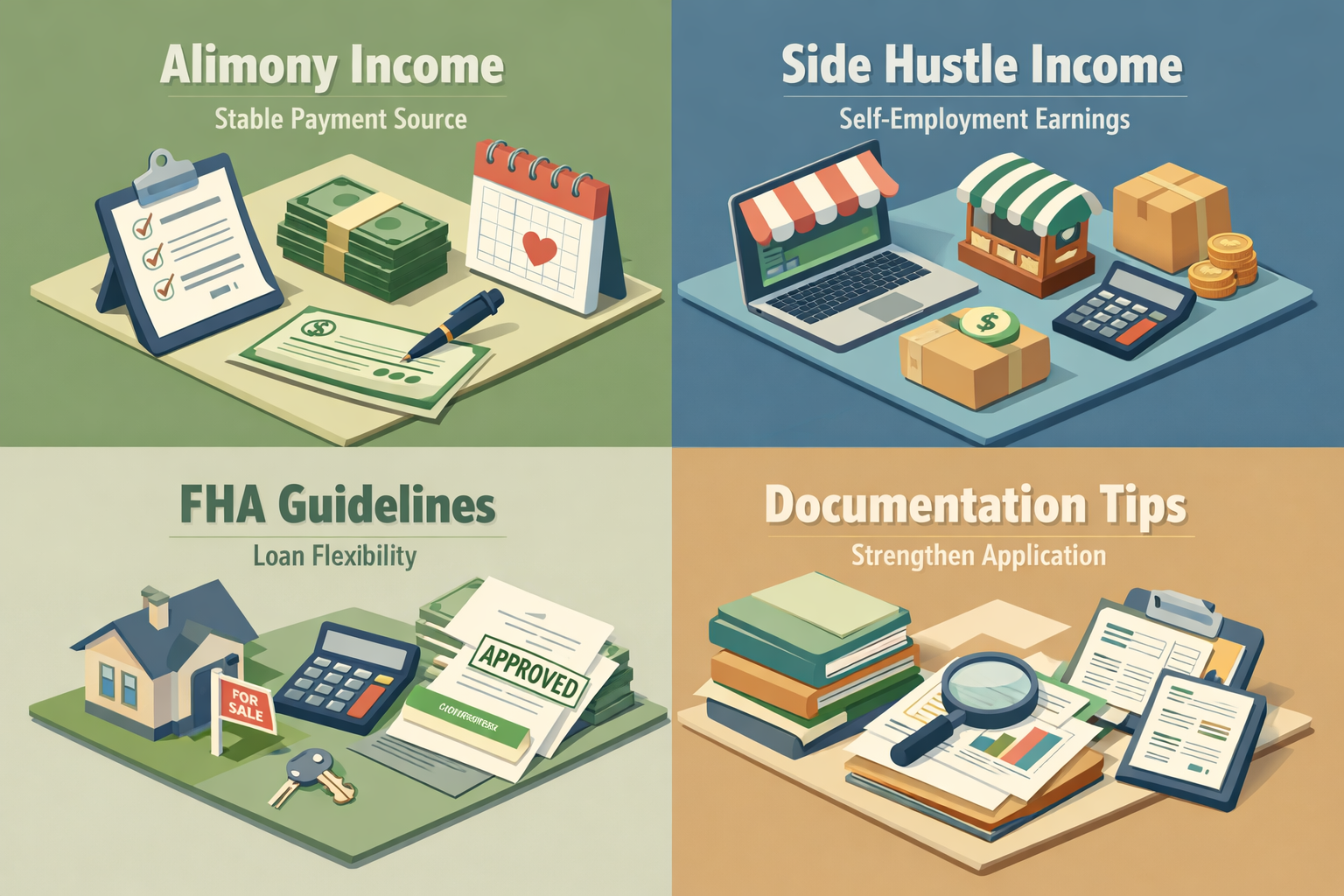
Now that we understand how each income type is evaluated, let's walk through the general process of how to calculate mortgage affordability with alimony income and side hustle earnings combined.
The basic formula lenders use is your gross qualifying monthly income multiplied by the maximum allowable DTI ratio. Here's a simplified example:
- W-2 job income: $3,500/month
- Alimony received: $1,000/month (documented, continuing 4+ years)
- Side hustle net income (averaged over 2 years): $800/month
- Total qualifying monthly income: $5,300/month
Using a common conventional loan guideline of a 43% maximum DTI, your total allowable monthly debt payments — including your new mortgage — would be roughly $2,279/month. If you already have $400/month in car and student loan payments, that leaves approximately $1,879/month for your mortgage payment. From there, you can work backward using a mortgage affordability calculator to estimate the loan amount that fits within that payment.
Keep in mind that FHA loans may allow DTI ratios up to 50% in some cases, which could expand your affordability range. However, this typically requires compensating factors such as a strong credit score, significant reserves, or a larger down payment. Every lender applies these guidelines slightly differently, so getting a pre-qualification or pre-approval is the most reliable way to understand your actual buying power.
Also remember that your qualifying income and your comfortable budget aren't always the same thing. Qualifying for a higher loan amount doesn't necessarily mean you should borrow the maximum. Factor in property taxes, homeowner's insurance, HOA fees, and maintenance costs when deciding what's truly affordable for your lifestyle.
FHA Loan Income Requirements for Alimony and Side Hustle Borrowers
FHA loans are a popular choice among homebuyers who may not qualify for conventional financing, including those with mixed or non-traditional income profiles. Understanding FHA loan income requirements alimony side hustle rules can help you decide if this program is a strong fit for your situation.
FHA guidelines generally follow the principle that income must be stable, reliable, and expected to continue. Here's how they typically handle each income type:
- Alimony under FHA: Alimony may be counted as effective income if it is likely to continue for at least three years and is supported by a legal agreement and documented receipt history. FHA does not treat alimony differently from other regular income once these conditions are met.
- Self-employment and side hustle under FHA: FHA requires a minimum of two years of self-employment history in the same field. A side hustle in a completely different industry from your primary job may face additional scrutiny. The income is typically averaged over two years using your tax returns, and lenders may add back certain non-cash deductions like depreciation to increase the qualifying amount.
- Credit score thresholds: FHA loans allow down payments as low as 3.5% for borrowers with credit scores of 580 or higher. Borrowers with scores between 500 and 579 may still qualify but may need a 10% down payment. A strong credit profile can help offset concerns about income complexity.
One advantage of FHA lending is that it tends to offer more flexibility for borrowers with layered income types. That said, the documentation requirements are thorough, and working with an FHA-approved lender who has experience with self-employed or non-traditional income borrowers can make a meaningful difference in the outcome of your application.
Documentation Tips to Strengthen Your Mortgage Application
Whether you're applying for an FHA loan or a conventional mortgage, being organized and proactive with your documentation can significantly improve your chances of approval. Here are practical steps to help your application stand out:
- Gather two years of tax returns: Both personal and business returns, if applicable. Make sure they've been filed and that the income reported is consistent with what you're claiming.
- Compile your divorce or separation decree: Highlight the section that specifies the alimony amount and duration. Lenders may ask for the full document.
- Print 12 months of bank statements: These should show consistent alimony deposits and any regular transfers or payments from your side hustle clients or platforms.
- Create a profit-and-loss statement: For self-employed borrowers, a current year-to-date P&L can help demonstrate that income is still active and stable, even if your most recent tax return is from a prior year.
- Keep your credit clean before applying: Avoid taking on new debt, making large purchases, or closing credit accounts in the months before you apply. Even a minor credit score drop can affect your interest rate or loan terms.
- Consider a letter of explanation: If your income history has any gaps or unusual patterns, a clear, concise letter explaining the circumstances can help underwriters understand your situation and reduce unnecessary delays.
Being prepared doesn't just speed up the process — it also signals to lenders that you're a serious, responsible borrower. That perception can matter more than people realize.
●Conclusion
Navigating mortgage affordability with multiple income sources doesn't have to be overwhelming. By understanding how lenders evaluate alimony and side hustle earnings, you're already ahead of many first-time applicants. The key is documentation, consistency, and working with a lender who understands non-traditional income profiles. Whether you're exploring an FHA loan or a conventional mortgage, knowing how to calculate mortgage affordability with alimony income and side hustle revenue puts you in a much stronger position to make informed decisions. Ready to explore your options? Connect with a LoanWise lending specialist today to get a personalized affordability estimate based on your full income picture.