
Buying a home is one of the biggest financial decisions you'll ever make — and it can feel even more complex when your income doesn't come from a traditional paycheck. If you're a freelancer, independent contractor, or self-employed professional who also receives child support, you may be wondering exactly how lenders look at your finances. Understanding how to calculate mortgage affordability with 1099 income and child support is the first step toward turning your homeownership goals into reality. The good news is that lenders do have established ways to evaluate non-traditional income sources, and with the right preparation, you can absolutely qualify for a home loan.
Why 1099 Income Is Treated Differently by Mortgage Lenders
When you work as an employee, your lender can simply review your W-2 forms and pay stubs to confirm what you earn. But if you receive 1099 forms as a freelancer, gig worker, or independent contractor, your income picture is often more complicated. Lenders tend to be more cautious with self-employed borrowers because income can fluctuate from year to year, and deductions on tax returns can significantly reduce the figure lenders are actually allowed to count.
Most conventional lenders and government-backed loan programs require two years of self-employment history before they'll consider 1099 income as stable and qualifying. They typically use your net income — what's left after business deductions — rather than your gross earnings. This means that even if your total 1099 income looks impressive, heavy deductions for home offices, equipment, or mileage could lower your qualifying income considerably.
Here's what lenders generally look at when evaluating 1099 borrowers:
- Two years of federal tax returns (personal and business if applicable)
- Year-to-date profit and loss statement from a licensed accountant or CPA
- Average net income calculated across 24 months
- Consistency or growth in earnings from one year to the next
- Business bank statements to verify cash flow patterns
If your income has declined between years, lenders may use the lower year's figure — or in some cases, may not qualify you at all under standard guidelines. That's why it's so important to understand how your numbers are calculated before you apply.
How Child Support Factors Into Your Qualifying Income
Child support can be a meaningful income source for many homebuyers, and the good news is that most lenders will count it — under the right conditions. Both Fannie Mae and Freddie Mac guidelines, which govern many conventional loans, typically allow child support to be included as qualifying income if you can demonstrate that it's stable, consistent, and likely to continue.
To use child support as qualifying income, lenders generally require:
- A court order or legal agreement specifying the payment amount and duration
- Proof that payments have been received consistently for at least 12 months, often verified through bank statements or canceled checks
- Evidence that payments will continue for at least three years after the mortgage closes
It's worth noting that if child support payments are set to end within a few years, lenders may exclude that income or reduce how much weight they give it. The lender's goal is to ensure you can sustain your mortgage payments long-term, so they look for income that will reliably be there after closing.
If you're paying child support rather than receiving it, that's a different situation — those payments count as a monthly debt obligation, which affects your debt-to-income ratio (DTI). We'll cover that in more detail shortly.
Step-by-Step: How to Calculate Mortgage Affordability with 1099 Income and Child Support
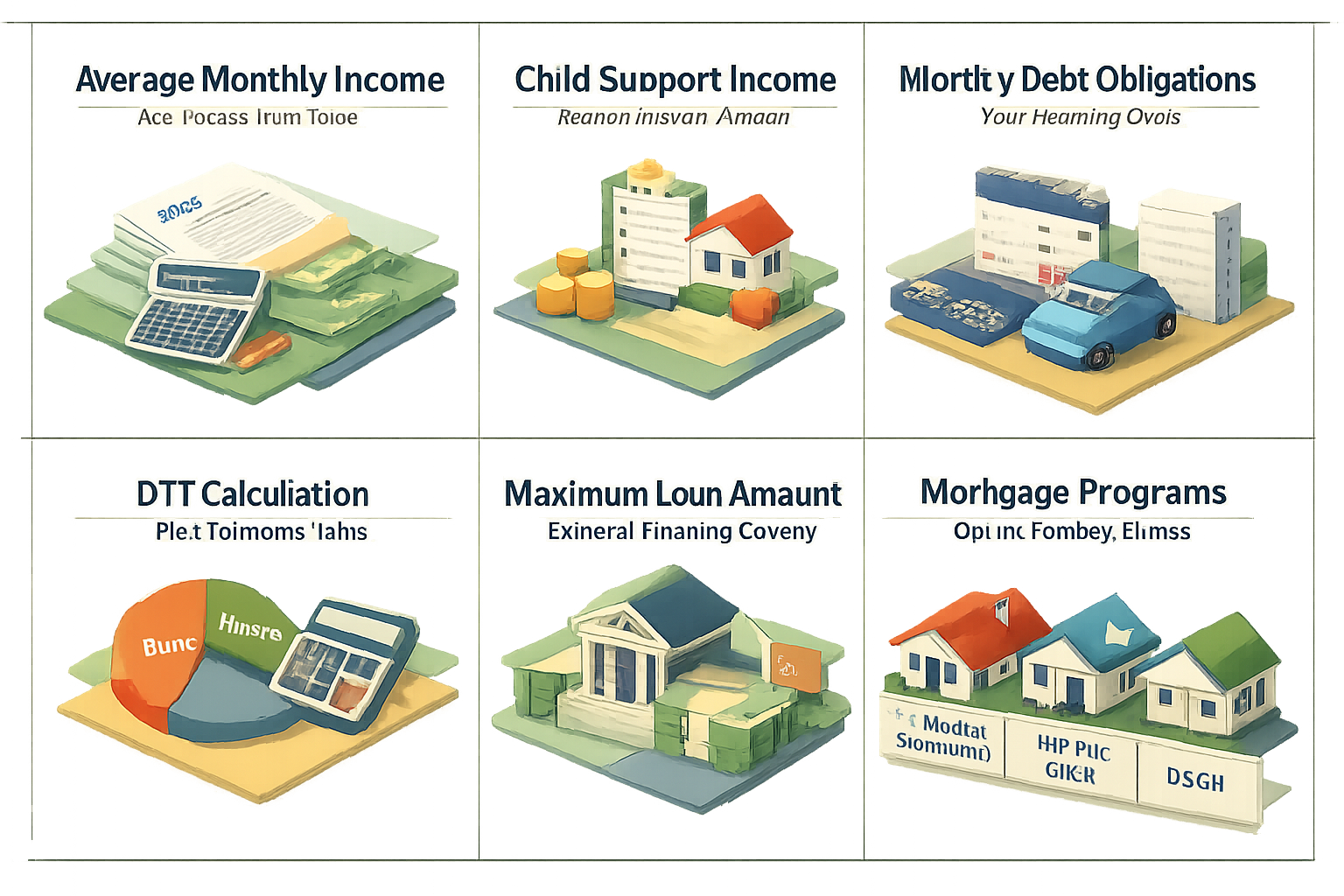
Now let's walk through the practical math. Understanding how to calculate mortgage affordability with 1099 income and child support involves a few clear steps that you can work through before ever speaking to a lender.
Step 1: Calculate Your Average Monthly Net Income from 1099 Earnings
Pull your last two years of federal tax returns. Look at your net self-employment income — typically found on Schedule C if you're a sole proprietor. Add the two years together and divide by 24 to get your average monthly qualifying income. For example, if you earned a net of $72,000 in year one and $84,000 in year two, your average monthly income would be $6,500.
Step 2: Add Verified Child Support Income
If you receive child support and it meets the lender's documentation requirements, add that monthly amount to your qualifying income. Using the example above, if you receive $1,200 per month in child support, your total qualifying monthly income would be $7,700.
Step 3: Calculate Your Monthly Debt Obligations
List all recurring monthly debts that appear on your credit report. These typically include car loans, student loans, credit card minimum payments, and any child support you're paying. Add these up to get your total monthly debt load.
Step 4: Apply the DTI Formula
Debt-to-income ratio (DTI) is one of the most critical numbers in mortgage qualification. Your front-end DTI measures your proposed housing payment against your gross qualifying income. Your back-end DTI includes all monthly debts plus the proposed housing payment. Most conventional lenders prefer a back-end DTI at or below 45%, though some programs may allow higher ratios with compensating factors like strong credit or significant reserves.
The formula is simple: Total Monthly Debts ÷ Total Qualifying Monthly Income = DTI Ratio. If your total debts (including proposed mortgage payment) equal $3,080 and your qualifying income is $7,700, your DTI is 40% — generally within acceptable range.
Step 5: Estimate Your Maximum Loan Amount
Once you know your maximum allowable monthly payment, you can work backward using an online mortgage calculator or speak with a loan officer. Factor in current interest rates, property taxes, homeowners insurance, and any HOA fees to get a realistic picture of what you can afford to comfortably finance.
Using a Self-Employed Mortgage Calculator to Sharpen Your DTI Picture
A self-employed mortgage calculator DTI tool can be extremely helpful when you're trying to map out your affordability before approaching a lender. These specialized calculators are designed to account for the nuances of 1099 income — including the fact that your qualifying income may differ significantly from your gross earnings.
When using a self-employed mortgage calculator, you'll typically input:
- Your average annual net income from Schedule C or business returns
- Any additional qualifying income, such as child support
- Total monthly debt obligations
- Desired loan amount or purchase price
- Estimated interest rate and loan term
The calculator then gives you an estimated DTI ratio and may flag whether you're within acceptable lending guidelines. Keep in mind that these tools provide estimates only — they won't account for every lender-specific guideline or compensating factor. But they're a great starting point to identify potential red flags before a formal application.
Many lenders and mortgage platforms, including LoanWise, offer these tools to help self-employed borrowers plan ahead. Taking the time to run your numbers through a self-employed mortgage calculator DTI tool could save you from surprises during the underwriting process.
Loan Programs That May Work Well for 1099 Earners
Not every mortgage program is equally friendly to self-employed borrowers. It's worth understanding your options so you can choose the path that fits your financial profile best.
Conventional Loans
Conventional loans backed by Fannie Mae or Freddie Mac are available to self-employed borrowers, but the documentation requirements can be rigorous. You'll typically need two years of tax returns, a year-to-date profit and loss statement, and solid credit. If your net income after deductions supports the loan amount you need, conventional financing can offer competitive rates.
FHA Loans
FHA loans may be a good option if your credit score is lower or your down payment is limited. The Federal Housing Administration allows self-employed borrowers to qualify using the same two-year income averaging approach. FHA loans also tend to be more flexible on DTI, which could help if your income situation is more complex.
Bank Statement Loans (Non-QM)
For self-employed borrowers whose tax deductions significantly reduce their qualifying income, bank statement loans — a type of non-qualified mortgage (Non-QM) — may offer an alternative path. These programs use 12 to 24 months of personal or business bank statements to estimate income, rather than tax returns. This can result in a higher qualifying income figure for those with substantial write-offs. However, non-QM loans may carry higher interest rates and stricter down payment requirements.
USDA and VA Loans
If you're purchasing in a rural area or you're a qualifying veteran, USDA and VA loans may also be accessible to 1099 earners using similar income documentation standards. Both programs can offer favorable terms, and VA loans in particular have no private mortgage insurance requirement, which can meaningfully lower your monthly payment.
Common Mistakes Self-Employed Homebuyers Make When Applying for a Mortgage
Even with solid income and reliable child support payments, self-employed borrowers can inadvertently create obstacles during the mortgage process. Being aware of these common missteps can help you avoid unnecessary delays or denials.
- Maximizing deductions right before applying: While reducing your tax bill is smart from a tax standpoint, aggressive deductions in the year before you apply for a mortgage can significantly lower your qualifying income. Consider speaking with both a CPA and a loan officer before filing your taxes in the year you plan to buy.
- Not documenting child support properly: Verbal agreements or informal payment arrangements won't satisfy lender requirements. Make sure you have a legal court order and a clear paper trail of received payments.
- Applying with inconsistent income history: If your income dropped sharply in one of the two qualifying years, lenders may use the lower figure — or decline to qualify you entirely. Building a more consistent income track record before applying can strengthen your file.
- Overlooking compensating factors: Strong credit, substantial savings, or a larger down payment can offset some DTI concerns. Don't overlook these assets when presenting your application.
- Skipping pre-qualification: Getting pre-qualified or pre-approved before house hunting gives you a realistic budget and signals to sellers that you're a serious buyer. It also helps you approach lenders with confidence.
●Conclusion
Knowing how to calculate mortgage affordability with 1099 income and child support puts you in a far stronger position as a homebuyer. While the process is more involved than it is for traditionally employed borrowers, it's entirely achievable with the right documentation, a clear understanding of your DTI, and a lender experienced in working with self-employed clients. Start by gathering your tax returns, verifying your child support documentation, and running your numbers through a self-employed mortgage calculator DTI tool to get a realistic picture of where you stand. When you're ready to take the next step, the team at LoanWise is here to help you explore loan options tailored to your unique income situation and guide you toward the home financing solution that works best for you.