
Buying a home is one of the most exciting financial milestones you can reach — but if you're carrying student loan debt and earning extra income through a side hustle, the path to homeownership can feel a little complicated. The good news is that lenders have developed ways to evaluate non-traditional income sources, and understanding how to calculate mortgage affordability with side hustle income and student loans can put you in a much stronger position before you ever apply. In this guide, we'll break down exactly how lenders view your full financial picture, how to crunch the numbers yourself, and what steps you might take to improve your approval odds.
Why Side Hustle Income and Student Loans Complicate the Mortgage Equation
Most mortgage lenders rely on a fairly straightforward formula to determine what you can borrow: your income versus your debts. But when part of your income comes from freelance work, gig platforms, or a small business on the side, and when your monthly obligations include student loan payments, that formula gets more nuanced.
Lenders typically want to see stable, consistent, and documentable income. A salaried job offers exactly that — a pay stub tells the whole story. Side hustle income, however, may fluctuate month to month, which makes lenders more cautious. They often require at least a two-year history of self-employment or freelance income before they'll count it toward your qualifying income. If your side hustle is newer than that, it may not be fully usable, even if it's substantial.
Student loans add another layer. Even if you're on an income-driven repayment plan with a low monthly payment, many lenders will use a different calculation to determine how your student loans affect your debt load. Understanding how these two factors interact is the foundation of learning how to calculate mortgage affordability with side hustle income and student loans.
Understanding Your Debt-to-Income Ratio and Why It Matters
The debt-to-income ratio (DTI) is the single most important metric lenders use to evaluate mortgage affordability. It compares your total monthly debt obligations to your gross monthly income. Lenders typically look at two versions of this ratio:
- Front-end DTI: Your proposed monthly housing costs (principal, interest, taxes, and insurance) divided by your gross monthly income.
- Back-end DTI: All of your monthly debt payments — including housing, student loans, credit cards, car payments, and any other obligations — divided by your gross monthly income.
For conventional loans, lenders often prefer a back-end DTI of 45% or lower, though some loan programs may allow higher ratios under certain circumstances. FHA loans can sometimes accommodate DTI ratios up to 50% or slightly above, depending on compensating factors like strong credit or significant cash reserves.
Using a debt-to-income ratio calculator for side hustles can help you estimate your position before speaking with a lender. The key is inputting your income accurately — which means understanding what income lenders will actually count.
How Lenders Evaluate Side Hustle Income for Mortgage Qualification
Not all income is treated equally when it comes to mortgage underwriting. If you're earning money through freelancing, rideshare driving, content creation, consulting, or any other self-directed venture, here's how lenders typically approach it:
- Two-year history requirement: Most conventional and government-backed loan programs want to see at least two years of consistent self-employment or side hustle income, typically documented through federal tax returns.
- Averaged income: Lenders will often average your net income from the past two years. If your side hustle earned $20,000 in year one and $30,000 in year two, the lender may use $25,000 annually, or approximately $2,083 per month.
- Net income, not gross: Because side hustle earners file Schedule C or similar tax documents, lenders usually look at your net income after business expenses — not your gross revenue. Significant write-offs may actually reduce the income lenders count toward your mortgage.
- Trend matters: If your side hustle income is declining from year one to year two, some lenders may use the lower figure or view it as a risk factor.
If your side hustle income is growing and well-documented, it could meaningfully increase your borrowing capacity. However, if it's inconsistent or newly started, it may be best treated as a financial buffer rather than qualifying income for now.
How Student Loans Are Factored Into Your Monthly Debt Obligations
Student loans are one of the most misunderstood elements of mortgage qualification. Many borrowers assume that their income-driven repayment (IDR) monthly payment is what lenders will use in their DTI calculation — but that's not always the case.
Here's how different loan programs may handle student loan debt:
- Conventional loans (Fannie Mae): Typically use the actual monthly payment shown on your credit report. If you're in an IDR plan with a $0 payment, Fannie Mae guidelines have historically required lenders to use 1% of the outstanding balance as a monthly payment figure, though guidelines can change.
- FHA loans: FHA guidelines have generally required lenders to use either the actual monthly payment or 0.5% to 1% of the total loan balance per month, depending on current guidance.
- VA loans: For veterans and active-duty service members, VA guidelines may allow more flexibility if student loans are in deferment, though lenders still vary in their approach.
- USDA loans: Rural development loans have their own student loan calculation methods, which can change periodically with updated agency guidance.
Because these rules can shift and vary by lender, it's important to consult directly with a mortgage professional about how your specific student loan balance and repayment plan will be treated during underwriting.
A Step-by-Step Guide to Estimating Your Home Buying Budget
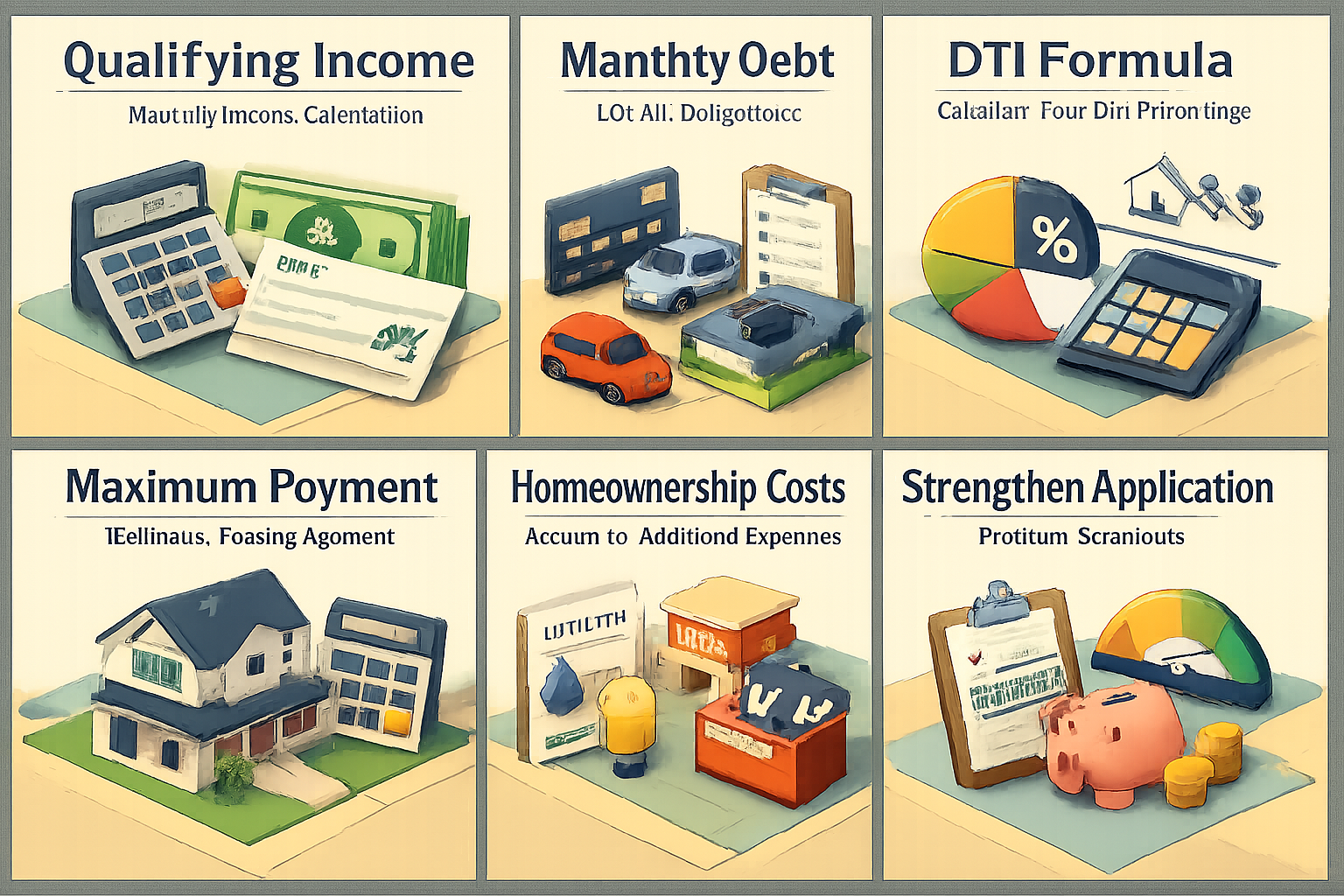
Ready to run your own numbers? Here's a straightforward process for estimating your mortgage affordability when you have side hustle income and student loans in the mix.
Step 1: Calculate Your Qualifying Monthly Income
Start with your primary job's gross monthly income. Then, if your side hustle has a two-year documented history, average your annual net income from both tax years and divide by 12. Add these two figures together to get your estimated qualifying monthly income.
Step 2: List All Monthly Debt Payments
Write down every recurring monthly debt obligation: student loan payment (using the lender's calculation method, not necessarily your actual IDR payment), credit card minimum payments, auto loans, personal loans, and any other installment debts. Do not include recurring expenses like utilities or subscriptions, as these are not typically factored into DTI.
Step 3: Apply the DTI Formula
Divide your total monthly debt payments by your qualifying monthly income. Multiply by 100 to get your back-end DTI percentage. For example, if you have $1,500 in monthly debts and $5,000 in qualifying income, your DTI is 30% — which is generally considered favorable.
Step 4: Estimate Your Maximum Monthly Housing Payment
Many lenders target a back-end DTI of 43% to 45% for conventional loans. Multiply your qualifying income by 0.43 or 0.45, then subtract your existing monthly debts. The remaining figure represents the approximate maximum monthly housing payment a lender might approve. From there, use a mortgage calculator to work backward to an estimated home purchase price.
Step 5: Account for Other Homeownership Costs
Remember that your monthly mortgage payment includes more than principal and interest. Property taxes, homeowner's insurance, and potentially private mortgage insurance (PMI) if your down payment is under 20% will all factor into the front-end DTI calculation. Make sure your estimate accounts for these additional costs.
Practical Strategies to Strengthen Your Mortgage Application
If the numbers feel tight right now, there are several approaches that might help improve your position before applying for a mortgage.
- Pay down high-interest debt first: Reducing your credit card balances can lower your DTI and improve your credit utilization ratio, which may positively impact your credit score — both of which matter to lenders.
- Avoid writing off everything on your taxes: If you're close to applying for a mortgage, consider speaking with a tax professional about the trade-off between maximizing deductions and preserving qualifying income. Fewer write-offs mean higher net income on your Schedule C, which could help your DTI.
- Document your side hustle income thoroughly: Keep organized records of income statements, contracts, invoices, and bank deposits. Lenders may request supplemental documentation beyond tax returns, especially for self-employed borrowers.
- Consider refinancing student loans: In some cases, refinancing federal student loans into a private loan with a lower monthly payment could reduce your DTI — but weigh this carefully, as you may lose federal protections like income-driven repayment or loan forgiveness eligibility.
- Save a larger down payment: A larger down payment reduces the loan amount you need and may lower your monthly payment enough to bring your DTI into a more comfortable range.
- Explore non-QM or bank statement loans: For borrowers with strong side hustle income that doesn't appear favorably on tax returns, non-qualified mortgage (non-QM) programs may offer alternative documentation options, such as 12 to 24 months of bank statements to verify income.
Choosing the Right Loan Program When You Have a Complex Income Profile
Not every mortgage product is equally well-suited for borrowers with side hustle income and student loan obligations. Here's a brief overview of how different programs might fit your situation:
- Conventional loans: Offer competitive rates and flexibility for borrowers with strong credit and documented income. Fannie Mae and Freddie Mac both have guidelines that can accommodate self-employment income with proper documentation.
- FHA loans: May be a good fit for first-time homebuyers with moderate credit scores and higher DTI ratios. The lower down payment requirement (as low as 3.5%) could be helpful if you're still building savings while managing student debt.
- VA loans: If you qualify based on military service, VA loans offer significant advantages including no down payment requirement and no PMI, which can make affordability calculations much more favorable.
- Non-QM loans: Designed for borrowers who don't fit traditional underwriting boxes. Bank statement programs, asset-depletion loans, and 1099-only programs may be options worth exploring if your side hustle income is your primary earnings source or isn't yet two years old.
Working with a knowledgeable mortgage advisor who understands how to calculate mortgage affordability with side hustle income and student loans can help you identify the right program and avoid wasted time applying for products that don't match your profile.
●Conclusion
Navigating homeownership with a side hustle and student loans isn't always simple, but it's absolutely achievable with the right preparation. By understanding how lenders calculate your qualifying income, how your student debt affects your DTI, and which loan programs offer the most flexibility, you can enter the mortgage process with confidence. Take the time to document your income carefully, run your numbers before you apply, and connect with a mortgage professional who can tailor a strategy to your unique financial picture. Your path to homeownership may look a little different from the traditional route — but with the right knowledge and guidance, it can be just as rewarding.