
Buying a home when you earn 1099 income can feel more complicated than it needs to be. Whether you're a freelancer, independent contractor, gig worker, or self-employed professional, lenders don't always make it easy to prove what you actually earn. The good news is that qualifying for a mortgage with non-traditional income is entirely possible — it just requires a bit more preparation and a clear understanding of how the process works. This guide walks you through how to calculate mortgage affordability with 1099 income, what lenders look for, and how tools like a self-employed mortgage calculator can help you plan ahead with confidence.
Why 1099 Income Is Treated Differently by Mortgage Lenders
Traditional W-2 employees have a straightforward path to mortgage approval. Their income is consistent, documented, and easy to verify. For 1099 earners, the picture is more layered. Lenders typically view self-employed borrowers as carrying a slightly higher risk profile — not because the income isn't real, but because it can fluctuate from month to month or year to year.
When you file taxes as a self-employed individual, you're likely deducting legitimate business expenses to reduce your taxable income. That's smart tax planning, but it can work against you during the mortgage process. Lenders generally qualify borrowers based on net income after deductions, not gross revenue. This means your reported income on paper may look significantly lower than what you actually bring in.
For example, if you earned $120,000 in gross 1099 income but deducted $40,000 in business expenses, lenders may only consider $80,000 as your qualifying income. That difference can meaningfully affect the loan amount you're eligible for. Understanding this distinction is the first step in learning how to calculate mortgage affordability with 1099 income accurately.
How Lenders Calculate Qualifying Income for Self-Employed Borrowers
Most conventional lenders follow a standardized process when evaluating 1099 income. Here's what that typically looks like in practice:
- Two-year income average: Lenders usually require at least two years of self-employment history and will average your net income across both tax returns. If your income has increased significantly, some lenders may use only the most recent year's figure, but this varies.
- Tax return analysis: Lenders will review your Schedule C (for sole proprietors), Schedule K-1 (for partnerships or S-corps), or other relevant tax forms to determine your adjusted gross income.
- Add-backs: Certain non-cash deductions — such as depreciation — may be added back to your net income, which can increase your qualifying amount.
- Profit and loss statements: Some lenders may request a year-to-date profit and loss statement, especially if your most recent tax return doesn't fully reflect your current earnings.
It's also worth knowing that some non-QM (non-qualified mortgage) lenders offer alternative income documentation options, such as bank statement loans. These programs may use 12 to 24 months of personal or business bank statements to calculate your average monthly deposits instead of relying solely on tax returns. This can be a helpful path for borrowers whose tax returns significantly understate their actual cash flow.
Using a Self-Employed Mortgage Calculator to Estimate Your Budget
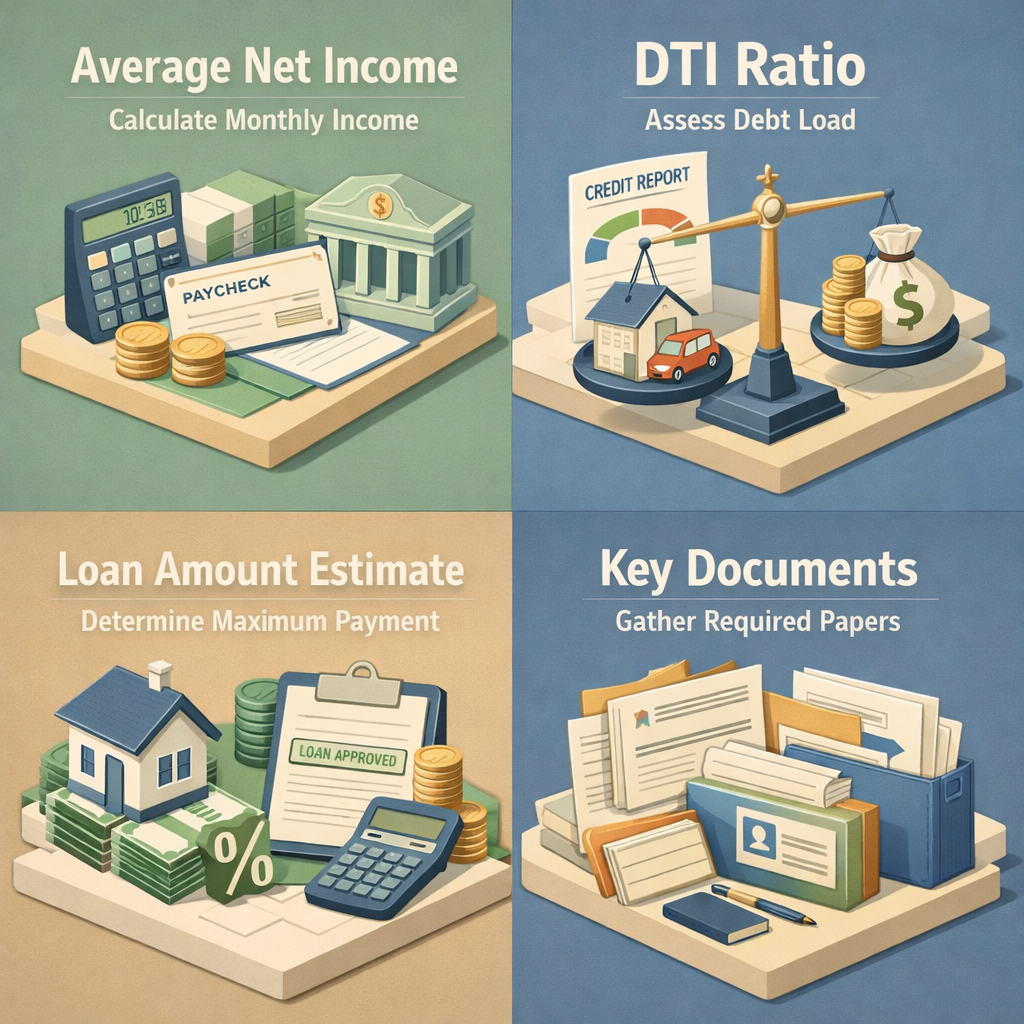
One of the most practical tools available to 1099 earners is a self-employed mortgage calculator. Unlike a standard mortgage calculator that simply asks for your income, a self-employed version is designed to account for the nuances of variable and documented net income. These calculators typically prompt you to enter your net business income, average your earnings over two years, and factor in your monthly debt obligations to estimate a realistic loan amount.
Here's a general framework you can use even before reaching a lender:
- Step 1 — Determine your average net income: Add your net income from the past two years of tax returns and divide by 24 to find your average monthly qualifying income.
- Step 2 — Apply the debt-to-income (DTI) ratio: Most conventional lenders prefer a total DTI of 43% or lower. Multiply your average monthly income by 0.43, then subtract your existing monthly debt payments (car loans, student loans, credit cards). The remaining figure represents the maximum monthly mortgage payment you may qualify for.
- Step 3 — Estimate your loan amount: Use your maximum monthly payment to back-calculate a loan amount based on current interest rates and a standard 30-year or 15-year term.
- Step 4 — Account for taxes, insurance, and HOA: Remember that your monthly payment includes more than principal and interest. Property taxes, homeowner's insurance, and any HOA fees all count toward your DTI.
While these steps offer a solid starting point, a self-employed mortgage calculator can automate this process and give you a more precise range to work with as you begin your homebuying journey.
Key Documents You'll Need to Support Your 1099 Mortgage Application
Preparation is everything when applying for a home loan with 1099 income. Lenders will want to see a clear and consistent paper trail that confirms your income is stable and ongoing. Here's what you'll likely need to gather:
- Two years of federal tax returns (personal and business, if applicable)
- All relevant tax schedules, including Schedule C, Schedule E, or K-1 forms
- 1099 forms from all clients or income sources
- Bank statements — typically two to three months of personal and business accounts
- A current profit and loss statement prepared by a CPA or licensed accountant
- Business license or proof of self-employment to establish legitimacy and longevity
- Letters from clients or contracts demonstrating ongoing income relationships (sometimes requested)
Having these documents organized before you apply can streamline your loan process significantly. Gaps or inconsistencies in your documentation may raise questions and slow down your approval timeline, so it's worth spending time upfront to make sure everything is in order.
Debt-to-Income Ratio and Credit Score Considerations for 1099 Borrowers
Your debt-to-income ratio and credit score are two of the most important factors in any mortgage application — and they matter just as much, if not more, for self-employed borrowers. Because lenders already view 1099 income as less predictable than salaried income, a strong credit profile can help offset any concerns about income variability.
Most conventional loans require a minimum credit score of around 620, though borrowers with scores of 740 or higher typically access the most competitive interest rates. For non-QM or bank statement loan programs, minimum score requirements may vary by lender. It's generally a good idea to review your credit report before applying, address any errors, and pay down revolving balances where possible to improve your score.
On the DTI side, managing your existing debt load before applying can meaningfully improve the loan amount you qualify for. If you're carrying a high car payment or significant credit card balances, even partially paying these down before your mortgage application could shift your DTI into a more favorable range and expand your purchasing power.
Loan Programs That May Work Well for Self-Employed Homebuyers
Not all mortgage programs treat 1099 income the same way. Knowing which options may suit your situation can save you time and increase your chances of approval.
- Conventional loans: These are available to self-employed borrowers but typically require strong documentation, a two-year employment history, and a DTI under 43% to 50% depending on the lender and loan specifics.
- FHA loans: Backed by the Federal Housing Administration, FHA loans may offer more flexible credit requirements. They're available to self-employed borrowers who can document at least two years of self-employment income through tax returns.
- Bank statement loans (Non-QM): These programs are specifically designed for self-employed borrowers. Instead of tax returns, lenders use 12 to 24 months of bank deposits to calculate qualifying income. They may come with slightly higher interest rates but offer a meaningful alternative for borrowers whose taxable income doesn't tell the full story.
- Asset depletion loans: If you have significant liquid assets, some lenders may allow those assets to be converted into a hypothetical monthly income stream for qualification purposes — a potentially useful strategy for high-net-worth self-employed individuals.
Talking with a knowledgeable mortgage professional who has experience with non-traditional income borrowers can help you identify which program aligns best with your financial profile and homeownership goals.
Practical Strategies to Strengthen Your Mortgage Application as a 1099 Earner
There are several steps 1099 earners can take — ideally months or even a year before applying — to improve their position when it comes time to seek mortgage approval.
- Consider your deduction strategy: If you plan to buy a home in the near future, speak with your tax advisor about balancing tax savings with income documentation. Claiming fewer deductions for one or two years may result in a higher taxable income, which could improve your qualifying amount.
- Build up cash reserves: Lenders often look more favorably on self-employed borrowers who have several months of mortgage payments in reserve. This signals financial stability even if monthly income fluctuates.
- Maintain consistent income: A steady or growing income trend across two years is a positive signal. Significant drops in income year over year can raise lender concerns.
- Work with a CPA experienced in mortgage applications: Some accountants understand how to structure your financials in a way that accurately reflects your earning capacity without sacrificing legitimate deductions unnecessarily.
- Get pre-qualified early: Use a self-employed mortgage calculator and connect with a lender who specializes in 1099 income early in the process. Early pre-qualification helps you understand your budget and identify any documentation gaps before they become problems.
Learning how to calculate mortgage affordability with 1099 income isn't just about running numbers — it's about building a complete financial picture that lenders can trust. With the right preparation, the right loan program, and the right lending partner, homeownership is well within reach for self-employed borrowers.
●Conclusion
Navigating the mortgage process with 1099 income requires a bit more effort, but it's far from impossible. By understanding how lenders evaluate self-employed earnings, using a self-employed mortgage calculator to set realistic expectations, and organizing your documentation in advance, you can approach the homebuying process with clarity and confidence. The key is starting early, working with experienced professionals, and choosing a loan program that fits your actual financial situation — not just your tax return. If you're ready to explore your options, LoanWise is here to help you find the right path forward.