Buying your first home is one of the most exciting financial milestones you can reach. But before you start browsing listings or scheduling open houses, there's one critical question you need to answer: how much home can you actually afford? Understanding how to calculate mortgage affordability for first time buyers is the essential first step toward making a confident, informed purchase. Without a clear picture of your financial boundaries, it's easy to fall in love with a home that stretches your budget too thin — or to underestimate how much you could qualify for. This guide walks you through the key formulas, ratios, and considerations that lenders use to determine your borrowing power, so you can step into the homebuying process fully prepared.
Why Mortgage Affordability Matters Before You Start House Hunting
Many first-time buyers make the mistake of shopping for homes before they've assessed their financial readiness. This often leads to disappointment when a lender approves a loan amount well below what they expected — or worse, denial of the application altogether. Knowing your affordability range upfront saves time, reduces stress, and puts you in a much stronger negotiating position.
Mortgage affordability isn't just about what you earn. It's a combination of your income, existing debts, credit profile, available down payment, and the current interest rate environment. Lenders weigh all of these factors together to determine how much risk they're taking on when they lend to you. The good news is that once you understand how each factor works, you can take deliberate steps to improve your position before applying.
Using a first time home buyer affordability calculator is a great starting point. These tools give you a quick estimate based on your gross income, monthly debts, and expected interest rate. However, they're most useful when you understand the underlying math — which is exactly what we'll cover in this article.
The Income Formula: How Much Do You Need to Qualify?
One of the most common questions first-time buyers ask is: what income needed for first home? The honest answer is that it depends on the home price, your debts, and the loan program you're using. But there's a reliable framework lenders use to get started.
A widely used guideline suggests that your total monthly housing payment — including principal, interest, property taxes, homeowner's insurance, and any HOA fees — should not exceed 28% of your gross monthly income. This is sometimes called the "front-end ratio" or housing expense ratio.
Here's a simplified example of how the math might work:
- Gross monthly income: $6,000
- 28% of income: $1,680 (maximum suggested monthly housing cost)
- Estimated loan amount at this payment: Varies based on interest rate and term
Keep in mind that this is a general guideline, not a hard rule. Some loan programs, particularly FHA loans, may allow higher housing expense ratios under certain conditions. Your lender will calculate this based on your specific financial profile. It's also worth noting that gross income — your earnings before taxes — is what lenders use, not your take-home pay. Salaried employees, self-employed borrowers, and those with variable income may have their qualifying income calculated differently.
Understanding DTI for New Homeowners: The Number Lenders Watch Most Closely
If there's one metric that carries the most weight in the mortgage approval process, it's your debt-to-income ratio, commonly known as DTI. For new homeowners especially, understanding DTI is critical to figuring out how much they can borrow.
Your DTI compares your total monthly debt obligations to your gross monthly income. Lenders typically look at two versions of this ratio:
- Front-end DTI: Only your proposed housing payment divided by gross monthly income.
- Back-end DTI: All monthly debt payments — including the housing payment, car loans, student loans, credit cards, and other obligations — divided by gross monthly income.
Most conventional loan programs prefer a back-end DTI of 43% or lower, though some programs may accept higher ratios with compensating factors like strong credit or a larger down payment. FHA loans may allow back-end DTIs up to around 50% in some cases, depending on the lender and borrower profile.
Here's a simple DTI calculation example:
- Gross monthly income: $6,000
- Monthly debts (car + student loan + credit cards): $600
- Proposed housing payment: $1,500
- Total monthly obligations: $2,100
- Back-end DTI: $2,100 ÷ $6,000 = 35%
In this scenario, the borrower's DTI falls well within most lenders' acceptable range. If your DTI is higher, paying down existing debts before applying for a mortgage could meaningfully improve your qualifying position.
How to Calculate Mortgage Affordability for First Time Buyers Step by Step
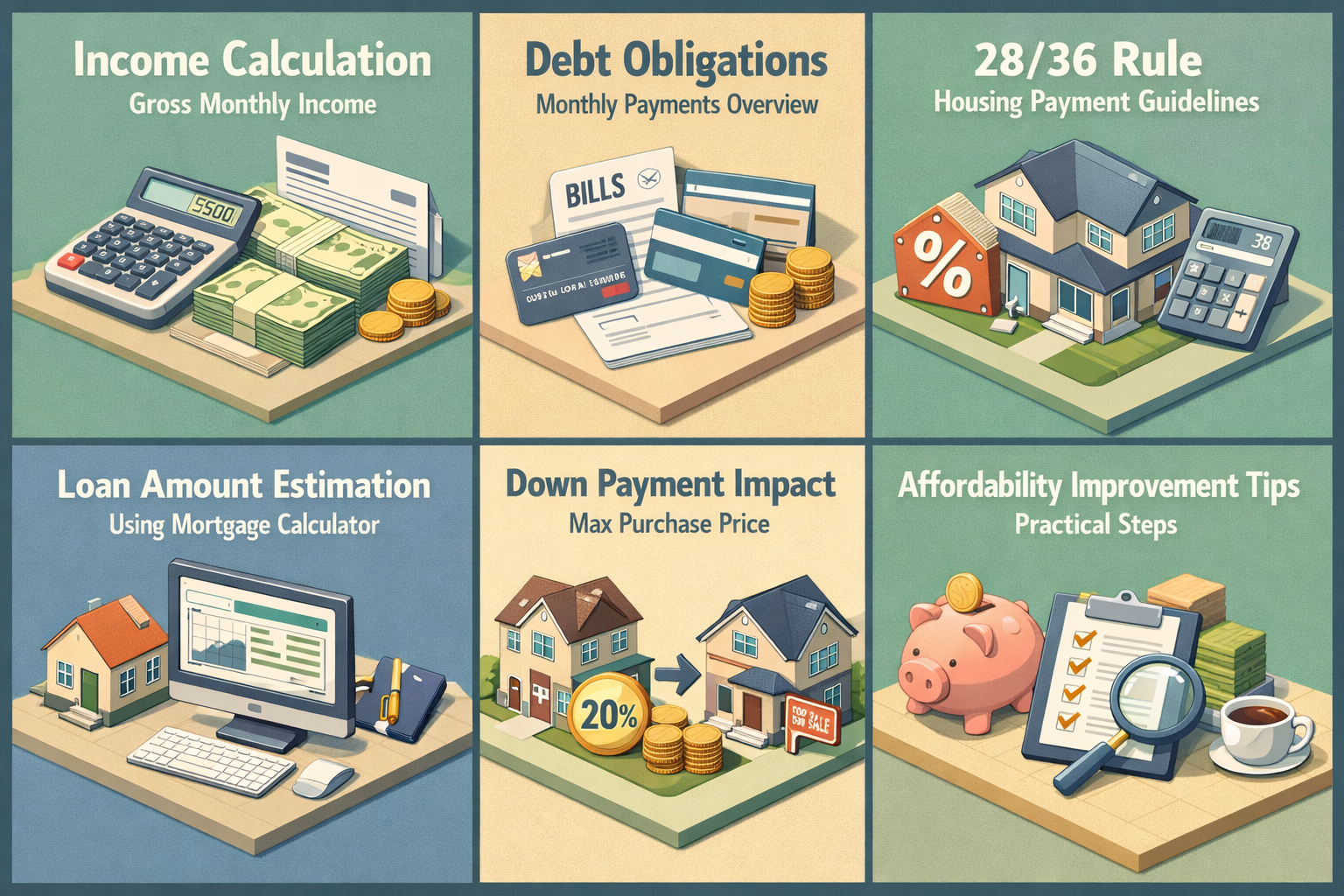
Now that you understand the key ratios involved, let's walk through a practical step-by-step process for how to calculate mortgage affordability for first time buyers. Following these steps gives you a realistic target range before you ever speak with a lender.
Step 1: Determine Your Gross Monthly Income
Add up all reliable monthly income sources before taxes. For salaried employees, this is straightforward. If you're self-employed or earn commissions, lenders typically average your income over the past two years using tax returns.
Step 2: List All Monthly Debt Obligations
Include minimum payments on credit cards, auto loans, student loans, personal loans, and any other recurring debt. Do not include utilities, subscriptions, or groceries — lenders only count installment and revolving debts that appear on your credit report.
Step 3: Apply the 28/36 or 28/43 Rule
Calculate 28% of your gross monthly income for your maximum housing payment. Then calculate 36% or 43% of your gross monthly income to find your maximum total debt threshold. Subtract your existing debts from that total to see how much room remains for a housing payment.
Step 4: Estimate the Loan Amount
Using an online mortgage calculator or working with a loan officer, input your maximum monthly payment along with current interest rate estimates to determine the loan amount that payment supports. Remember to account for taxes, insurance, and PMI if your down payment is less than 20%.
Step 5: Factor In Your Down Payment
Add your available down payment to the estimated loan amount. The result is your approximate maximum purchase price. Keep in mind that a larger down payment not only increases your buying power but may also help you avoid private mortgage insurance, which adds to your monthly cost.
Credit Scores, Down Payments, and Their Role in Qualifying for a Mortgage
When it comes to qualifying for a mortgage as a first-time buyer, two factors beyond income and DTI can significantly influence your outcome: your credit score and the size of your down payment.
Your credit score affects both your eligibility and the interest rate you'll receive. A higher score generally unlocks better rates, which directly impacts your monthly payment and overall affordability. Conventional loans typically require a minimum score around 620, while FHA loans may accept scores as low as 580 with a 3.5% down payment. Some programs may even accommodate scores below 580 with a higher down payment, though options become more limited.
Even a modest difference in interest rate — say, half a percentage point — can change your monthly payment by a meaningful amount on a large loan. This means improving your credit score before qualifying for a mortgage could translate into real savings over the life of your mortgage.
Your down payment matters in several ways:
- Loan amount: A larger down payment means you're borrowing less, which lowers your monthly payment and improves your DTI.
- PMI: Putting less than 20% down on a conventional loan typically triggers private mortgage insurance, adding to your monthly costs.
- Loan program eligibility: Some programs designed for first-time buyers allow down payments as low as 3%, which can make homeownership accessible sooner — though it does increase your overall loan balance.
Many first-time buyers are also unaware of down payment assistance programs offered through state housing agencies, local governments, and nonprofit organizations. These programs may provide grants or low-interest secondary loans to help bridge the gap if saving a full down payment feels out of reach.
Using a First Time Home Buyer Affordability Calculator Effectively
A first time home buyer affordability calculator is one of the most accessible tools available to new buyers. Most lender websites and financial platforms offer free versions that allow you to input your income, debts, down payment, and estimated interest rate to generate a target price range.
To get the most accurate results from these tools, keep the following in mind:
- Use realistic income figures: Enter your gross monthly income, not your net take-home pay. Using the wrong number will skew your results significantly.
- Include all debts: Don't leave out any monthly obligations that appear on your credit report. Even small minimum payments affect your DTI.
- Use current rate estimates: Mortgage rates change frequently. Check current market rates or speak with a loan officer to use a realistic figure.
- Account for additional costs: Property taxes, homeowner's insurance, and HOA fees are real monthly costs that reduce how much you can spend on principal and interest.
- Run multiple scenarios: Try different down payment amounts or loan terms to see how they affect your affordability range.
Online calculators are helpful for ballpark estimates, but they can't account for every nuance of your financial profile. A conversation with a licensed mortgage professional will give you a much more precise picture and may surface loan programs or strategies you hadn't considered.
Practical Tips to Strengthen Your Affordability Before Applying
If your initial affordability calculation doesn't land where you'd hoped, don't be discouraged. There are several practical steps you can take to improve your position over time.
Pay Down High-Balance Debts First
Reducing your monthly debt obligations directly improves your back-end DTI. Focus on eliminating or significantly reducing high-balance installment loans or credit cards with large minimum payments. Even eliminating one monthly payment can shift your qualifying range considerably.
Avoid New Credit Applications
Opening new credit accounts before applying for a mortgage can temporarily lower your credit score and increase your apparent debt obligations. Try to avoid new credit inquiries for at least three to six months before you plan to apply.
Build Your Savings Steadily
A larger down payment not only reduces your loan amount but also signals financial discipline to lenders. Set up an automatic savings plan dedicated to your home purchase. Even modest monthly contributions add up meaningfully over a year or two.
Consider a Co-Borrower
If your income alone doesn't support the home price you're targeting, adding a co-borrower — such as a spouse or partner — can significantly improve your qualifying income and DTI. Both borrowers' credit profiles will be evaluated, so it's important that both are in good standing.
Explore First-Time Buyer Programs
Many loan programs specifically designed for first-time buyers offer more flexible qualifying criteria, reduced down payment requirements, or below-market interest rates. FHA, USDA, and certain state-sponsored programs are worth exploring with a knowledgeable loan officer who can match you with the right option.
●Conclusion
Understanding how to calculate mortgage affordability for first time buyers is the foundation of a successful homebuying journey. When you know your income limits, DTI thresholds, credit requirements, and down payment options, you can approach the process with clarity and confidence rather than anxiety and guesswork. The numbers don't have to feel overwhelming — they're simply a roadmap that tells you where you stand and what steps might help you get where you want to be.
At LoanWise, we believe every first-time buyer deserves straightforward guidance and access to the right loan options for their situation. Whether you're just starting to explore your affordability range or you're ready to take the next step, speaking with one of our experienced mortgage professionals could be the most valuable move you make. Connect with LoanWise today and let's build a clear path to your first home together.