
If you're earning overtime pay at work, you might be wondering whether that extra income can help you qualify for a larger FHA loan. The good news is that it often can — but lenders don't simply take your most recent paycheck at face value. Understanding how to calculate FHA loan affordability with overtime pay is essential before you start shopping for a home. FHA loans are a popular choice for first-time homebuyers and those with moderate credit profiles, thanks to their lower down payment requirements and flexible qualification guidelines. However, variable income like overtime requires a specific verification process that can affect how much house you're actually approved to buy. This guide walks you through everything you need to know, from how lenders view overtime income to how it factors into your debt-to-income ratio.
Why Overtime Income Is Treated Differently by FHA Lenders
Overtime pay is considered variable income because it isn't guaranteed month to month. Your employer isn't contractually obligated to offer it, and it can fluctuate based on business needs, seasonal demand, or staffing changes. This is why FHA lenders — and the guidelines set by the Federal Housing Administration — treat overtime differently from your regular base salary.
When lenders evaluate a standard salaried income, they can reasonably project it forward with confidence. Overtime, however, requires a history of consistency before it can be included in your qualifying income. FHA guidelines generally require that overtime income be received for at least two years before a lender will consider it. If you've only been earning overtime for a few months, most lenders may not be able to count it at all.
There's also the question of continuity. Lenders will typically want to see that overtime income is likely to continue. If your employer has recently cut back on overtime opportunities or if your industry tends to have seasonal fluctuations, the lender may apply additional scrutiny. This doesn't mean you can't qualify — it just means the documentation process becomes especially important.
How Lenders Verify and Average Your Overtime Earnings
The process of verifying overtime income for an FHA mortgage typically involves reviewing your recent pay stubs, W-2 forms from the past two years, and sometimes a written Verification of Employment (VOE) from your employer. Lenders want to see a consistent pattern — not just one strong year followed by a weaker one.
Once the documentation is in hand, the lender will usually calculate a two-year average of your overtime earnings. Here's a simplified example of how that might work:
- Year 1 overtime income: $8,000
- Year 2 overtime income: $10,000
- Two-year total: $18,000
- Average annual overtime: $9,000
- Average monthly overtime added to qualifying income: $750
This monthly figure would then be added to your base monthly salary to determine your total qualifying income. It's worth noting that if your overtime earnings have been declining over the two-year period, some lenders may use the lower figure or decline to include it altogether. Stability and an upward or flat trend tend to work in your favor.
Additionally, if you've been with your current employer for less than two years but can document consistent overtime at a previous job in the same field, some lenders may consider a combined history. Always ask your loan officer about this possibility, as guidelines can vary between lenders.
How to Calculate FHA Loan Affordability With Overtime Pay Step by Step
Knowing how to calculate FHA loan affordability with overtime pay starts with building an accurate picture of your total monthly income. Let's walk through a practical example.
Suppose your base salary is $55,000 per year, or approximately $4,583 per month. Over the past two years, you've earned an average of $9,000 in overtime annually, which adds $750 per month to your qualifying income. Your total qualifying monthly income would be $5,333.
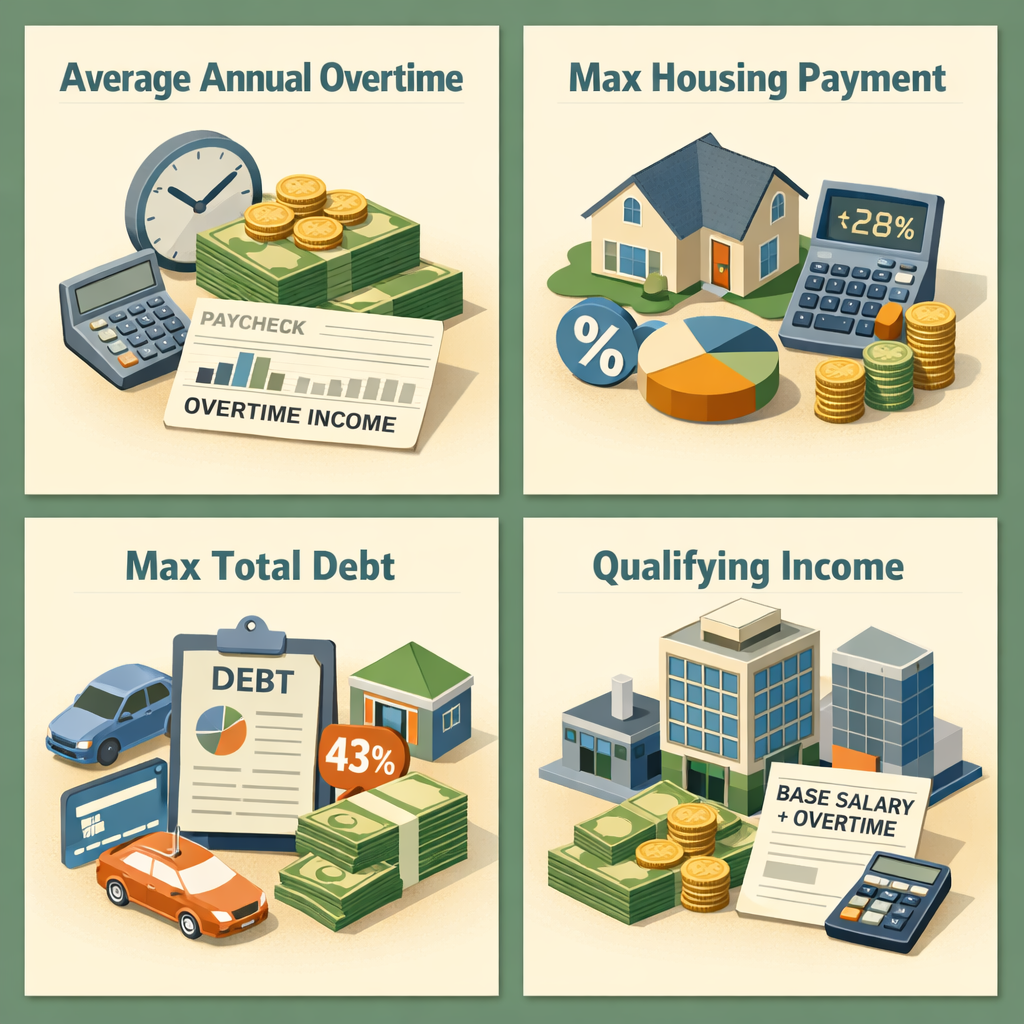
From there, you'd apply FHA's standard debt-to-income (DTI) ratio guidelines. FHA typically allows a front-end ratio (housing expenses divided by gross income) of up to 31% and a back-end ratio (all monthly debts divided by gross income) of up to 43%, though some lenders may approve higher ratios with compensating factors like strong credit or significant cash reserves.
- Max housing payment (31%): $5,333 x 0.31 = approximately $1,653 per month
- Max total debt (43%): $5,333 x 0.43 = approximately $2,293 per month
Using an FHA mortgage calculator with overtime income built into these numbers, you can estimate how much home you might afford. Keep in mind that your housing payment includes principal, interest, property taxes, homeowner's insurance, and the FHA mortgage insurance premium (MIP). These additional costs can meaningfully reduce the loan amount you qualify for, so it's important to factor all of them in when running your numbers.
Understanding DTI Calculation for FHA Loans When Income Varies
The DTI calculation for FHA overtime follows the same basic formula as any other mortgage, but the key variable is the income figure you're working with. Because overtime is averaged rather than taken at face value, your qualifying income may be lower than what your most recent paychecks suggest — which is something many borrowers don't anticipate.
Your back-end DTI includes all recurring monthly debt obligations. This typically covers your projected mortgage payment, car loans, student loans, credit card minimum payments, and any other installment or revolving debts. It does not include everyday living expenses like groceries, utilities, or subscriptions.
Here's why this matters: if you're carrying significant debt alongside variable income, your DTI could end up higher than expected. For instance, if you have $600 per month in car and student loan payments and your qualifying income is $5,333, your mortgage payment would need to stay under approximately $1,693 just to meet the 43% back-end cap — leaving limited room for a large loan balance.
One helpful strategy is to pay down revolving debt before applying. Even reducing a credit card balance to lower the minimum payment could meaningfully shift your DTI ratio. Borrowers who are qualifying for FHA loans with variable pay often benefit from cleaning up their debt picture first to maximize the income advantage that overtime can provide.
What Documentation You'll Need to Support Your Overtime Income
Lenders take a careful look at documentation when overtime income is part of the equation. Being prepared with the right paperwork can speed up your approval and reduce back-and-forth with your loan officer. Here's what you'll likely need:
- Two years of W-2 forms: These provide a clear annual record of your total earnings, including overtime.
- Recent pay stubs (typically the last 30 days): These show your current year-to-date earnings and confirm overtime is still ongoing.
- Verbal or written Verification of Employment (VOE): Your lender may contact your employer directly to confirm your employment status and the likelihood that overtime will continue.
- Tax returns (in some cases): If your income situation is complex — especially if you have deductions that affect your net income — lenders may request your federal tax returns as well.
It's a good idea to gather these documents early in the process. If there are gaps in your overtime history or if your earnings dipped in one of the two years, having a clear explanation ready can help your loan officer present your file more effectively to the underwriter.
How Lenders View Overtime Income for FHA Qualification — And What Can Help Your Case
Understanding the lenders' view on overtime for FHA applications can help you position yourself more strategically. Generally speaking, lenders appreciate overtime income that is consistent, well-documented, and tied to a stable employment situation. A nurse who regularly works extra shifts, a manufacturing employee with a clear history of overtime pay, or a first responder with documented shift differentials are all examples of borrowers who may be well-positioned to use this income.
On the other hand, if overtime is sporadic, tied to a single project, or dependent on circumstances that may not continue, lenders may be reluctant to include it — or may only use a portion of it. This isn't a hard rule, but it reflects the general caution lenders apply to unpredictable income streams.
Several compensating factors can strengthen your overall application when overtime is part of your income picture:
- Strong credit score: A higher credit score (generally 680 or above) signals lower risk and may give your lender more flexibility.
- Low existing debt: A clean debt profile makes your DTI more favorable even with averaged income.
- Larger down payment: Contributing more upfront reduces your loan amount and improves your FHA loan affordability ratios.
- Cash reserves: Having several months of mortgage payments in savings can demonstrate financial stability to underwriters.
Working with a loan officer who has experience structuring files with variable income can also make a meaningful difference. They'll know how to present your overtime history in the most accurate and favorable light within FHA guidelines.
Using an FHA Mortgage Calculator to Estimate Affordability With Overtime
An FHA mortgage calculator with overtime income can be a powerful planning tool — but only if you input the right numbers. Rather than entering your gross salary plus all current overtime earnings, remember to use your averaged monthly overtime figure as lenders would calculate it.
When using any affordability calculator, make sure to account for:
- FHA MIP (Mortgage Insurance Premium): FHA loans require both an upfront MIP (typically 1.75% of the loan amount) and an annual MIP paid monthly. This adds to your housing cost and affects how much loan you can qualify for.
- Property taxes and homeowner's insurance: These are included in your monthly PITI payment and directly affect your front-end DTI ratio.
- Interest rate estimates: Even a small change in rate can shift your monthly payment by a notable amount, so use current market rate estimates for accuracy.
After plugging in your total qualifying income — base pay plus averaged overtime — and your current debts, a well-built calculator will give you a reasonable loan amount range to work with. Keep in mind that an online estimate is a starting point, not a guarantee. Only a full loan application and underwriting review will produce an official approval with verified numbers.
If you're unsure how to set up the calculation, a licensed loan officer at LoanWise can walk you through the process and help you understand exactly how your overtime pay factors into your purchasing power under current FHA guidelines.
●Conclusion
Overtime pay can be a genuine asset when you're trying to qualify for an FHA loan — but it needs to be handled correctly. Lenders will look for a two-year history of consistent earnings, average your income to determine a qualifying figure, and apply standard DTI guidelines to assess how much you can borrow. By understanding how to calculate FHA loan affordability with overtime pay, you can walk into the process with realistic expectations and a clear strategy. Whether you're a first-time homebuyer or someone looking to move into a larger home, taking time to organize your documentation and reduce existing debt puts you in a much stronger position. Ready to see what your overtime income could mean for your home purchase? Connect with a LoanWise mortgage specialist today and get a personalized affordability estimate built around your full income picture.