
If you've recently received an inheritance or you're working a part-time job while applying for a mortgage, you might be wondering how lenders will view your financial picture. Knowing how to calculate DTI with recent inheritance and part-time job income is more important than many homebuyers realize. Your debt-to-income ratio — commonly called DTI — is one of the most critical factors a lender evaluates when deciding whether to approve your loan and at what terms. But not all money is treated equally in the eyes of underwriters. Inherited funds and part-time earnings each come with their own rules, and understanding those rules could make the difference between getting approved or being turned away. This guide walks you through exactly what you need to know.
What Is DTI and Why Does It Matter for Mortgage Approval
Your debt-to-income ratio is a simple but powerful number. It compares your total monthly debt obligations to your gross monthly income — that is, your income before taxes and deductions. Lenders use this ratio to gauge how much financial strain you're carrying and whether you can comfortably take on a new mortgage payment.
The formula looks like this:
- DTI = Total Monthly Debt Payments ÷ Gross Monthly Income × 100
For example, if your monthly debts total $2,000 and your gross monthly income is $6,000, your DTI would be approximately 33%. Most conventional loan programs prefer a DTI at or below 43%, though some lenders may allow higher ratios depending on other compensating factors like strong credit or significant reserves.
There are actually two versions of DTI that lenders often look at. The front-end ratio covers only housing costs — your proposed mortgage payment, property taxes, homeowners insurance, and any HOA fees. The back-end ratio includes all monthly debt obligations, such as student loans, auto loans, credit card minimums, and the new housing payment. Most lenders focus primarily on the back-end ratio when making approval decisions.
Understanding DTI is especially important when your income picture is non-traditional. Part-time work and inherited funds don't always fit neatly into standard income categories, which is why many borrowers find themselves confused during the application process.
How Part-Time Job Income Is Treated in DTI Calculations
Part-time income can absolutely be used to qualify for a mortgage, but lenders typically apply stricter standards to it compared to full-time employment income. The primary concern underwriters have is consistency — they want to see that your part-time earnings are reliable and likely to continue.
The Two-Year History Requirement
Most conventional lenders, along with FHA and other government-backed loan programs, generally require a two-year history of part-time employment before that income can be counted toward your DTI calculation. This history is typically verified through W-2 forms, tax returns, and recent pay stubs. If you've only been working part-time for six months or a year, a lender may not be able to include that income in your qualifying calculation at all.
Averaging Part-Time Earnings
When part-time income does qualify, lenders typically average it over a 24-month period rather than using your most recent paycheck as the baseline. So if your part-time earnings have fluctuated — say, higher during the holiday season and lower in the summer — that variability will be smoothed into a monthly average. This averaging process could result in a lower qualifying income figure than you might expect.
What Documentation You'll Need
To support part-time income in your mortgage application, you'll generally need to provide:
- Two years of federal tax returns (personal)
- W-2 statements from the part-time employer for the past two years
- Recent pay stubs covering at least 30 days
- A written verification of employment from your part-time employer, if required
It's worth noting that if your part-time income is from a self-employed side gig — such as freelance work or gig economy platforms — lenders may treat it differently and may require additional documentation like profit and loss statements.
Debt to Income Ratio Calculation With Inheritance Funds Explained
This is where things get particularly nuanced. Understanding the debt to income ratio calculation with inheritance funds requires separating two distinct ways an inheritance might help you: as a down payment or asset, and as a potential income stream. These are treated very differently by mortgage underwriters.
Lump-Sum Inheritance as an Asset, Not Income
If you recently received a lump-sum inheritance — cash, investment accounts, or real estate proceeds — it's generally classified as an asset rather than income. This means it won't directly increase your gross monthly income for DTI purposes, and it won't reduce the percentage of your debt obligations either. However, it can still strengthen your mortgage application in meaningful ways:
- Down payment: Using inherited funds for a larger down payment can lower your loan amount, which in turn reduces your monthly mortgage payment and improves your DTI ratio indirectly.
- Cash reserves: Lenders often look favorably on borrowers who have several months of mortgage payments saved. Inherited funds can serve as reserves, acting as a compensating factor if your DTI is borderline.
- Paying down debt: If you use inheritance money to pay off existing debts — like a car loan or credit card balances — before applying, you could meaningfully lower your monthly obligations and improve your DTI directly.
When Inherited Assets May Be Counted as Income
There are situations where inheritance-related funds could be factored into your income, depending on the nature of the asset. For instance, if you inherited a rental property that generates documented rental income, that income may qualify — typically after accounting for vacancies and expenses as reported on your tax returns. Similarly, if you inherited an investment portfolio and are drawing regular distributions, some lenders might consider those distributions as income if they can be documented and are expected to continue for at least three years.
Always work with your lender to clarify exactly how inherited assets will be classified before you finalize your application strategy.
How to Calculate DTI With Recent Inheritance and Part-Time Job Income Together
Putting it all together, here's a practical example of how to calculate DTI with recent inheritance and part-time job income in a real-world scenario.
Imagine a homebuyer named Sarah. She works a full-time job earning $4,500 per month gross and a part-time job she's held for two years, averaging $800 per month. She recently inherited $60,000 in cash. Her monthly debt obligations include a car payment of $350 and minimum credit card payments of $150. She's applying for a mortgage with a proposed monthly payment of $1,400.
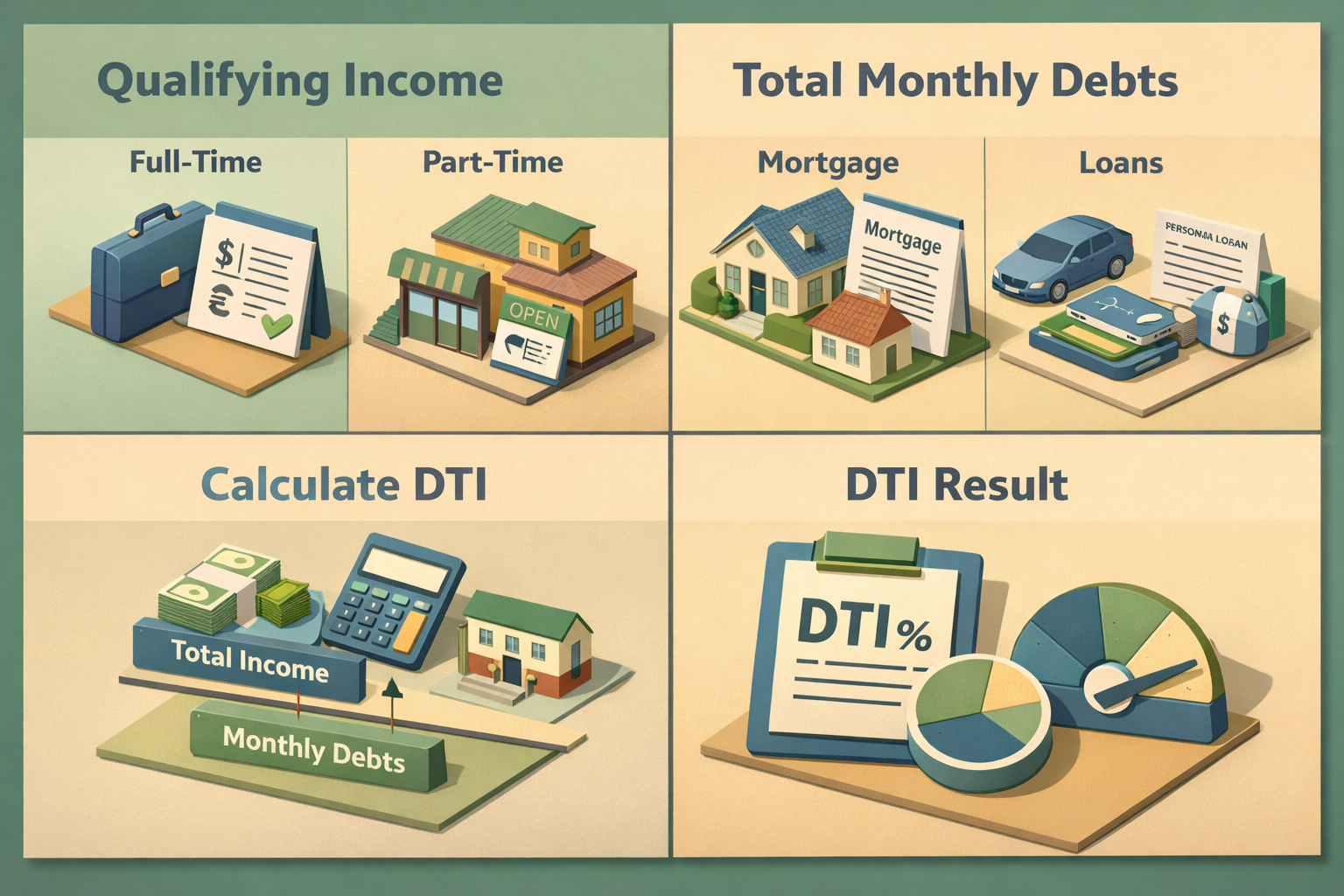
Step 1: Determine Qualifying Income
- Full-time income: $4,500/month
- Part-time income (two-year history, averaged): $800/month
- Inherited cash: Not counted as income (lump sum asset)
- Total qualifying income: $5,300/month
Step 2: Total Monthly Debts
- Proposed mortgage payment: $1,400
- Car loan: $350
- Credit card minimums: $150
- Total monthly debts: $1,900
Step 3: Calculate DTI
$1,900 ÷ $5,300 = approximately 35.8% DTI — a figure that falls comfortably within conventional lending guidelines.
Now, if Sarah uses part of her inheritance to pay off her car loan before applying, her total monthly debts drop to $1,550. That pushes her DTI down to roughly 29.2%, which is an even stronger position. This illustrates how inherited funds, while not counted as income, can still dramatically improve your debt to income ratio calculation through strategic debt reduction.
Common Lender Concerns and How to Address Them
When lenders see non-traditional income sources or large recent deposits, they often have questions. Being prepared for those questions can speed up your approval process and reduce stress.
Large Deposits From an Inheritance
If a significant sum of money recently appeared in your bank account, underwriters will want to know where it came from. This is standard practice — lenders must verify that funds used for a down payment or reserves are legitimate and not an undisclosed loan. For inheritance funds, you'll typically need to provide:
- A copy of the will, trust document, or estate settlement letter
- A letter from the estate attorney or executor confirming the distribution
- Bank statements showing the deposit
Inconsistent Part-Time Earnings
If your part-time income has varied significantly from year to year, a lender may average the two years at a lower figure or, in some cases, decline to count it entirely if there's a pattern of decline. Try to provide context where helpful — a letter of explanation and documentation of stable or growing hours can sometimes support your case.
Recent Job Start Dates
If your part-time job is newer than two years, discuss this with your loan officer early. Some lenders may consider exceptions depending on your field, your primary income strength, and overall credit profile. Don't assume a newer job automatically disqualifies you — every situation is different.
Strategies to Strengthen Your Mortgage Application
Whether you're a first-time homebuyer or someone refinancing their current home, there are practical steps you can take to put your best foot forward when your income picture includes inheritance and part-time work.
- Use inheritance to reduce debt first: Pay off high-interest debts or installment loans before applying. This directly lowers your monthly obligations and improves your DTI ratio.
- Make a larger down payment: A bigger down payment reduces your loan amount, lowers your monthly mortgage payment, and can help you avoid private mortgage insurance (PMI) — all of which help your DTI.
- Document everything thoroughly: Gather your tax returns, pay stubs, estate documents, and bank statements well in advance. Lenders appreciate organized, complete applications.
- Maintain or improve your credit score: A strong credit score can compensate for a higher DTI in some cases. Avoid opening new credit accounts or making large purchases before closing.
- Consider loan programs with flexible DTI limits: FHA loans, for example, may allow higher DTI ratios with appropriate compensating factors. Speaking with an experienced loan officer about your specific profile is always a wise step.
Working with a knowledgeable mortgage professional who understands non-traditional income situations can make a significant difference in how your application is structured and presented to underwriters.
●Conclusion
Understanding how to calculate DTI with recent inheritance and part-time job income doesn't have to be overwhelming. The key is knowing how each income source is classified, what documentation lenders require, and how to use inherited assets strategically — even when they don't count directly toward your qualifying income. Part-time earnings can absolutely support a mortgage application when they have a documented two-year history, and inheritance funds can strengthen your position through larger down payments, debt payoff, or cash reserves. Every borrower's situation is unique, which is why speaking with a qualified mortgage advisor at LoanWise can help you map out the right approach for your goals. With the right preparation and guidance, a successful home purchase or refinance is well within reach.