
When you're applying for a mortgage, your debt-to-income ratio — commonly known as DTI — is one of the most important numbers a lender will review. It tells them how much of your monthly income goes toward paying debts. But what happens when your income doesn't fit the typical nine-to-five mold? If you've recently inherited money or you work a part-time job alongside your main career, you might be wondering how those income sources fit into the picture. Understanding how to calculate DTI with inheritance and part-time job income could make a real difference in whether your mortgage application gets approved — and on what terms.
What Is DTI and Why Does It Matter for Homebuyers
Your debt-to-income ratio is a straightforward calculation: divide your total monthly debt payments by your gross monthly income, then multiply by 100 to get a percentage. For example, if you pay $1,500 per month in debts and you earn $5,000 per month before taxes, your DTI is 30%.
Lenders use this ratio to gauge your ability to handle a new mortgage payment on top of your existing financial obligations. Most conventional loan programs typically look for a DTI at or below 43%, though some programs may allow higher ratios with compensating factors such as a strong credit score or a larger down payment. FHA loans may be somewhat more flexible, while jumbo loans often apply stricter standards.
The lower your DTI, the more financially comfortable you appear to a lender. A strong ratio signals that you're not stretched too thin and that you have enough breathing room to manage a home loan responsibly. That's why knowing exactly which income sources count — and how much of them count — is so important before you apply.
Breaking Down the Two Sides of the DTI Formula
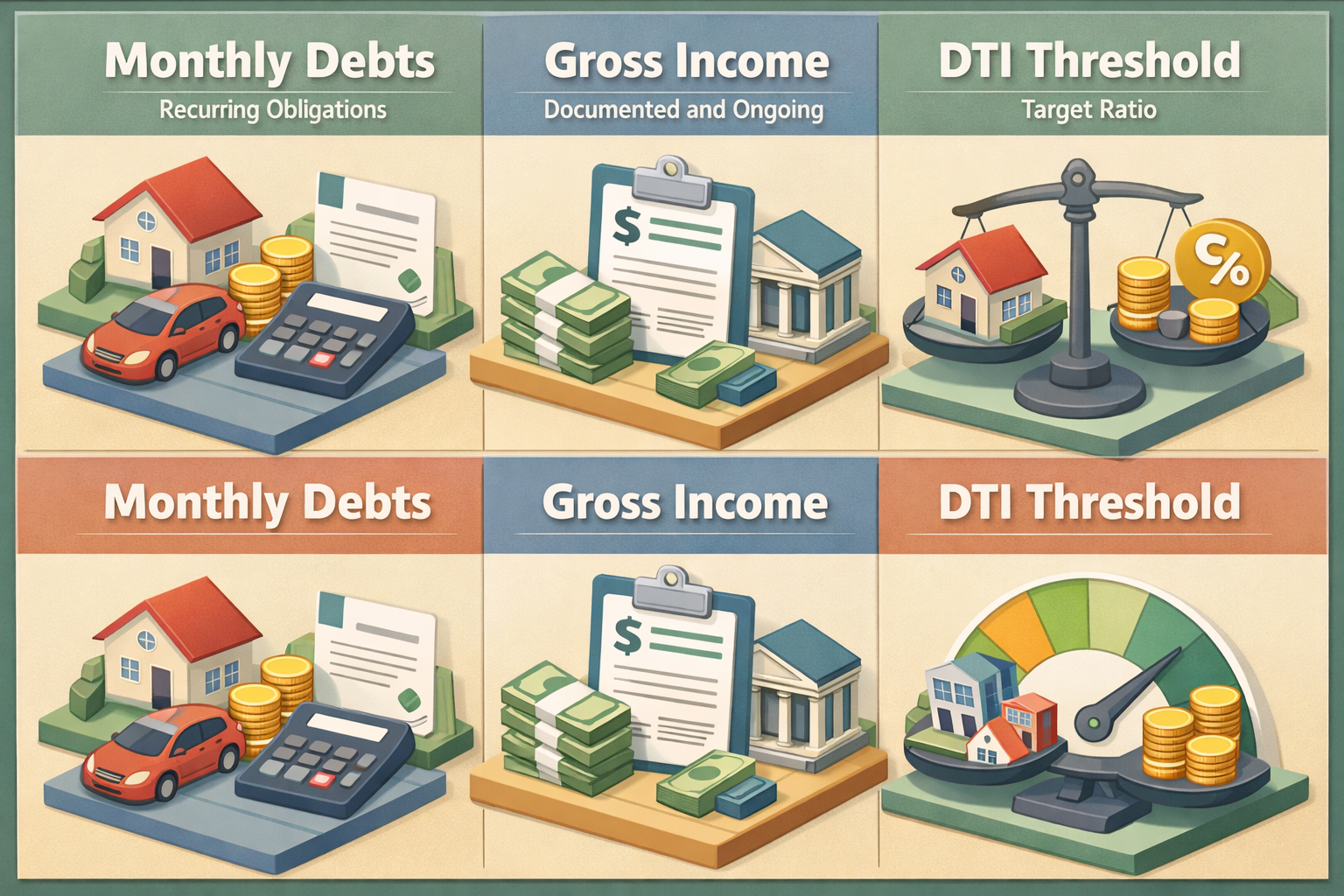
To use the DTI formula effectively, you need to understand what goes on each side of the equation. Your monthly debts typically include your proposed mortgage payment (principal, interest, taxes, and insurance), car loans, student loans, credit card minimum payments, and any other recurring debt obligations. One-time expenses like utility bills or groceries generally don't count.
Your gross monthly income is the figure before taxes and deductions are taken out. This is where things get more nuanced when you have non-traditional income sources. Lenders don't automatically count every dollar you receive — they typically want income that is stable, consistent, and likely to continue for at least two to three years. That standard shapes how both inheritance funds and part-time earnings are evaluated.
- Monthly debts: Include all recurring obligations such as housing costs, loans, and minimum card payments.
- Gross income: Calculated before taxes; must be documentable and, ideally, ongoing.
- DTI threshold: Most programs target 43% or lower, though flexibility may exist depending on the loan type.
How Lenders Evaluate Part-Time Job Income for Mortgage Qualification
Part-time employment income can absolutely be used to qualify for a mortgage, but lenders typically apply a few key conditions before they'll count it. The most common requirement is a two-year history of part-time work. Lenders want to see that this income isn't a recent development but rather a reliable, established part of your financial picture.
Most lenders will average your part-time earnings over 24 months to arrive at a monthly income figure. For instance, if you earned $12,000 from a part-time job income in year one and $14,000 in year two, your averaged monthly income from that source would be approximately $1,083 per month. This is the figure that would be added to your primary income when calculating your DTI.
Lenders may also consider whether your part-time work is in the same field as your primary job or whether it's likely to continue. Seasonal part-time work may be viewed differently than year-round part-time employment. It's worth gathering two years of W-2s, tax returns, and pay stubs to document this income clearly before you apply.
Tips for Documenting Part-Time Earnings
- Provide two years of W-2 forms or tax returns showing consistent part-time income.
- Include recent pay stubs that reflect your current earnings rate.
- A letter from your part-time employer confirming your position and likelihood of continued employment could help strengthen your file.
- If self-employed part-time, be prepared to share profit and loss statements and business bank records.
How Inheritance Fits Into the Debt-to-Income Ratio Calculation
Inheritance is one of the more complex income types when it comes to mortgage qualification, and understanding how it interacts with your debt-to-income ratio calculation is essential. Lenders generally distinguish between two scenarios: receiving a lump-sum inheritance and receiving ongoing income from an inherited asset.
A one-time lump-sum inheritance — such as cash transferred from an estate — is typically not counted as qualifying income for DTI purposes. That's because DTI is based on recurring monthly income, and a one-time windfall doesn't represent an ongoing revenue stream. However, a lump-sum inheritance can still help your application in other ways. It may be used as a down payment, to pay down existing debts (which lowers your DTI directly), or as cash reserves that demonstrate financial stability.
On the other hand, ongoing income derived from an inherited asset may be eligible as qualifying income. Common examples include:
- Rental income from an inherited property
- Distributions from an inherited trust or annuity
- Dividends or interest from inherited investment accounts
For these ongoing sources to count, lenders will typically require documentation showing the income has been received consistently and is expected to continue for at least two to three years. You may need trust documents, account statements, tax returns showing the income, and potentially a letter from the trust administrator or financial institution.
Step-by-Step: How to Calculate DTI With Inheritance and Part-Time Job Income
Let's walk through a practical example so you can see how to calculate DTI with inheritance and part-time job income in a real-world scenario.
Scenario: Sarah works full-time and earns $4,500 per month. She also works a part-time retail job she's held for three years, averaging $900 per month. She recently inherited a rental property from her aunt that generates $800 per month in rental income, which she has been receiving for over a year and expects to continue receiving.
Step 1: Add Up Qualifying Monthly Income
- Full-time salary: $4,500
- Part-time job (two-year average): $900
- Inherited rental income (documented and ongoing): $800
- Total gross monthly income: $6,200
Step 2: Add Up Monthly Debt Obligations
- Proposed mortgage payment (PITI): $1,500
- Car loan: $350
- Student loan: $200
- Credit card minimum: $75
- Total monthly debts: $2,125
Step 3: Calculate the DTI Ratio
Divide total monthly debts by total gross monthly income: $2,125 ÷ $6,200 = 0.343, or approximately 34.3%. This is a healthy DTI that would likely qualify for most conventional mortgage programs. Without the part-time and inherited rental income, Sarah's DTI would have been closer to 43%, which sits right at the edge of many lender thresholds.
Strategies to Improve Your DTI Before Applying for a Mortgage
Whether you're leaning on part-time income, inherited assets, or a combination of both, there are several strategies that may help you present the strongest possible DTI to a lender.
Use Inherited Cash to Pay Down Debts
If you've received a lump-sum inheritance, one of the most impactful things you can do is pay off high-balance debts before applying. Eliminating a car loan or paying down credit card balances reduces your monthly debt obligations, which directly lowers your DTI. This could shift your ratio from borderline to comfortably approvable.
Build a Consistent Track Record with Part-Time Work
If you haven't yet hit the two-year mark with your part-time employer, it may be worth delaying your mortgage application slightly. Lenders are more confident in income that has a demonstrated history, so giving yourself time to establish that track record could expand your qualifying income significantly.
Explore Loan Programs That Allow Higher DTI Thresholds
Some loan programs, such as FHA loans, may permit DTI ratios above 43% under certain conditions. Working with an experienced mortgage professional can help you identify which programs might be the best fit for your income profile.
Consider a Larger Down Payment
A bigger down payment reduces the loan amount, which lowers your proposed monthly mortgage payment. A lower payment means a lower DTI — and it may also help you qualify for better interest rates or avoid private mortgage insurance.
Working With a Lender Who Understands Non-Traditional Income Sources
Not all lenders assess non-traditional income the same way. Some may be more experienced with borrowers who have complex income profiles involving part-time work, trust distributions, rental income from inherited properties, or investment account withdrawals. Choosing the right lending partner can make a meaningful difference in how your income is evaluated and whether more of it counts toward your qualifying total.
When meeting with a lender, come prepared with thorough documentation. Transparency is your best tool. Bring two years of tax returns, all W-2s and 1099s, bank statements showing regular deposits from inherited income sources, trust or estate documentation, and any employer verification letters. The clearer the paper trail, the easier it is for an underwriter to approve the income.
It may also help to speak with a HUD-approved housing counselor or a mortgage broker who specializes in non-QM (non-qualified mortgage) products if your income picture is especially complex. These professionals can help you understand which programs might work best and how to position your application for the strongest possible outcome.
●Conclusion
Understanding how to calculate DTI with inheritance and part-time job income doesn't have to feel overwhelming. By breaking down your income sources, documenting them carefully, and reducing debts where possible, you can build a mortgage application that accurately reflects your financial strength. Inherited assets and part-time earnings are real, meaningful parts of many borrowers' financial lives — and with the right preparation, lenders can see them that way too. Ready to explore your mortgage options? Connect with a LoanWise mortgage specialist today to get a personalized assessment of your DTI and your path to homeownership.