Buying a home is one of the biggest financial steps most people will ever take. For many first-time homebuyers, saving enough for a down payment can feel overwhelming — and that's exactly where a generous gift from a parent can make all the difference. But if that gift doesn't cover the full 20% down payment threshold, you'll likely need to pay for private mortgage insurance, or PMI. Understanding the cost of PMI for a conventional loan with a gifted down payment from a parent is essential before you commit to a purchase price or monthly budget. This article walks you through how gift funds work, what PMI typically costs, and how to manage those expenses wisely.
What Is PMI and Why Does It Apply to Conventional Loans
Private mortgage insurance is a type of coverage that protects the lender — not the borrower — in the event you default on your loan. It's typically required on conventional loans when the borrower puts down less than 20% of the home's purchase price. Unlike FHA mortgage insurance, which is backed by the federal government, PMI on a conventional loan is provided by private insurance companies and can eventually be removed once you build enough equity.
The requirement exists because lenders view low-down-payment borrowers as carrying more risk. If you were to stop making payments, the lender would have less collateral to recover their losses through a home sale. PMI helps offset that risk, making it possible for lenders to approve loans with smaller down payments.
For homebuyers using gift funds from a parent, PMI still applies in the same way it would for any other down payment source — as long as the total down payment remains below 20%. The origin of the funds doesn't eliminate the insurance requirement, but it does open the door to homeownership sooner than if you had to save entirely on your own.
How Gifted Down Payments Work on Conventional Loans
Conventional loans backed by Fannie Mae and Freddie Mac generally allow gift funds from family members, including parents, to be used toward a down payment. However, there are specific documentation requirements that both the borrower and the donor must meet. Lenders want to confirm that the gift is a true gift — not a loan in disguise — since a repayable loan would affect your debt-to-income ratio and overall loan qualification.
Typically, the process involves a few key steps:
- Gift letter: The parent providing the funds must sign a formal gift letter stating the amount, the relationship to the borrower, and a clear declaration that no repayment is expected.
- Fund verification: Lenders will often require bank statements from both the donor and the borrower to confirm the transfer of funds.
- Seasoning rules: Some lenders may require gift funds to be in the borrower's account for a minimum period — sometimes called a seasoning period — before the loan closes, though requirements vary.
It's also worth noting that if the gifted down payment is less than 20%, you'll still need to budget for PMI as part of your monthly housing costs. In some cases, lenders may have additional guidelines depending on the loan-to-value ratio, so it's always smart to confirm requirements with your specific lender early in the process.
Understanding the Cost of PMI for a Conventional Loan With a Gifted Down Payment From a Parent
The cost of PMI for a conventional loan with a gifted down payment from a parent is influenced by several variables. PMI is not a flat fee — it's typically calculated as a percentage of the original loan amount on an annual basis, then divided into monthly payments that are added to your mortgage bill.
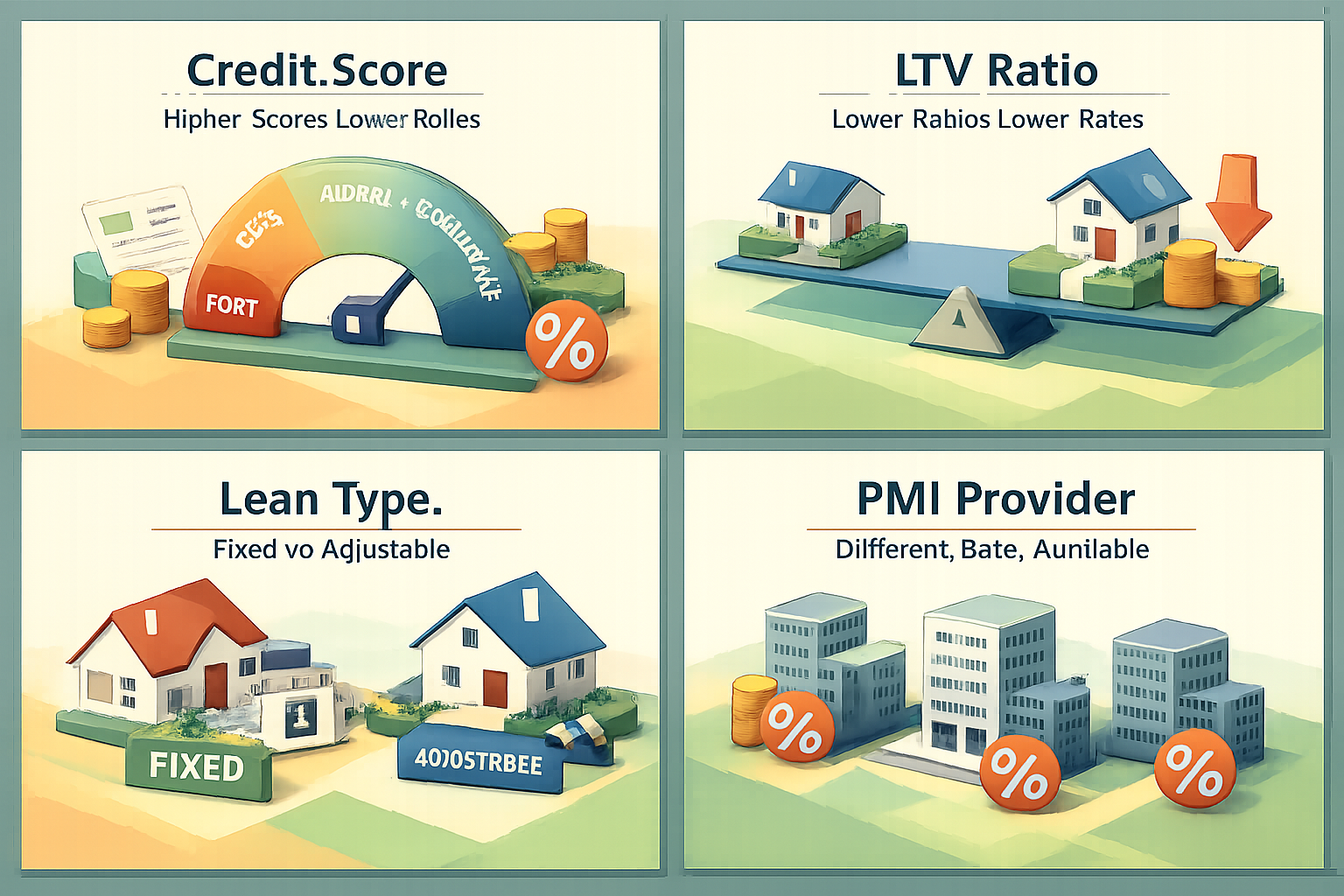
PMI rates on conventional loans can vary widely based on factors such as:
- Credit score: Borrowers with higher credit scores generally receive lower PMI rates. A strong credit profile signals less risk to the insurer.
- Loan-to-value (LTV) ratio: The less you put down, the higher your LTV, and the more you may pay for PMI. A 5% down payment typically results in a higher PMI rate than a 15% down payment.
- Loan term and type: Fixed-rate loans and adjustable-rate mortgages may carry slightly different PMI pricing structures.
- PMI provider: Because private companies offer PMI, rates can differ between insurers, and lenders may work with preferred providers.
While specific PMI rates vary by insurer and borrower profile, it's commonly cited in the industry that annual PMI costs might range from roughly 0.2% to 2% of the loan amount, though your actual rate could fall outside that range depending on your qualifications. For example, on a $300,000 loan, that could translate to anywhere from approximately $600 to $6,000 per year, or $50 to $500 per month — a meaningful addition to your housing budget.
The fact that your down payment came from a parent's gift doesn't itself change the PMI rate. What matters to the insurer is the size of your down payment relative to the home's value and your overall creditworthiness. That said, a larger gift that gets you closer to the 20% threshold could meaningfully reduce — or even eliminate — your PMI obligation.
How Your Down Payment Percentage Shapes Monthly Insurance Costs
The size of your down payment is one of the most direct factors influencing how much you'll pay for PMI. Even if part or all of that down payment comes from a gift, the percentage you put down will shape your loan-to-value ratio and, in turn, your PMI cost.
Here's a general look at how different down payment levels might affect your PMI situation:
- 3% to 5% down: This is the minimum for most conventional loans and typically carries the highest PMI rates. Borrowers at this level may want to focus on maintaining a strong credit score to offset the elevated LTV risk.
- 10% down: A more moderate PMI rate may apply, and your monthly PMI payment could be noticeably lower than at 5% down.
- 15% down: You're getting closer to the 20% threshold, which may result in lower PMI costs and a clearer path to cancellation.
- 20% or more: PMI is typically not required at this level, which is why many homebuyers aim for this target — even if it takes longer to save.
If your parent's gift brings you to one of these higher tiers, the long-term savings on PMI could be substantial. Even moving from a 5% to a 10% down payment with gift funds could reduce your monthly PMI costs and shorten the time before you can request cancellation.
When and How PMI Can Be Removed From Your Conventional Loan
One of the most encouraging aspects of PMI on a conventional loan is that it's not permanent. Under the federal Homeowners Protection Act, lenders are required to cancel PMI automatically once your loan balance reaches 78% of the original purchase price — assuming you're current on payments. You may also be able to request cancellation earlier, once you reach 80% LTV, though lenders may require a formal request and in some cases a new appraisal.
There are a few practical paths to PMI removal that homebuyers should know about:
- Scheduled amortization: Simply continuing to make your regular mortgage payments will gradually reduce your balance. Over time, your equity grows and your LTV drops until automatic cancellation kicks in.
- Extra principal payments: Making additional payments toward your loan principal can accelerate equity building and potentially allow for earlier PMI cancellation.
- Home value appreciation: If your home increases in value, your LTV ratio improves even without extra payments. You may be able to request PMI removal based on a new appraisal, though lender policies vary.
- Refinancing: If rates drop or your home has appreciated significantly, refinancing into a new loan at a lower LTV could eliminate PMI altogether — though you'd need to weigh closing costs against the savings.
For homebuyers who used gifted funds as part of their down payment, the path to PMI removal works exactly the same way. The source of the original down payment has no bearing on how or when PMI can be cancelled.
Smart Strategies for Homebuyers Using Gift Funds to Reduce PMI Impact
If you're planning to use a gift from your parents and want to minimize the impact of PMI on your finances, there are several approaches worth considering. While no strategy is one-size-fits-all, the following tips may help you manage costs more effectively:
- Combine gift funds with personal savings: Supplementing your parent's gift with your own savings could push your total down payment higher, potentially lowering your LTV and your PMI rate.
- Improve your credit score before applying: Since credit score plays a significant role in PMI pricing, taking time to pay down debts and correct any errors on your credit report could result in a lower insurance rate.
- Ask about lender-paid PMI (LPMI): Some lenders offer to cover PMI costs in exchange for a slightly higher interest rate. This can simplify your monthly payment structure, though it may cost more over the life of the loan depending on how long you keep the mortgage.
- Explore piggyback loan structures: A second mortgage, sometimes called a piggyback loan, may help some borrowers avoid PMI by splitting the financing between two loans. This option has its own costs and risks, so it's worth discussing with a qualified mortgage advisor.
- Shop PMI providers: Because PMI is offered by multiple private companies, your lender may be able to compare rates from several providers. A lower PMI rate — even by a fraction of a percent — can add up to meaningful savings over time.
Working with an experienced loan officer who understands gift fund guidelines and PMI options is one of the most valuable steps you can take. They can model different scenarios based on your specific financial profile and help you find the approach that makes the most sense for your situation.
●Conclusion
Understanding the cost of PMI for a conventional loan with a gifted down payment from a parent is a key part of planning a successful home purchase. A gift from a loved one can be a meaningful head start — but knowing how that gift interacts with your loan terms, insurance requirements, and long-term costs helps you make smarter decisions every step of the way. PMI doesn't have to be a burden if you plan ahead, manage your credit profile, and work with a knowledgeable lending team. At LoanWise, we're here to help you navigate every detail of the mortgage process — from gift fund documentation to finding the most competitive PMI rates available for your situation. Reach out today and let's build a home financing plan that works for you.