
If you earn overtime pay regularly, you might be wondering whether that extra income can help you qualify for a home loan. The good news is that it often can — but the process isn't as straightforward as counting your regular salary. Understanding how to calculate affordability for FHA loan with overtime pay is a crucial first step before you start shopping for a home. FHA loans are popular among first-time homebuyers and those with moderate income because they offer flexible credit requirements and lower down payment options. However, when your income includes variable components like overtime, lenders take a more careful look. This guide walks you through exactly what to expect, how your income gets evaluated, and how to position yourself for approval.
What Makes FHA Loans a Strong Option for Wage Earners
FHA loans, backed by the Federal Housing Administration, are designed to make homeownership more accessible. They typically require a lower down payment — often as low as 3.5% for borrowers with qualifying credit scores — and they tend to be more forgiving of past credit challenges compared to conventional loans. For everyday wage earners, including those who depend partly on overtime to round out their annual income, FHA loans can be an especially attractive path to homeownership.
What sets FHA loans apart is their structured approach to income verification. Lenders must follow guidelines set by the U.S. Department of Housing and Urban Development (HUD) when underwriting these loans. That means there are clear rules around how overtime income is counted, which can actually work in your favor if you've been earning it consistently. Rather than leaving the assessment entirely up to individual lender discretion, you have a framework to work within and prepare for.
It's worth noting that while FHA loans offer flexibility, they also come with mortgage insurance premiums (MIP) — both upfront and annual — which add to your total loan cost. Even so, for many buyers, the accessibility and structured qualifying guidelines make FHA loans one of the most practical options available.
How Lenders View Overtime Income for FHA Qualification
One of the most common questions homebuyers ask is: will my overtime count toward my qualifying income? The answer depends largely on how long you've been receiving it and whether it's likely to continue. According to general FHA underwriting guidelines, overtime income may be used to qualify if it has been received for at least two years and the employer confirms there's a reasonable expectation it will continue.
Lenders typically take the position that overtime is considered variable pay — meaning it's not guaranteed like a base salary. Because of this, they tend to average your overtime earnings over a 24-month period. If you've been earning overtime for less than two years, some lenders may still consider it, but they'll typically require strong compensating factors and may apply more conservative calculations. If your overtime income has been declining year over year, lenders may exclude it entirely or apply the lower figure.
This is why the lenders view on overtime for FHA loans is both nuanced and documentation-heavy. Your pay history matters, your employer's outlook matters, and the trend of your earnings matters. A borrower who consistently earns overtime across two or more years is in a much stronger position than someone who received a large one-time overtime payout in the most recent year.
Gathering the Right Documents to Support Your Overtime Income
Documentation is everything when it comes to qualifying for FHA loan with variable pay. Lenders need to see a clear, verifiable record of your income history before they'll factor overtime into your qualifying figures. Here's what you'll typically need to prepare:
- Two years of W-2 forms: These provide a summary of your total annual earnings, including any overtime reflected in your gross wages.
- Recent pay stubs: Most lenders request your most recent 30 days of pay stubs to confirm current earnings and break down base pay versus overtime.
- Written Verification of Employment (VOE): Your employer may be asked to confirm your current position, base salary, overtime history, and whether overtime is likely to continue.
- Federal tax returns: If you're self-employed or have complex finances, two years of tax returns may also be required, though for traditional W-2 employees, they're sometimes optional.
Being organized and proactive with your paperwork can significantly speed up the underwriting process. It also helps your loan officer make the strongest possible case to the underwriter when presenting your income profile. If your employer can provide a letter confirming that overtime opportunities are expected to remain available, that documentation can strengthen your file considerably.
Step-by-Step: How to Calculate Affordability for FHA Loan with Overtime Pay
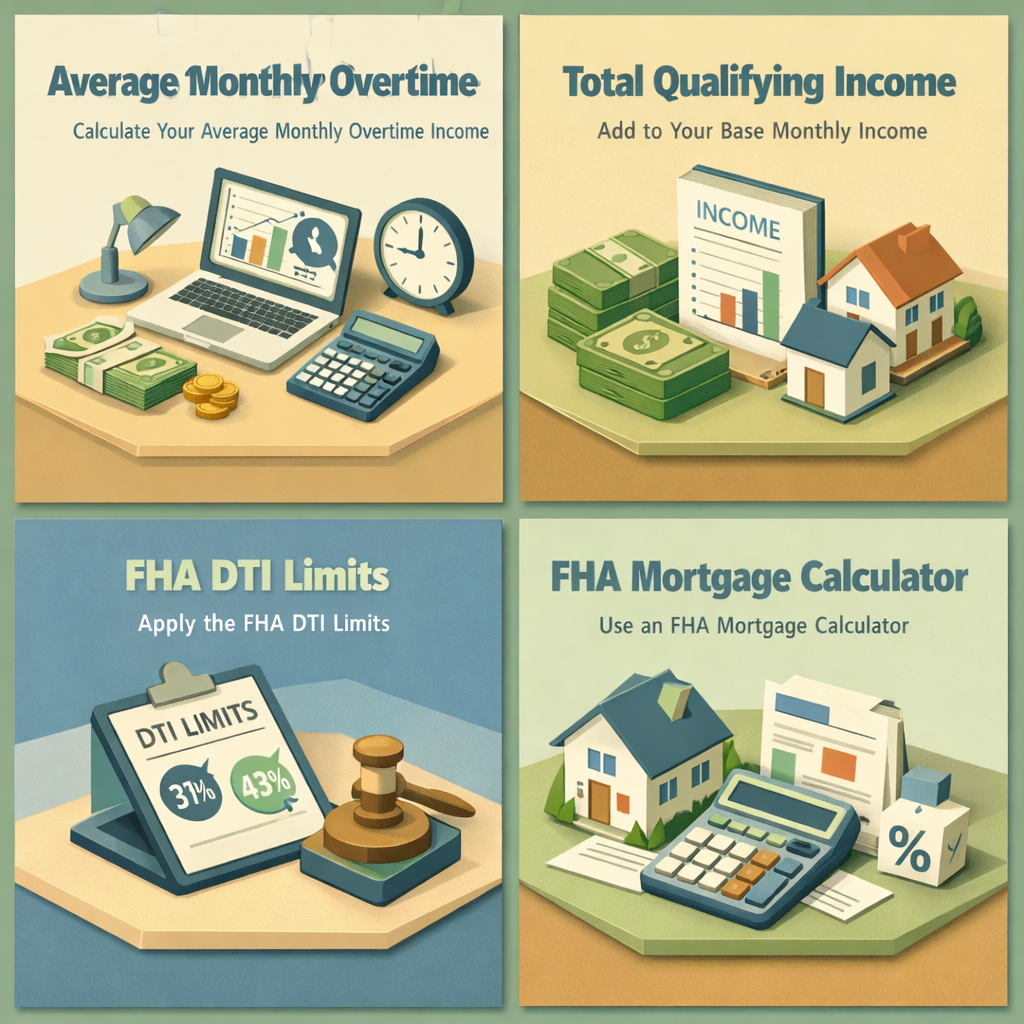
Understanding the mechanics behind your qualifying income helps you go into the process with realistic expectations. Here's a practical breakdown of how to calculate affordability for FHA loan with overtime pay:
Step 1: Calculate Your Average Monthly Overtime Income
Add up all overtime earnings from the past 24 months, then divide by 24 to get your average monthly overtime income. For example, if you earned $8,400 in overtime in year one and $9,600 in year two, your total is $18,000 — divided by 24 gives you $750 per month in usable overtime income.
Step 2: Add to Your Base Monthly Income
Take your gross monthly base salary and add the averaged overtime figure. If your base pay is $4,500 per month and your averaged overtime is $750, your total qualifying income would be approximately $5,250 per month.
Step 3: Apply the FHA DTI Limits
FHA guidelines generally use two debt-to-income (DTI) ratios. The front-end ratio covers housing expenses only — typically capped around 31% of gross monthly income. The back-end ratio includes all monthly debt obligations and is generally limited to around 43%, though lenders may go higher with strong compensating factors. Using our example, 43% of $5,250 is $2,257.50 — meaning your total monthly debts, including your new mortgage, shouldn't exceed that threshold.
Step 4: Use an FHA Mortgage Calculator
An FHA mortgage calculator overtime income tool can be incredibly helpful here. Input your total qualifying income, estimated loan amount, current FHA interest rate, and monthly debts to get a clearer picture of what you may be able to afford. Many online calculators also allow you to factor in MIP, property taxes, and homeowner's insurance to give you a true estimated monthly payment.
Understanding DTI Calculations When Your Pay Varies
The DTI calculation FHA overtime process requires attention to detail, especially when your income isn't uniform month to month. Your debt-to-income ratio is one of the most important numbers in your mortgage application — it tells lenders how much of your income is already committed to existing debts before adding a new mortgage payment.
Here are some key points to keep in mind when your income includes overtime:
- Lenders use gross income, not net: Your DTI is calculated based on what you earn before taxes and deductions, not your take-home pay.
- All debts are counted: Monthly obligations on credit cards, auto loans, student loans, and other installment accounts all factor into your back-end DTI ratio.
- One-time windfalls don't count: A bonus or exceptional overtime period in a single month won't help if it's not part of a consistent two-year pattern.
- Declining overtime could hurt: If your overtime earnings were higher in year one than year two, a cautious lender might use only the lower year's figure or apply a more conservative average.
Because of these nuances, it may be worth working with an experienced loan officer who understands FHA income guidelines. They can help you interpret your pay history, identify potential red flags before underwriting, and suggest strategies to strengthen your application.
Practical Tips to Strengthen Your FHA Application with Overtime Income
Even if your overtime history is solid, there are steps you can take to make your application as competitive as possible. Here are several strategies that may improve your chances of a smooth approval:
- Maintain steady employment: FHA lenders want to see stability. Staying with the same employer over the two-year period makes it easier to document consistent overtime income.
- Reduce existing debt before applying: Paying down credit card balances or eliminating smaller loans can lower your DTI ratio and give your overtime income more room to work.
- Avoid taking on new debt: Opening new credit lines or financing a vehicle shortly before applying can negatively impact both your credit score and your DTI.
- Build up your savings: Having reserves — money left over after your down payment and closing costs — can serve as a compensating factor if your DTI is on the higher end.
- Get a pre-approval early: Working with a lender early in the process allows you to understand exactly how your overtime income will be calculated and what purchase price you realistically qualify for.
It's also worth shopping around. Different FHA-approved lenders may interpret income guidelines slightly differently within the boundaries of HUD rules. One lender might be more comfortable with your specific income profile than another, so getting multiple pre-approval quotes could be beneficial.
●Conclusion
Overtime pay can genuinely expand your buying power when you're pursuing an FHA loan — but only when it's properly documented and meets the consistency requirements lenders need to see. Knowing how to calculate affordability for FHA loan with overtime pay puts you in a far better position to set realistic expectations, prepare your paperwork, and work confidently with your loan officer. Start by averaging your overtime over 24 months, add it to your base income, and run the numbers against FHA's DTI guidelines. From there, an experienced mortgage professional can help you take the next step. At LoanWise, we're here to help you navigate every detail of the FHA process — including how your full income picture gets counted toward the home you deserve.