
If you earn overtime on top of your base salary, you might be wondering whether that extra income can help you qualify for a home loan — and specifically, an adjustable-rate mortgage. The good news is that overtime income can count toward your qualifying income, but lenders apply specific rules before they'll include it. When you're trying to figure out how to calculate affordability for an ARM mortgage with overtime, there are several moving parts to understand: how lenders average your overtime, how adjustable-rate payments factor into your debt-to-income ratio, and what documentation you'll need to make your case. This guide walks you through each piece so you can approach the process with confidence.
What Is an ARM Mortgage and Why Do Borrowers Choose It
An adjustable-rate mortgage (ARM) is a home loan where the interest rate remains fixed for an initial period — commonly three, five, seven, or ten years — and then adjusts periodically based on a market index. Because the initial rate on an ARM is typically lower than that of a 30-year fixed mortgage, many homebuyers and real estate investors find it attractive, especially when they don't plan to stay in a property for decades.
For borrowers who earn variable income, like overtime pay, an ARM can be a practical strategy. The lower initial payment may make monthly cash flow more manageable during the fixed period, which can be helpful when your take-home pay fluctuates from month to month. That said, it's important to plan ahead for potential rate adjustments once the fixed period ends.
Common ARM structures include the 5/1 ARM, the 7/1 ARM, and the 10/1 ARM. The first number represents how many years the rate stays fixed, and the second represents how often it adjusts after that. Understanding these timelines is a key part of planning for long-term affordability — especially when your overtime income may not always be predictable.
How Lenders View Overtime Income for Mortgage Qualification
One of the most common questions among wage earners is whether overtime counts as qualifying income. The short answer is: it often can, but lenders apply strict criteria. When qualifying for an ARM loan with variable pay, lenders typically want to see that your overtime income has a demonstrated history and is likely to continue.
Most conventional lenders following Fannie Mae or Freddie Mac guidelines will require at least a two-year history of overtime earnings before they'll include it in your qualifying income. They'll review your W-2 forms and pay stubs to verify consistency. If your overtime has been increasing or staying steady, that generally works in your favor. If it's been declining or irregular, lenders may discount it or exclude it entirely.
Here's how overtime income is typically treated:
- Two-year average: Lenders usually average your overtime over the past 24 months using your W-2s and year-to-date pay stubs.
- Continuity requirement: The income should be expected to continue. Your employer may be asked to verify that overtime opportunities are still available.
- Declining income caution: If your overtime earnings have dropped significantly in the most recent year, some lenders may use only the lower figure or exclude it altogether.
- Part-time vs. consistent overtime: Sporadic overtime is treated differently than regular, structured overtime. Consistent patterns carry more weight.
It's worth noting that FHA, VA, and USDA loans follow similar guidelines, though specific documentation requirements may vary slightly by program. Talking to a loan officer early in the process can help you understand how your specific overtime history will be assessed.
Step-by-Step: How to Calculate Affordability for ARM Mortgage with Overtime
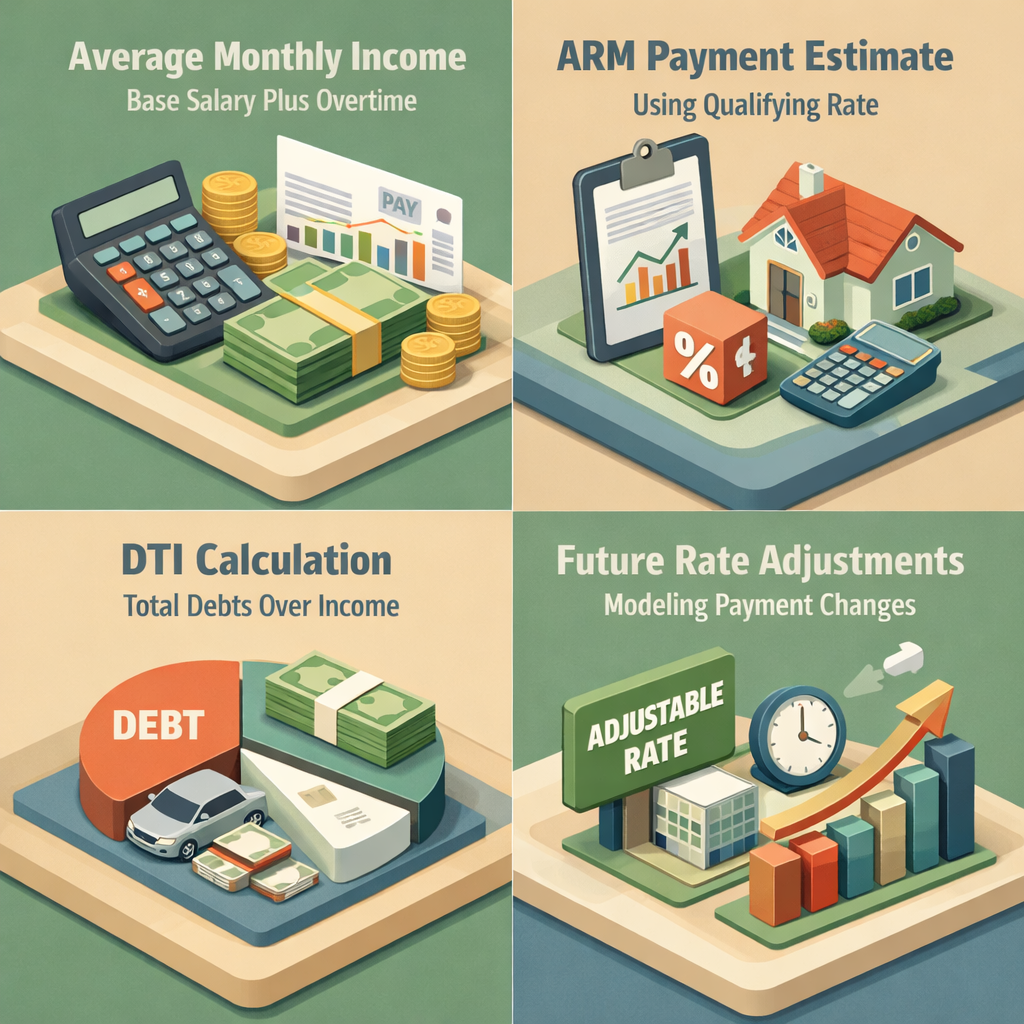
Understanding how to calculate affordability for an ARM mortgage with overtime involves combining your eligible income with your projected ARM payment and comparing that to your total monthly debts. Here's a practical breakdown of the process.
Step 1 — Calculate Your Average Monthly Qualifying Income
Start by pulling your last two years of W-2 forms. Add up your total overtime earnings for both years and divide by 24 to get your average monthly overtime income. Then add that to your base monthly gross salary.
Example: If your base salary is $5,000 per month and your overtime averaged $1,000 per month over two years, your total qualifying income would be approximately $6,000 per month — assuming lenders accept the full amount.
Step 2 — Estimate Your ARM Payment Using the Qualifying Rate
Here's where ARM loans require extra attention. Lenders don't just use the initial teaser rate to qualify you. For most conventional ARM loans, lenders are required to qualifying for ARM loan borrowers at the fully indexed rate or a specified floor rate — whichever is higher. This is designed to ensure you can still afford the loan if rates rise after the initial period.
Use an ARM mortgage calculator overtime income inputs to estimate your payment at the qualifying rate. Many online calculators allow you to enter the loan amount, term, and interest rate. Plug in the qualifying rate your lender specifies, not just the initial rate shown in marketing materials.
Step 3 — Calculate Your Debt-to-Income Ratio
DTI calculation for ARM overtime works the same way as any mortgage: divide your total monthly debt obligations (including the projected ARM payment) by your total qualifying monthly income.
Formula: DTI = (Total Monthly Debts ÷ Gross Monthly Income) × 100
Most conventional lenders prefer a DTI at or below 43–45%, though some programs may allow slightly higher ratios with compensating factors like strong credit or a large down payment. FHA loans may permit higher DTIs in certain cases, but it depends on the lender and the automated underwriting findings.
Step 4 — Account for Future Rate Adjustments
A smart affordability check goes beyond the initial ARM period. Use your ARM mortgage calculator to model what your payment could look like after the first adjustment — factoring in the loan's periodic and lifetime caps. This helps you determine whether your income (including overtime) would still cover the payment if the rate adjusts upward.
DTI Guidelines and How Variable Pay Shifts the Numbers
Your debt-to-income ratio (DTI) is one of the most important figures in any mortgage qualification process. When part of your income comes from overtime, the DTI calculation can shift depending on how much of that income lenders are willing to count.
Let's look at how DTI might differ with and without overtime included:
- Without overtime: Base income of $5,000/month with $2,000 in monthly debts produces a DTI of 40%. Depending on loan type, this may or may not be approvable.
- With averaged overtime ($1,000/month): Total qualifying income rises to $6,000/month. The same $2,000 in debts now produces a DTI of roughly 33%, which is significantly stronger.
This difference can be meaningful when you're trying to qualify for a larger loan amount or meet a lender's maximum DTI threshold. That's why documenting overtime carefully — and working with a lender who understands how to handle variable income — can make a real difference in your outcome.
It's also worth understanding that if your overtime income isn't fully accepted (say, only 75% is counted due to inconsistency), your effective qualifying income drops, and your DTI increases accordingly. Always run multiple scenarios when planning your budget.
What Documentation Lenders Typically Require for Overtime Income
When you apply for an ARM loan with overtime income, be prepared to provide thorough documentation. Lenders want a clear paper trail showing that your overtime earnings are real, consistent, and likely to continue. Here's what you'll typically need:
- Two years of W-2 forms: These verify your total annual earnings, including overtime, for the past two tax years.
- Recent pay stubs: Usually the most recent 30 days of pay stubs showing year-to-date earnings, including any overtime line items.
- Employer verification: Some lenders may request a written verification of employment (VOE) confirming that overtime is available and expected to continue.
- Federal tax returns: In some cases, lenders may ask for two years of personal tax returns to cross-reference reported income.
- Explanation letter: If your overtime has fluctuated significantly, a brief letter explaining the circumstances — such as seasonal demand or a shift change — may help the underwriter understand the context.
The more organized and complete your documentation, the smoother the underwriting process tends to be. Gaps or inconsistencies in your income history can raise questions that slow down your approval.
How Lenders Assess ARM Risk When Income Includes Overtime
When a lender evaluates your application for an adjustable-rate mortgage with overtime income, they're looking at two layers of risk simultaneously: the variability of your income and the variability of the loan's future payments. Understanding how lenders view overtime for ARM loans helps you position your application more effectively.
From the lender's perspective, combining an adjustable-rate loan with variable income requires careful stress-testing. They want confidence that you can handle the payment not just today, but also if rates adjust higher and if your overtime hours decrease. This is why lenders may apply a more conservative income figure and qualify you at a higher rate than the starting ARM rate.
Here are some factors that can strengthen your application:
- Strong credit score: A higher credit score signals financial responsibility and may give underwriters more confidence in your ability to manage rate adjustments.
- Larger down payment: Putting more money down reduces the loan-to-value ratio, which lowers the lender's risk exposure.
- Healthy cash reserves: Having several months of mortgage payments in savings shows that you can cover obligations even if overtime dries up temporarily.
- Long employment tenure: The longer you've been with your employer — particularly in a role that regularly includes overtime — the more credible your income history appears.
- Lower overall DTI: Even if overtime income isn't fully counted, keeping your total debt load manageable improves your overall profile.
It may also help to work with a lender who has experience underwriting files with variable income. Not all loan officers handle these scenarios the same way, and an experienced one can often find solutions that a less experienced one might overlook.
●Conclusion
Figuring out how to calculate affordability for an ARM mortgage with overtime doesn't have to feel overwhelming. The key is understanding how lenders average your variable income, how the ARM's qualifying rate affects your payment estimate, and how your overall DTI holds up under different income scenarios. Overtime income can genuinely strengthen your mortgage application — but it needs to be documented carefully and consistently over time.
If you're planning to use overtime income to qualify for an adjustable-rate mortgage, start by pulling together your last two years of W-2s and recent pay stubs. Then use an ARM mortgage calculator to model your payment at the qualifying rate, and run your DTI both with and without overtime to understand your range. Working with a knowledgeable loan officer who understands variable income can make a meaningful difference in how smoothly your approval process goes.
Ready to explore your ARM mortgage options? Connect with a LoanWise lending specialist today to get a personalized assessment of your qualifying income and see what loan amount you may be able to afford.