
An adjustable-rate mortgage can be an appealing option for homebuyers and refinancers who want lower initial payments and plan to move or refinance before rates shift. But before you commit, it's important to understand exactly what you're signing up for — because your payment today may not be your payment tomorrow. Knowing how to calculate affordability for an ARM mortgage is one of the most valuable skills you can develop as a borrower. It helps you avoid payment shock, qualify more confidently, and make a financing decision that truly fits your long-term financial picture.
What Makes an ARM Mortgage Different From a Fixed-Rate Loan
Before diving into calculations, it helps to understand the core structure of an adjustable-rate mortgage. Unlike a fixed-rate loan, where your interest rate stays the same for the life of the loan, an ARM starts with a fixed introductory period — commonly 5, 7, or 10 years — and then adjusts periodically based on a benchmark index plus a set margin.
For example, a 5/1 ARM keeps its initial rate for five years, then adjusts once per year after that. A 7/6 ARM holds steady for seven years and adjusts every six months. These structures can offer meaningfully lower starting rates compared to 30-year fixed mortgages, which is part of their appeal for buyers who don't plan to stay in a home long-term.
However, the variable nature of ARM payments is exactly why affordability planning matters so much. You're not just budgeting for today's payment — you need to prepare for what that payment could become after the initial fixed period ends.
Breaking Down the Adjustable Rate Mortgage Payment Calculation
The adjustable rate mortgage payment calculation involves a few moving parts. Your initial monthly payment is calculated the same way as any amortizing loan: using your loan amount, the initial interest rate, and the loan term. The standard formula looks at principal and interest spread across your repayment schedule.
Here's a simplified example. Suppose you borrow $400,000 on a 5/1 ARM with a starting rate of 6.0% and a 30-year term. Your initial monthly payment for principal and interest would be approximately $2,398. That payment holds steady for the first five years.
After that initial period ends, your rate adjusts. The new rate is determined by adding a margin (set by your lender, often around 2.5% to 3%) to a financial index — such as the Secured Overnight Financing Rate (SOFR). If that index sits at 4.5% at the time of your first adjustment, and your margin is 2.75%, your new rate could reach 7.25%, pushing your monthly payment noticeably higher.
This is why running multiple payment scenarios is so important. Use an ARM mortgage affordability calculator to model not just your starting payment, but also what you'd owe at the first adjustment, at the cap ceiling, and at various points in between. Many online calculators allow you to enter your loan amount, initial rate, adjustment caps, and index assumptions to generate a full adjustable rate mortgage payment calculation timeline.
Understanding ARM Rate Caps and Why They Matter for Your Budget
Understanding ARM rate caps is a critical piece of affordability planning that borrowers sometimes overlook. Rate caps limit how much your interest rate can change at any given adjustment — and how high it can go over the life of the loan. Most ARMs come with a cap structure expressed as three numbers, such as 2/2/5.
- First cap: The maximum rate increase allowed at the first adjustment (e.g., 2% above your initial rate).
- Periodic cap: The maximum increase allowed at each subsequent adjustment (e.g., 2% per adjustment period).
- Lifetime cap: The maximum total increase over the life of the loan (e.g., 5% above the starting rate).
Using our earlier example, if your starting rate is 6.0% and you have a 2/2/5 cap structure, your rate could rise to as high as 11.0% over the life of the loan. That's a significant jump — and it could translate to a substantially higher monthly payment than you started with.
When using an ARM mortgage affordability calculator, always input the worst-case scenario based on your cap structure. This gives you a realistic ceiling for your future payments and helps you determine whether your budget can absorb that maximum potential increase. If the worst-case payment feels unmanageable, it may be worth considering a longer fixed-rate period or a different loan product altogether.
How DTI Affects ARM Loan Approval and Long-Term Affordability
Your debt-to-income ratio plays a central role in both qualifying for an ARM and sustaining the loan once rates adjust. How DTI affects ARM loan approval is more nuanced than many borrowers realize, because lenders don't always qualify you solely on your initial payment.
DTI is calculated by dividing your total monthly debt obligations — including housing costs, car payments, student loans, and credit card minimums — by your gross monthly income. Most conventional lenders look for a DTI at or below 45%, though some programs may allow up to 50% with compensating factors such as strong credit or significant reserves.
Where ARMs get more complex is in how lenders calculate the qualifying payment. Some lenders qualify borrowers at the fully indexed rate (the index plus margin), rather than the initial teaser rate. Others use the start rate plus a buffer margin. This is intended to protect borrowers from qualifying for a payment they could no longer afford after the first adjustment.
As a borrower, you should run your own DTI calculation using the adjusted payment scenarios you modeled with your ARM mortgage affordability calculator. Ask yourself: if my rate adjusts to the first cap ceiling, will my DTI still fall within a comfortable range? If the adjusted payment pushes your DTI above 50%, that's a signal your finances may be stretched too thin for the long run.
Building in a financial cushion is always wise. Ideally, you'd qualify comfortably even at a rate one or two percentage points above your starting rate. That buffer gives you room to breathe if rates move against you before you have the chance to refinance.
Step-by-Step Guide on How to Calculate Affordability for an ARM Mortgage
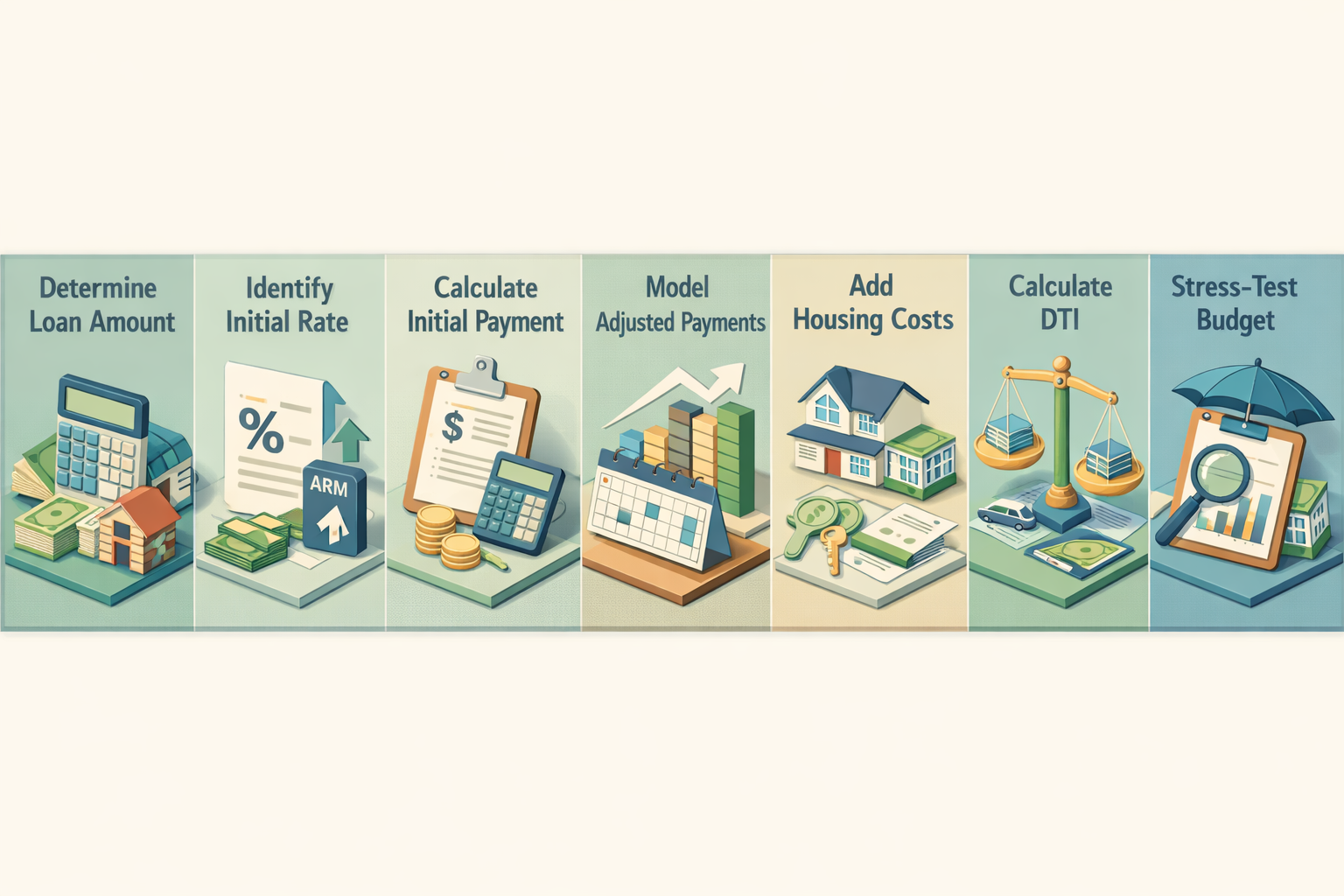
Now that we've covered the key components, let's walk through a practical approach to how to calculate affordability for an ARM mortgage. Follow these steps to get a complete picture of your financial exposure.
- Step 1 — Determine your loan amount. Start with your purchase price minus your down payment. Don't forget to factor in closing costs, which may affect how much cash you have available upfront.
- Step 2 — Identify your initial rate and loan term. Gather the starting rate offered by your lender and the full amortization term (typically 30 years).
- Step 3 — Calculate your initial monthly payment. Use an online ARM mortgage affordability calculator or a standard amortization formula to find your baseline principal and interest payment.
- Step 4 — Model adjusted payment scenarios. Input your cap structure and current index rate. Calculate payments at the first adjustment cap, subsequent caps, and the lifetime cap ceiling.
- Step 5 — Add housing costs. Include property taxes, homeowner's insurance, and HOA fees if applicable. These are part of your total housing payment and factor into your DTI.
- Step 6 — Calculate your DTI at each scenario. Divide your total monthly obligations (including the adjusted mortgage payment) by your gross monthly income. Check whether each scenario keeps your DTI within an acceptable range.
- Step 7 — Stress-test your budget. Ask yourself whether you could absorb the maximum possible payment increase without compromising other financial priorities such as retirement contributions or emergency savings.
This process may feel detailed, but it's the kind of due diligence that protects you from being caught off guard down the road. A lender or mortgage advisor can help you calculate affordability more precisely using your actual loan terms.
When an ARM Might Make Financial Sense for Homebuyers
ARMs aren't right for every borrower, but there are scenarios where they could make strong financial sense. Understanding when the math works in your favor is just as important as knowing how to calculate the risks.
If you're a homebuyer who expects to sell or refinance within the initial fixed period, an ARM's lower starting rate could save you a meaningful amount in interest over those early years. For instance, if a 5/1 ARM offers a rate that's 0.75% to 1% lower than a comparable 30-year fixed loan, the savings during the five-year fixed window could add up to thousands of dollars — especially on larger loan amounts common in higher-cost markets.
Real estate investors may also find ARMs attractive when acquiring properties with shorter projected hold periods. If the investment strategy calls for a sale or cash-out refinance within five to seven years, locking into a lower initial rate can improve cash flow during the hold period.
Additionally, borrowers expecting a significant income increase — such as medical professionals or executives early in their careers — may be comfortable accepting the rate risk of an ARM, knowing their earnings are likely to grow alongside any potential payment increases.
That said, these scenarios require honest self-assessment. Plans change, markets shift, and refinancing isn't always possible when you need it most. Always weigh the potential savings against the realistic risks before choosing an ARM over a fixed-rate product.
●Conclusion
Adjustable-rate mortgages can be a smart financing tool — but only when you truly understand what you're agreeing to. By learning how to calculate affordability for an ARM mortgage, modeling payment scenarios across your cap structure, and checking your DTI at each possible rate level, you put yourself in a much stronger position to make a confident, informed decision. Whether you're buying your first home, upgrading to a larger property, or refinancing for a lower initial rate, the right mortgage should fit both your present budget and your future plans. If you're ready to explore your ARM options and run real numbers based on your situation, LoanWise is here to help you take the next step with clarity and confidence.