
As a homeowner, you've likely built up equity in your property over time — and that equity can be a powerful financial tool. Whether you're planning a home renovation, consolidating debt, or covering a major expense, tapping into your home's equity may give you access to funds at rates that are often more competitive than personal loans or credit cards. But when it comes to choosing between a home equity loan vs HELOC, many homeowners find themselves unsure which path makes the most sense. Both options let you borrow against your home's value, yet they work in meaningfully different ways. Understanding those differences could save you money and help you make a smarter borrowing decision.
Understanding How Home Equity Works for Borrowers
Before comparing a home equity loan vs HELOC, it helps to understand what home equity actually is. Simply put, home equity is the difference between your home's current market value and the amount you still owe on your mortgage. For example, if your home is worth $400,000 and your remaining mortgage balance is $250,000, you may have up to $150,000 in usable equity.
Most lenders typically allow homeowners to borrow up to 80% to 85% of their combined loan-to-value (CLTV) ratio, though this can vary by lender and borrower profile. Your credit score, income, and overall financial health will also play a role in how much you can borrow and at what interest rate. The stronger your financial profile, the more favorable your terms may be.
Both a home equity loan and a HELOC use your home as collateral, which means failing to repay could put your property at risk. That's why it's important to borrow responsibly and only take out what you genuinely need and can comfortably repay.
What Is a Home Equity Loan and How Does It Work
A home equity loan — sometimes called a second mortgage — allows you to borrow a lump sum of money against your home's equity. Once approved, you receive the full loan amount upfront and begin making fixed monthly payments immediately. The interest rate on a home equity loan is typically fixed, meaning your payment stays the same throughout the life of the loan.
This predictability makes home equity loans particularly appealing for homeowners who have a clear, one-time financial need. Common uses include:
- Home renovations or major repairs with a set budget
- Debt consolidation, replacing high-interest debt with a lower fixed rate
- Large one-time expenses such as medical bills or tuition
- Real estate investment purchases where a specific amount is needed
Repayment terms for home equity loans often range from five to thirty years, depending on the lender and loan amount. Because your rate is fixed, you'll always know exactly what you owe each month — which can make budgeting much easier.
What Is a HELOC and How Does It Differ
A Home Equity Line of Credit, or HELOC, works more like a credit card than a traditional loan. Instead of receiving a lump sum, you're approved for a revolving line of credit up to a certain limit, and you can draw from it as needed during what's called the draw period — typically around ten years. You only pay interest on what you actually borrow, not the full credit limit.
After the draw period ends, the HELOC typically enters a repayment period — often ten to twenty years — during which you can no longer draw funds and must repay the outstanding balance, usually with both principal and interest payments.
One key distinction is that most HELOCs carry a variable interest rate, meaning your rate — and therefore your monthly payment — can fluctuate with market conditions. Some lenders may offer a fixed-rate conversion option on portions of the balance, but this varies by institution.
HELOCs tend to work well for homeowners whose borrowing needs are ongoing or unpredictable, such as:
- Multi-phase renovation projects spread over several years
- Business owners using home equity to fund working capital needs
- Investors managing multiple properties with variable cash flow requirements
- Families building an emergency financial cushion
Home Equity Loan vs HELOC: A Side-by-Side Comparison
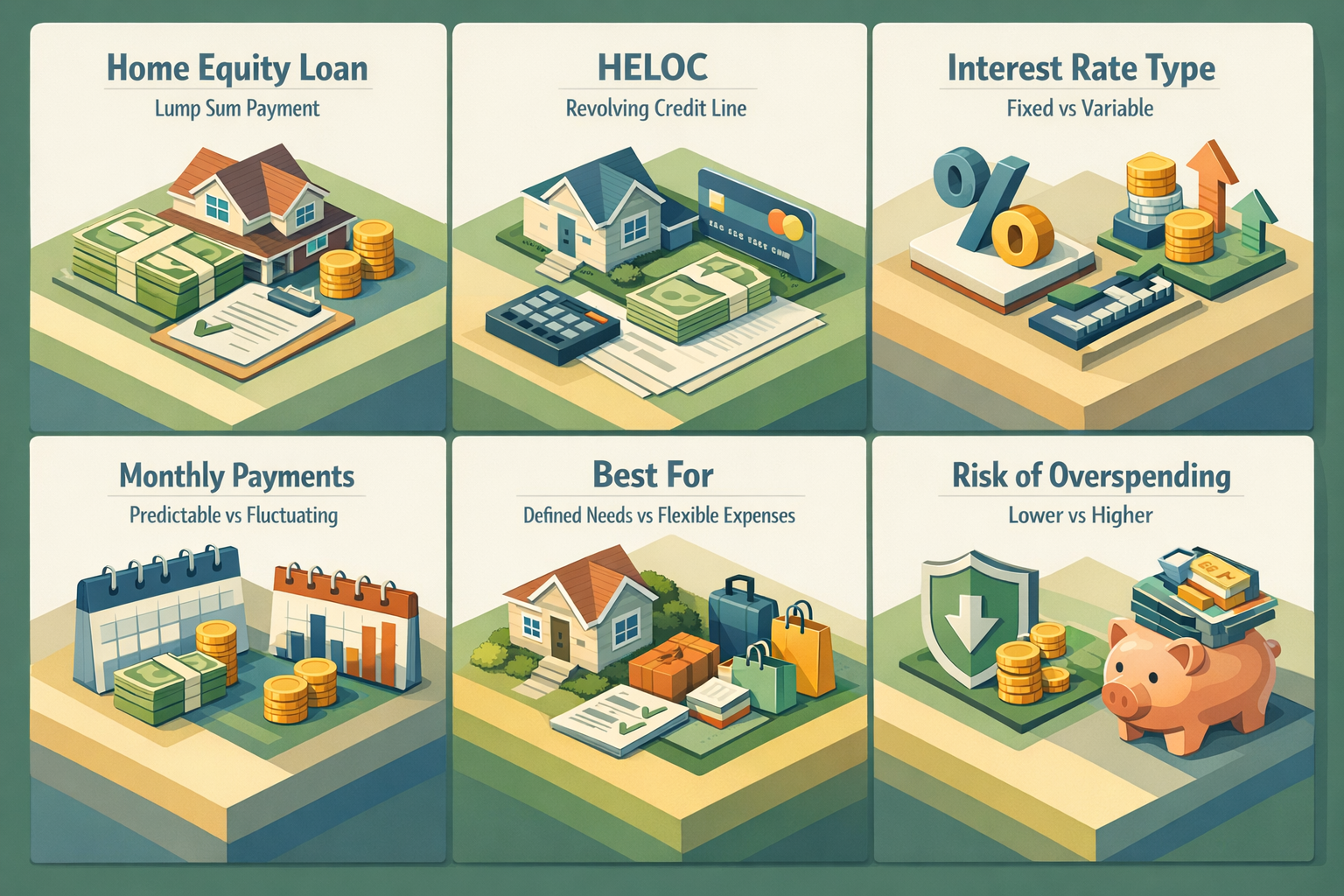
When weighing a home equity loan vs HELOC, it's helpful to look at the core differences in a straightforward way. Here's how each works across several key factors:
- Funding structure: Home equity loans provide a one-time lump sum; HELOCs offer a revolving line of credit.
- Interest rate type: Home equity loans typically have fixed rates; HELOCs usually carry variable rates.
- Monthly payments: Home equity loan payments are consistent and predictable; HELOC payments can change month to month.
- Best for: Home equity loans suit defined, one-time needs; HELOCs suit flexible or ongoing expenses.
- Risk of overspending: Lower with a lump-sum loan; higher with a revolving credit line if spending isn't managed carefully.
- Interest costs: With a HELOC, you only pay interest on what you use; with a home equity loan, interest accrues on the full amount from day one.
Neither option is universally better than the other. The right choice depends on your financial goals, spending habits, risk tolerance, and the nature of your borrowing need. Taking time to honestly evaluate these factors could help you avoid unnecessary costs down the road.
Qualification Requirements and What Lenders Look For
Both home equity loans and HELOCs require you to meet certain qualification standards, though specific requirements can vary by lender. Generally speaking, lenders will evaluate:
- Credit score: A score of 620 or higher is often required, though borrowers with scores above 700 may access more favorable rates and terms.
- Debt-to-income (DTI) ratio: Most lenders prefer a DTI below 43%, meaning your total monthly debt payments shouldn't exceed 43% of your gross monthly income.
- Home equity: Lenders typically require you to retain at least 15% to 20% equity in your home after borrowing.
- Employment and income verification: Consistent income history helps demonstrate your ability to repay. Self-employed borrowers may need to provide additional documentation.
- Property appraisal: Lenders will usually require an appraisal or valuation to confirm your home's current market value.
It's worth noting that lenders may tighten or loosen these standards based on broader economic conditions or their own lending appetite. If you've been turned down by one lender, shopping around and comparing multiple offers is often a smart strategy.
Tax Considerations and Potential Benefits to Know
One area that sometimes surprises homeowners is the potential tax treatment of interest paid on home equity loans and HELOCs. Under current U.S. tax law, the interest on these products may be tax-deductible — but only if the funds are used to buy, build, or substantially improve the home that secures the loan. Interest used for personal expenses like vacations or car purchases is generally not deductible.
This distinction matters, especially if you're comparing the after-tax cost of a home equity product versus other borrowing options. However, tax laws can change, and the deductibility of interest depends on your individual circumstances, including whether you itemize deductions. It's always advisable to consult a qualified tax professional before making borrowing decisions based on potential tax benefits.
Beyond taxes, both products may offer lower interest rates compared to unsecured debt options, which could make them cost-effective tools when used responsibly. Real estate investors, in particular, may find that using existing home equity to fund new acquisitions is a strategic way to grow a portfolio without liquidating assets — choose a product that fits your needs.
●Conclusion
Choosing between a home equity loan vs HELOC ultimately comes down to your specific financial situation and what you plan to do with the funds. If you need a set amount for a defined purpose and prefer predictable payments, a home equity loan may be the stronger fit. If your needs are flexible and ongoing, a HELOC's revolving structure could offer greater convenience and potentially lower interest costs over time.
Whichever route you're considering, taking time to compare lenders, understand the terms, and honestly assess your repayment capacity is essential. At LoanWise, we're here to help homeowners like you navigate these decisions with confidence. Reach out to our team today to explore your home equity borrowing options and find the solution that fits your goals.