
Real estate investors face a critical decision when selecting financing: hard money loans or traditional bank loans. Each option offers distinct advantages and challenges that can significantly impact your investment strategy's success. Understanding these differences helps investors make informed decisions that align with their timeline, property type, and financial goals.
Understanding Hard Money Loans for Real Estate Investors
Hard money loans are short-term financing solutions typically secured by real estate investment assets. These loans are often provided by private lenders or specialized lending companies rather than traditional banks. The approval process focuses primarily on the property's value and potential rather than the borrower's credit history or income documentation.
Most hard money loans feature terms ranging from six months to three years, making them ideal for time-sensitive investment opportunities. The asset-based lending approach means investors can often secure funding within days rather than weeks, which is crucial in competitive real estate markets.
Interest rates for hard money loans typically range higher than conventional financing, often between 8% to 15%, depending on the lender and deal structure. However, this premium reflects the speed, flexibility, and reduced documentation requirements that make these loans attractive for certain investment strategies.
Traditional Bank Loan Advantages and Requirements
Bank loans offer lower interest rates and longer repayment terms, making them cost-effective for long-term investment strategies. Conventional mortgages typically feature rates that may be several percentage points below hard money alternatives, potentially saving thousands in interest over the loan's life.
Traditional lenders require comprehensive documentation including tax returns, bank statements, employment verification, and detailed financial statements. The underwriting process examines debt-to-income ratios, credit scores, and cash reserves to ensure borrowers can handle monthly payments throughout the loan term.
Bank loans often provide terms extending 15 to 30 years, allowing investors to maintain lower monthly payments and preserve cash flow for additional investments or property improvements. This extended timeline works well for buy-and-hold strategies where immediate refinancing isn't necessary.
Speed and Approval Process Comparison
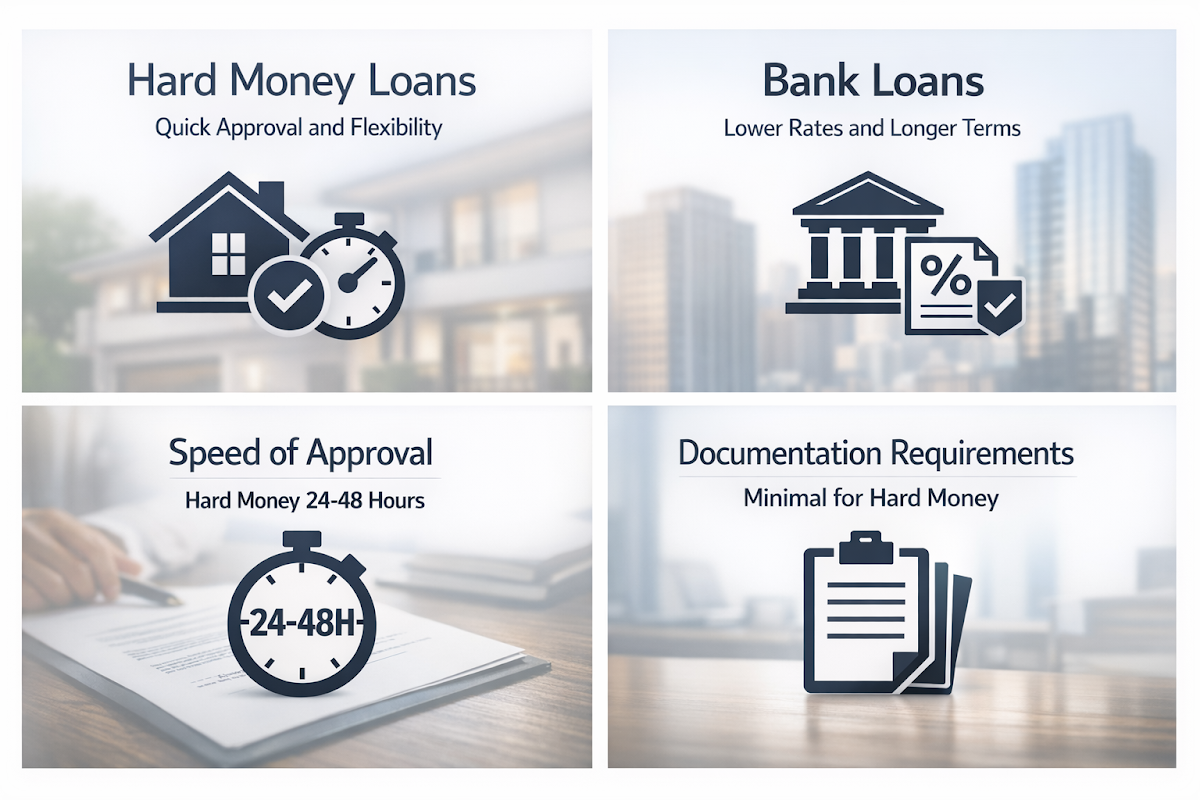
The most significant difference between hard money loans vs bank loans lies in processing speed and approval requirements. Hard money lenders can often provide approval within 24 to 48 hours and fund deals within one to two weeks. This rapid timeline proves essential for fix-and-flip projects or competitive bidding situations.
Traditional bank loans typically require 30 to 45 days for processing, with some complex deals taking even longer. The extensive documentation review, property appraisal, and committee approval processes create inherent delays that might cause investors to miss time-sensitive opportunities.
However, banks often provide more thorough due diligence, which can protect borrowers from problematic properties or unfavorable deal structures. The extended review process, while slower, may identify potential issues that could impact the investment's success.
Cost Analysis and Interest Rate Considerations
Interest rates represent just one component of total borrowing costs. Hard money loans typically charge higher rates but may include fewer fees than traditional mortgages. Some hard money lenders offer interest-only payments during the loan term, which can improve cash flow for short-term projects.
Bank loans feature lower interest rates but often include origination fees, appraisal costs, title insurance, and other closing expenses that can add thousands to the total project cost. These fees may be justified for longer-term holds where the lower rate provides substantial savings over time.
Investors should calculate the total cost of capital, including all fees and interest payments, when comparing options. A higher-rate hard money loan might cost less overall for a six-month fix-and-flip project than a lower-rate bank loan with extensive closing costs.
Ideal Investment Strategies for Each Loan Type
Hard money loans excel in scenarios requiring quick action or properties that don't qualify for traditional financing. Fix-and-flip projects, distressed properties, auction purchases, and time-sensitive opportunities often benefit from hard money's speed and flexibility.
These loans work particularly well when investors have identified profitable exit strategies within the short loan term, such as renovation and resale or refinancing into permanent financing once the property is stabilized.
Bank loans suit long-term rental property acquisitions, refinancing existing mortgages, or purchasing turnkey properties that don't require immediate renovation. The lower cost of capital makes them ideal for buy-and-hold strategies where investors plan to keep properties for years rather than months.
Documentation and Qualification Requirements
Hard money lenders typically require minimal documentation, focusing on the property's current value and after-repair value potential. Many approve loans based on the asset's strength rather than the borrower's financial profile, making them accessible to newer investors or those with complex income situations.
Self-employed investors, those with recent credit challenges, or investors seeking to close quickly often find hard money more accessible than traditional bank financing. The reduced paperwork requirement can streamline the approval process significantly.
Traditional banks require extensive financial documentation and maintain strict qualification standards. W-2 employees with steady income, strong credit scores, and substantial cash reserves typically find the best rates and terms through conventional lenders.
Making the Right Choice for Your Investment Goals
The decision between hard money loans vs bank loans depends on your specific investment strategy, timeline, and financial situation. Consider the property type, your exit strategy, available capital, and market conditions when evaluating options.
Experienced investors often use both financing types strategically, employing hard money for acquisition and renovation, then refinancing with traditional loans for long-term holds. This approach maximizes speed and flexibility while ultimately securing lower long-term financing costs.
Newer investors might benefit from starting with bank loans to understand the investment process before moving to more expensive hard money options. Building relationships with both traditional lenders and private money sources provides maximum flexibility for future opportunities.
●Conclusion
Both hard money loans and bank loans serve important roles in real estate investment financing. Success comes from matching the right financing tool to your specific investment strategy and goals. Consider your timeline, property type, exit strategy, and total cost of capital when making this crucial decision. Working with experienced mortgage professionals can help you navigate these options and structure financing that supports your investment success.