
Real estate investors often face unique challenges when securing traditional mortgage financing, particularly when their personal income doesn't align with conventional lending standards. DSCR loan requirements offer a solution by focusing on property cash flow rather than personal income verification. Understanding these requirements can open doors to investment opportunities that might otherwise remain inaccessible through traditional lending channels.
Understanding DSCR Loan Fundamentals
Debt Service Coverage Ratio loans represent a specialized financing option designed specifically for real estate investors. Unlike traditional mortgages that heavily scrutinize personal income through tax returns and employment verification, DSCR loans evaluate the property's ability to generate sufficient rental income to cover mortgage payments.
The core principle behind DSCR financing centers on the property's cash flow potential. Lenders calculate the debt service coverage ratio by dividing the property's gross rental income by the total debt service, including principal, interest, taxes, and insurance. This approach allows investors to qualify based on the investment property's performance rather than their personal financial situation.
Investment property financing through DSCR loans typically serves investors who may have complex income structures, multiple properties, or situations where traditional income documentation proves challenging. These loans can facilitate portfolio expansion without the constraints of conventional mortgage underwriting standards.
Key DSCR Loan Requirements and Qualification Criteria
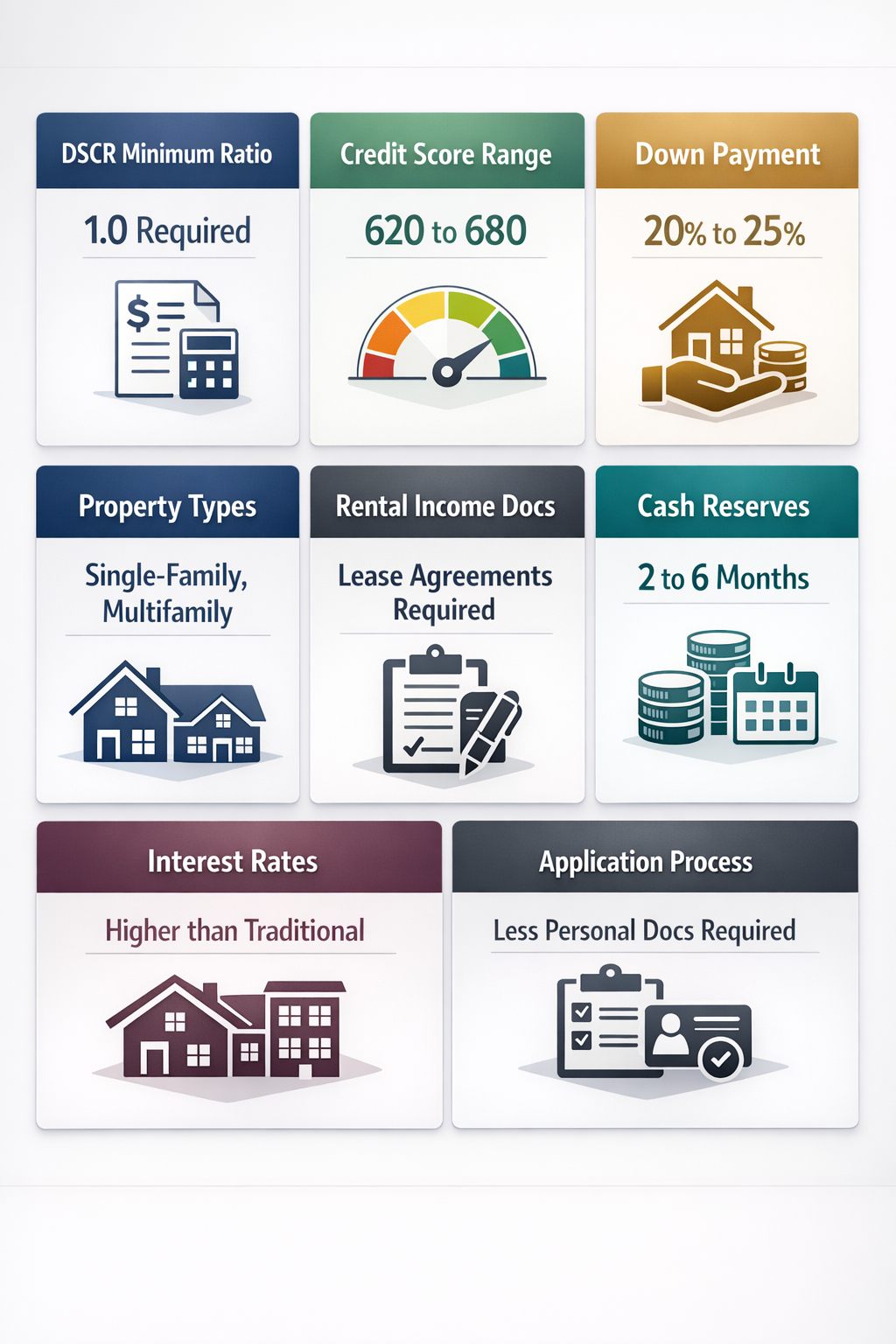
Most lenders require a minimum debt service coverage ratio of 1.0, though many prefer ratios of 1.25 or higher for optimal approval chances. A DSCR of 1.0 indicates that rental income exactly covers the mortgage payment, while ratios above 1.0 demonstrate positive cash flow potential.
Credit score requirements typically range from 620 to 680, depending on the lender and loan program. Higher credit scores often unlock better interest rates and more favorable terms. Additionally, most DSCR loan requirements require down payments between 20% and 25% of the property's purchase price.
Cash reserves play a crucial role in qualification. Lenders commonly require borrowers to maintain liquid assets equivalent to two to six months of mortgage payments. These reserves demonstrate the investor's ability to handle unexpected expenses or temporary vacancy periods.
Property type restrictions may apply, with most lenders focusing on traditional rental properties such as single-family homes, condominiums, and small multifamily units. Some programs extend to larger multifamily properties, though requirements may become more stringent.
Rental Income Documentation and Appraisal Process
For existing rental properties, lenders typically require lease agreements and rental history documentation to verify income streams. Bank statements showing rental deposits can strengthen the application by demonstrating consistent cash flow patterns.
When purchasing new investment properties, lenders often rely on market rent studies or appraisal rent schedules to determine potential rental income. Professional appraisals must include rent comparisons from similar properties in the area to establish realistic income projections.
Some lenders may accept rent surveys or broker opinions of value to supplement appraisal findings. However, the most reliable documentation comes from actual lease agreements with creditworthy tenants already in place.
Property condition significantly impacts both appraisal value and rental income estimates. Well-maintained properties in desirable locations typically receive higher rent projections, improving the overall debt service coverage ratio calculation.
Interest Rates and Loan Terms Structure
DSCR loan interest rates generally run higher than traditional mortgage rates, reflecting the increased risk associated with investment property financing. Rates might range from 0.5% to 1.5% above conventional mortgage rates, depending on market conditions and borrower qualifications.
Loan terms commonly span 30 years for amortization, though some programs offer 25-year or interest-only options. Shorter amortization periods result in higher monthly payments but reduced total interest costs over the loan's lifetime.
Many DSCR loans feature adjustable rate structures, with initial fixed periods ranging from two to ten years before converting to variable rates. Fixed-rate options may be available but could carry higher initial interest rates.
Prepayment penalties sometimes apply, particularly during the initial years of the loan term. These penalties protect lenders from early payoff scenarios that might reduce their expected returns on the investment.
Application Process and Documentation Requirements
The DSCR loan application process typically requires less personal financial documentation compared to traditional mortgages. However, borrowers must still provide basic identification, credit authorization, and asset verification.
Property-specific documentation takes precedence, including purchase agreements, property insurance quotes, and detailed property descriptions. For refinancing scenarios, current loan statements and property tax records become essential components.
Bank statements covering the previous two months help verify cash reserves and down payment sources. Some lenders may require additional asset documentation if the down payment comes from business accounts or investment liquidations.
Professional property management agreements, if applicable, should be included to demonstrate ongoing rental income collection and property maintenance arrangements. These agreements can strengthen the application by showing professional oversight of the investment.
Common Challenges and Approval Strategies
Market rent disputes can complicate DSCR loan approval when appraisers and borrowers disagree on rental income potential. Providing comparable rental listings and signed lease agreements helps support higher rent projections during the underwriting process.
Properties in transitional neighborhoods might face scrutiny regarding long-term rental demand. Demonstrating area development plans, population growth trends, and employment opportunities can address lender concerns about future rental stability.
Seasonal rental markets present unique challenges for DSCR qualification. Vacation rental properties or areas with significant seasonal employment fluctuations may require specialized lenders familiar with these market dynamics.
Multiple property ownership can complicate the application process, particularly if existing properties have marginal cash flow. Lenders may consider the overall portfolio performance, making strong-performing properties more valuable for qualification purposes.
Portfolio Expansion and Long-Term Investment Planning
DSCR loan requirements become increasingly important as investors scale their portfolios. Each additional property acquisition builds upon previous successes, with strong-performing properties supporting future financing opportunities.
Geographic diversification strategies should consider local DSCR lending availability and market rental conditions. Some regions may offer more favorable lending environments or stronger rental markets that improve debt service coverage calculations.
Refinancing existing properties into DSCR loans can free up personal income qualification capacity for other investments. This strategy allows investors to optimize their financing structure while maintaining portfolio growth momentum.
Long-term planning should account for potential interest rate adjustments and market rental property financing fluctuations. Building adequate cash flow cushions helps ensure continued loan performance throughout various economic cycles.
●Conclusion
DSCR loan requirements provide real estate investors with flexible financing solutions that focus on property performance rather than personal income constraints. Success with these programs requires understanding the qualification criteria, maintaining adequate cash reserves, and selecting properties with strong rental income potential. By mastering these requirements, investors can build substantial real estate portfolios while leveraging the unique advantages of debt service coverage ratio financing.