
Real estate investors seeking financing for rental properties often find traditional mortgage qualification challenging due to complex income verification requirements. DSCR loan requirements offer a streamlined alternative by focusing on the property's cash flow potential rather than personal income documentation. These specialized investment property loans evaluate your ability to service debt based on rental income, making them particularly attractive for experienced investors and those with non-traditional income sources. Understanding the specific qualification criteria can help you determine if this financing option aligns with your investment strategy and portfolio goals.
Understanding DSCR Loan Qualification Fundamentals
Debt Service Coverage Ratio loans represent a significant shift from traditional mortgage underwriting by prioritizing property performance over borrower income verification. The fundamental requirement centers on the property's ability to generate sufficient rental income to cover the monthly mortgage payment, typically requiring a minimum ratio of 1.0 or higher.
Most lenders prefer seeing ratios between 1.20 and 1.25, indicating the property generates 20-25% more income than needed for debt service. This buffer provides protection against vacancy periods and unexpected expenses that might affect rental income. The calculation involves dividing the property's gross monthly rental income by the total monthly debt service, including principal, interest, taxes, and insurance.
Investment property financing through DSCR programs often allows investors to qualify without traditional employment verification, tax returns, or income documentation that can complicate conventional loan applications. This streamlined approach particularly benefits self-employed investors, those with multiple income streams, or investors whose personal income doesn't reflect their true financial capacity.
Credit Score and Financial Requirements
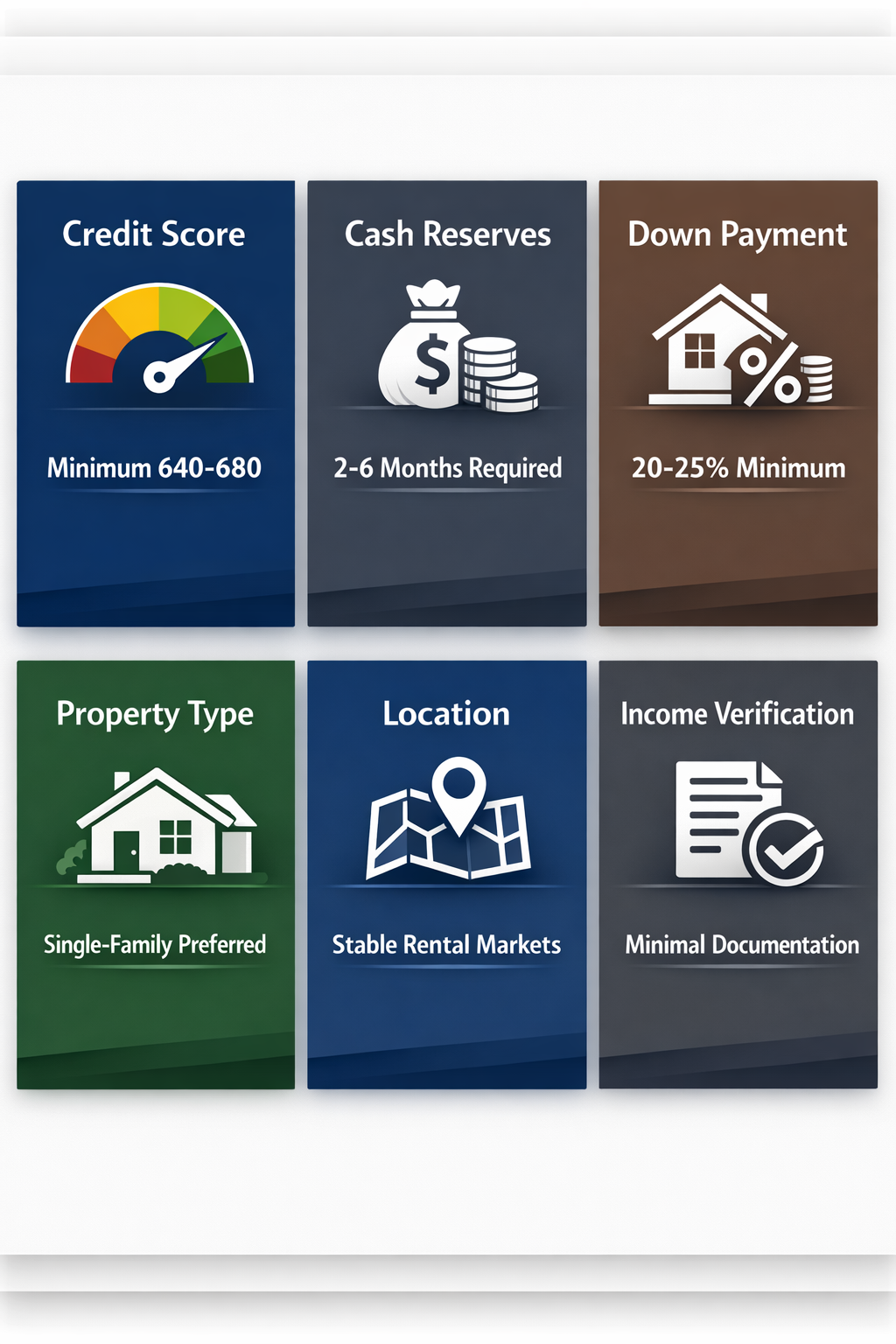
DSCR loan requirements typically mandate minimum credit scores ranging from 640 to 680, depending on the lender and specific program guidelines. Higher credit scores often unlock better interest rates and more favorable loan terms, making credit optimization an important consideration before applying.
Beyond credit scores, lenders evaluate overall creditworthiness through payment history, debt-to-income considerations, and existing real estate investment experience. While traditional income verification may not be required, lenders might still assess your ability to handle multiple mortgage payments if you own additional investment properties.
Cash reserves represent another critical requirement, with most programs requiring 2-6 months of mortgage payments held in reserve accounts. These reserves demonstrate your ability to handle unexpected vacancies or property expenses that could temporarily affect rental income. The exact reserve requirements often depend on your credit profile, property type, and overall investment experience.
Some lenders also require proof of property management experience or real estate investment history, particularly for larger loan amounts or more complex property types. First-time investors might face additional scrutiny or higher down payment requirements compared to experienced real estate investors with established track records.
Down Payment and Equity Requirements
Investment property financing through DSCR programs typically requires larger down payments compared to owner-occupied properties, with most lenders requiring 20-25% minimum down payments. Some programs might accept down payments as low as 15% for highly qualified borrowers with excellent credit and strong cash reserves.
The down payment amount directly impacts your loan-to-value ratio, which affects both approval likelihood and interest rate pricing. Lower LTV ratios generally result in better terms and reduced lender risk, making larger down payments advantageous when possible.
For refinancing existing investment properties, lenders typically allow cash-out up to 75-80% of the property's appraised value. This equity access can provide capital for additional investments, property improvements, or portfolio expansion strategies.
Gift funds for down payments are generally not accepted in DSCR loan programs, as lenders want to ensure borrowers have genuine financial investment in the property's success. All down payment funds must typically be seasoned in accounts for 60-90 days or come from verifiable asset liquidation.
Property Types and Location Considerations
DSCR loan requirements vary significantly based on property type, with single-family rentals, small multifamily properties, and condominiums typically receiving the most favorable treatment. Properties with 1-4 units are generally easier to finance and qualify for better rates compared to larger multifamily investments.
Geographic location plays a crucial role in approval decisions, as lenders prefer properties in stable rental markets with consistent demand. Urban and suburban areas with diverse employment bases typically receive more favorable consideration than rural locations or areas dependent on single industries.
Property condition requirements mandate that financed properties be rent-ready or require minimal work to achieve rental status. Extensive renovation projects or properties requiring significant repairs might not qualify for DSCR financing, as lenders need immediate rental income to support the debt service calculation.
Condominium financing through DSCR programs often requires additional scrutiny of homeowners association financial health and rental restrictions. Some HOAs limit rental activity, which could affect the property's eligibility for investment property financing.
Income Documentation and Verification Process
The streamlined nature of DSCR loan requirements means minimal personal income documentation, but lenders still require comprehensive property income verification. Existing rental properties need lease agreements, rental history, and sometimes property management statements to establish income reliability.
For properties without existing rental income, lenders typically use market rent analyses or appraisal rent estimates to determine income potential. These assessments consider comparable rental properties, local market conditions, and property-specific features that might affect rental rates.
Some programs allow rental income from other investment properties to strengthen the overall application, particularly when the subject property's DSCR falls slightly below preferred thresholds. This portfolio approach recognizes that experienced investors often manage multiple properties as an integrated investment strategy.
Vacancy factors are typically applied to gross rental income calculations, with most lenders using 75-80% of gross rents to account for normal vacancy periods and collection issues. This conservative approach ensures debt service calculations reflect realistic income expectations rather than optimistic projections.
Application Process and Timeline Expectations
The DSCR loan application process typically moves faster than conventional mortgage applications due to reduced documentation requirements, with most loans closing within 30-45 days under normal circumstances. However, complex properties or unique situations might extend timelines.
Initial pre-qualification can often be completed quickly using basic property information and credit assessment, allowing investors to move confidently when identifying potential acquisitions. This speed advantage proves particularly valuable in competitive real estate markets where quick closing capability provides negotiating leverage.
Appraisal requirements follow similar standards to other investment property loans, but appraisers must also provide rental income estimates that support the DSCR calculation. Market conditions and appraiser availability can sometimes create bottlenecks in the approval process.
Rate locks are typically available for 30-60 days, providing protection against interest rate fluctuations during the approval and closing process. Some lenders offer extended rate lock options for complex transactions or when property preparation might delay closing timelines.
Maximizing Approval Success and Rate Optimization
Successful DSCR loan approval often depends on presenting a complete financial picture that demonstrates investment experience and financial stability. Organizing property documentation, lease agreements, and financial statements before application submission can streamline the process significantly.
Working with experienced mortgage professionals who specialize in investment property financing can provide valuable guidance on program selection and application optimization. These professionals understand nuanced requirements that might affect approval decisions or rate pricing.
Consider timing applications when credit scores are optimized and cash reserves are maximized, as these factors directly impact both approval likelihood and final loan terms. Small improvements in these areas can sometimes result in significantly better pricing or program options.
Multiple property scenarios might benefit from portfolio lending approaches or programs that consider overall investment performance rather than individual property metrics. Experienced investors with strong track records often have access to more flexible underwriting guidelines and competitive pricing structures.
●Conclusion
DSCR loan requirements provide real estate investors with valuable financing alternatives that prioritize property performance over traditional income verification methods. Success in securing these loans depends on understanding the specific qualification criteria, maintaining strong credit profiles, and presenting properties that demonstrate reliable income potential. By focusing on debt service coverage ratios, cash reserves, and property fundamentals, investors can access capital for portfolio growth while avoiding the complexities of conventional mortgage documentation. Whether you're expanding an existing portfolio or entering the investment property market, understanding these requirements positions you to make informed financing decisions that support your long-term investment objectives.