Buying a home with less than 20% down is a common path for many homebuyers — especially those entering the market for the first time. If you're planning to put down 7% on a conventional loan, one term you'll need to understand is private mortgage insurance, or PMI. It's an added monthly cost that protects the lender if you were to default on the loan, and it directly affects your overall housing budget. Understanding the cost of PMI for a conventional loan with 7% down payment can help you plan smarter, compare loan options more effectively, and know when you might be able to drop the coverage altogether. This guide walks you through everything you need to know.
Why a 7% Down Payment Triggers Private Mortgage Insurance
When you take out a conventional loan — one not backed by a government agency like the FHA or VA — lenders typically require PMI if your down payment is less than 20% of the home's purchase price. At 7% down, you're financing 93% of the home's value, which means your loan-to-value ratio (LTV) sits at 93%. That's well above the 80% threshold lenders use to determine risk.
From the lender's perspective, a higher LTV means greater exposure if the borrower stops making payments. PMI offsets that risk. It's important to understand that PMI protects the lender, not you as the borrower — yet you're the one paying for it. This is a common point of confusion for homebuyers who are new to the mortgage process.
The good news is that PMI is not permanent. Once your loan balance drops to a certain level relative to the home's value, you may be eligible to have it removed. But first, let's look at what it actually costs.
Breaking Down the Private Mortgage Insurance Calculation at 7%
The private mortgage insurance calculation at 7% down depends on several factors, including your credit score, loan amount, loan term, and the PMI provider the lender uses. That said, PMI rates on conventional loans generally range from roughly 0.5% to 1.5% of the original loan amount per year, though your specific rate could fall outside this range depending on your financial profile.
Here's a simplified example to illustrate how this works in practice:
- Home purchase price: $350,000
- Down payment (7%): $24,500
- Loan amount: $325,500
- Estimated PMI rate: 0.85% annually
- Annual PMI cost: approximately $2,767
- Monthly PMI cost: approximately $231
This is a hypothetical illustration. Your actual PMI rate may be higher or lower depending on your credit score and the lender's requirements. Borrowers with stronger credit profiles — typically 740 and above — often qualify for lower PMI rates, while those with scores in the mid-600s may see higher premiums.
It's also worth noting that PMI is calculated based on the original loan amount in many cases, although some lenders base it on the declining balance. Always ask your lender how they calculate PMI before finalizing your loan.
Key Factors That Influence Your PMI Rate on a Conventional Loan
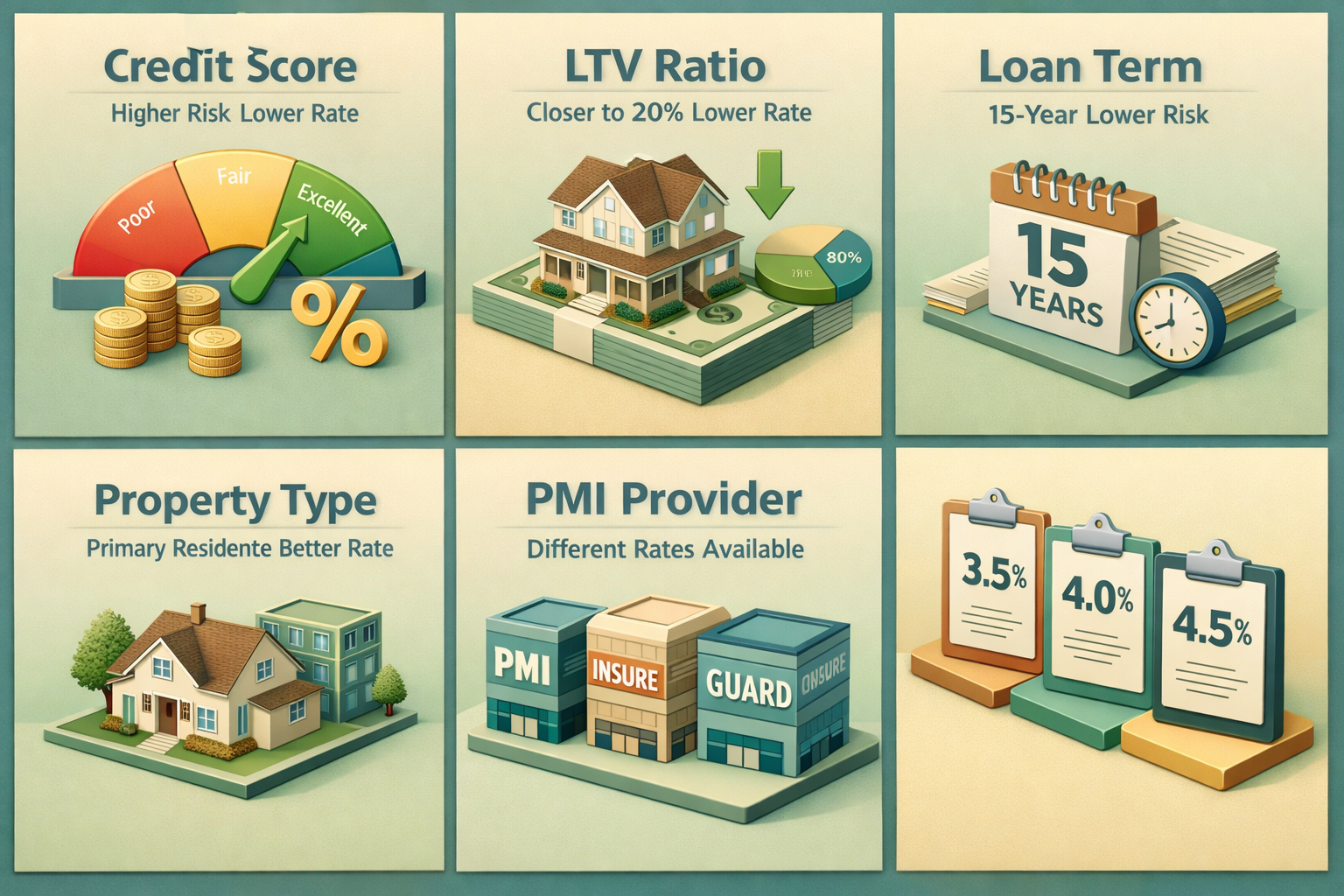
Not every borrower putting 7% down will pay the same PMI rate. Several variables play a role in determining what you'll owe each month. Understanding these factors can help you position yourself for a lower rate — or at least set realistic expectations.
- Credit score: This is often the most significant factor. A higher credit score signals lower risk to lenders and PMI providers, which can translate to a meaningfully lower insurance rate.
- Loan-to-value ratio (LTV): At 7% down, your LTV is 93%. The closer you can get to 20% down, the lower your PMI rate — or you may be able to eliminate it entirely.
- Loan term: A 15-year mortgage may carry a lower PMI rate compared to a 30-year loan because the shorter term reduces the lender's long-term risk exposure.
- Type of property: Primary residences typically receive better PMI rates than investment properties or second homes, which lenders view as higher risk.
- PMI provider: Lenders work with different private mortgage insurance companies, and rates can vary between them. You generally don't choose the provider directly, but you can ask your lender about alternatives.
If you're concerned about PMI costs, improving your credit score before applying — even by a modest amount — could potentially reduce your monthly premium and save you money over the life of the loan.
Different Ways Lenders Structure PMI Payments
PMI doesn't always come as a simple monthly add-on to your mortgage payment. Lenders may offer a few different payment structures, each with its own trade-offs. Knowing your options helps you choose what works best for your financial situation.
- Monthly PMI: The most common approach. A fixed monthly premium is added to your mortgage payment. This option requires no upfront cost and ends when you reach sufficient equity.
- Single-premium PMI: You pay the entire PMI cost upfront at closing, either in cash or rolled into the loan. This eliminates the monthly charge but increases your closing costs or loan balance.
- Split-premium PMI: A combination of an upfront payment at closing and reduced monthly premiums. This can lower your monthly obligation without requiring the full upfront premium.
- Lender-paid PMI (LPMI): The lender covers the PMI cost but typically charges a higher interest rate in exchange. While this removes the separate PMI line item, it may cost more over the long run since you can't cancel the higher rate once you reach 20% equity.
Monthly PMI tends to be the most flexible option for most homebuyers because it can be removed once your equity increases. However, if you expect to stay in the home for a shorter period, a single-premium or lender-paid structure might make more financial sense depending on the specific numbers.
How the Cost of PMI for a Conventional Loan with 7% Down Payment Compares to Other Options
It's helpful to put the cost of PMI for a conventional loan with 7% down payment into context by looking at how it stacks up against other financing paths available to homebuyers.
FHA loans also require mortgage insurance when you put less than 20% down, but FHA mortgage insurance premiums (MIP) work differently. FHA charges both an upfront premium and an annual premium. For many borrowers, FHA MIP may actually be more expensive over time — and unlike conventional PMI, FHA MIP on loans with low down payments often lasts the life of the loan unless you refinance.
VA loans don't require PMI at all, which is a significant benefit for eligible veterans and service members. However, VA loans come with a funding fee that varies based on down payment and service history.
USDA loans also skip traditional PMI but include a guarantee fee, which serves a similar protective function for the government-backed program.
Compared to these alternatives, a conventional loan with 7% down on a conventional loan and PMI may still offer competitive overall costs — especially if you have strong credit. The key advantage is that conventional PMI is cancellable, giving you a clear path to eliminating the extra expense once you build equity.
Smart Strategies to Reduce or Eliminate PMI Faster
Nobody wants to pay PMI longer than necessary. The good news is there are several approaches that could help you reduce or eliminate it more quickly after purchasing your home.
- Make extra principal payments: Paying down your loan balance faster accelerates the buildup of equity. Even small additional monthly payments toward principal can shorten the time it takes to reach the 80% LTV threshold.
- Request cancellation at 80% LTV: Under the Homeowners Protection Act, you have the right to request PMI cancellation when your loan balance reaches 80% of the original purchase price, provided you have a good payment history and meet lender requirements.
- Automatic termination at 78% LTV: Lenders are required by law to automatically cancel PMI when your loan balance reaches 78% of the original value — as long as you're current on payments.
- Reappraise after home value increases: If your home has appreciated significantly, you may be able to request a new appraisal to demonstrate that your current LTV has dropped below 80%, potentially qualifying you for early PMI removal. Lender policies on this vary, so ask directly.
- Refinance into a new loan: If interest rates are favorable and your home has appreciated, refinancing into a new conventional loan at or below 80% LTV could eliminate PMI entirely — though you'll need to weigh refinancing costs against the savings.
Planning ahead and staying proactive about your equity position can meaningfully reduce the total amount you spend on PMI over the course of your loan.
Is a 7% Down Conventional Loan Still Worth It Despite PMI Costs?
This is a question many homebuyers wrestle with, and the answer depends on your personal financial picture, local housing market conditions, and long-term goals. Waiting to save a full 20% down payment could take years — and during that time, home prices in your area might rise, potentially making it harder to afford the same property later.
In many cases, getting into a home sooner and building equity — even while paying PMI — may be financially advantageous compared to renting while saving for a larger down payment. The monthly PMI cost is real, but so is the opportunity to build wealth through homeownership and potential appreciation.
That said, it's worth doing the math specific to your situation. Consider how long you plan to stay in the home, your expected rate of equity accumulation, and whether the PMI premium fits comfortably within your monthly budget alongside your mortgage payment, taxes, and insurance.
Speaking with a knowledgeable mortgage professional can help you run different scenarios and determine whether 7% down makes sense for you — or whether adjusting your down payment amount, exploring different loan programs, or waiting a bit longer could lead to better outcomes. There's no single right answer, but being informed puts you in a much stronger position to decide.
●Conclusion
Understanding the cost of PMI for a conventional loan with 7% down payment is an essential step in planning your home purchase. While PMI adds to your monthly expenses, it doesn't have to be a permanent cost — and for many buyers, it's a worthwhile trade-off for the ability to purchase a home sooner. By knowing how PMI is calculated, what factors influence the rate, and how to strategically build equity, you can make confident, well-informed decisions about your mortgage. At LoanWise, we're here to help you explore your options and find the financing path that works best for your goals. Reach out to one of our mortgage specialists today and take the next step toward homeownership.