
Losing a job is stressful enough on its own, but when you also have an adjustable-rate mortgage (ARM) with a rate reset on the horizon, the financial pressure can feel overwhelming. The good news is that receiving a severance package may open more doors than you'd expect — including the possibility of refinancing into a more predictable, fixed-rate mortgage. Understanding the best options for refinancing ARM mortgage with severance package income requires knowing how lenders evaluate non-traditional earnings, what loan programs are available, and what steps you can take right now to protect your home and your financial future. This guide walks you through everything you need to know.
Why ARM Holders Should Consider Refinancing After Job Loss
An adjustable-rate mortgage can seem like a smart choice when interest rates are low and your income is stable. But once your fixed introductory period ends, your rate can adjust — sometimes significantly — based on broader market conditions. If you've recently experienced a job loss and are relying on a severance package to bridge the gap, a rate increase could stretch your budget to a breaking point.
Refinancing your ARM into a fixed-rate mortgage offers a way to lock in a consistent monthly payment, making it easier to manage your household finances during a period of income transition. A fixed-rate loan removes the uncertainty of future rate adjustments, giving you a predictable payment schedule regardless of what happens to benchmark interest rates.
Beyond payment stability, refinancing at the right time could potentially lower your interest rate depending on current market conditions, reduce your monthly obligation, or even allow you to tap into home equity if needed. For homeowners navigating a career transition, these benefits can make a meaningful difference in financial resilience.
How Lenders View Severance Pay as Qualifying Income
One of the most common questions homeowners ask is whether severance pay counts as qualifying income for a mortgage refinance. The honest answer is: it depends. Lenders typically assess income based on its consistency, documentation, and likelihood of continuation — and severance pay can be tricky on all three fronts.
In general, conventional lenders following Fannie Mae and Freddie Mac guidelines may consider severance income if it's well-documented and expected to continue for a defined period, often at least three years from the loan's closing date. However, since severance pay is by nature temporary, many lenders may not count it as primary qualifying income on its own. Instead, it might be viewed as a financial reserve or a supplement to other documented income sources.
That said, there are situations where severance income could strengthen your application:
- As a financial reserve: Even if lenders don't count your severance as monthly income, demonstrating several months of reserves can reassure underwriters that you can meet mortgage obligations during a job search.
- Bridge income documentation: If your severance agreement specifies a lump sum or a continuation of salary payments over a set period, your lender may view the documented term favorably.
- Asset depletion method: Some lenders allow borrowers to convert documented assets — including cash from a severance payout — into a monthly income equivalent for qualifying purposes.
It's wise to speak with a licensed mortgage professional who can evaluate your specific severance agreement and help you present your financial situation in the strongest possible light.
Exploring the Best Options for Refinancing ARM Mortgage with Severance Package Income
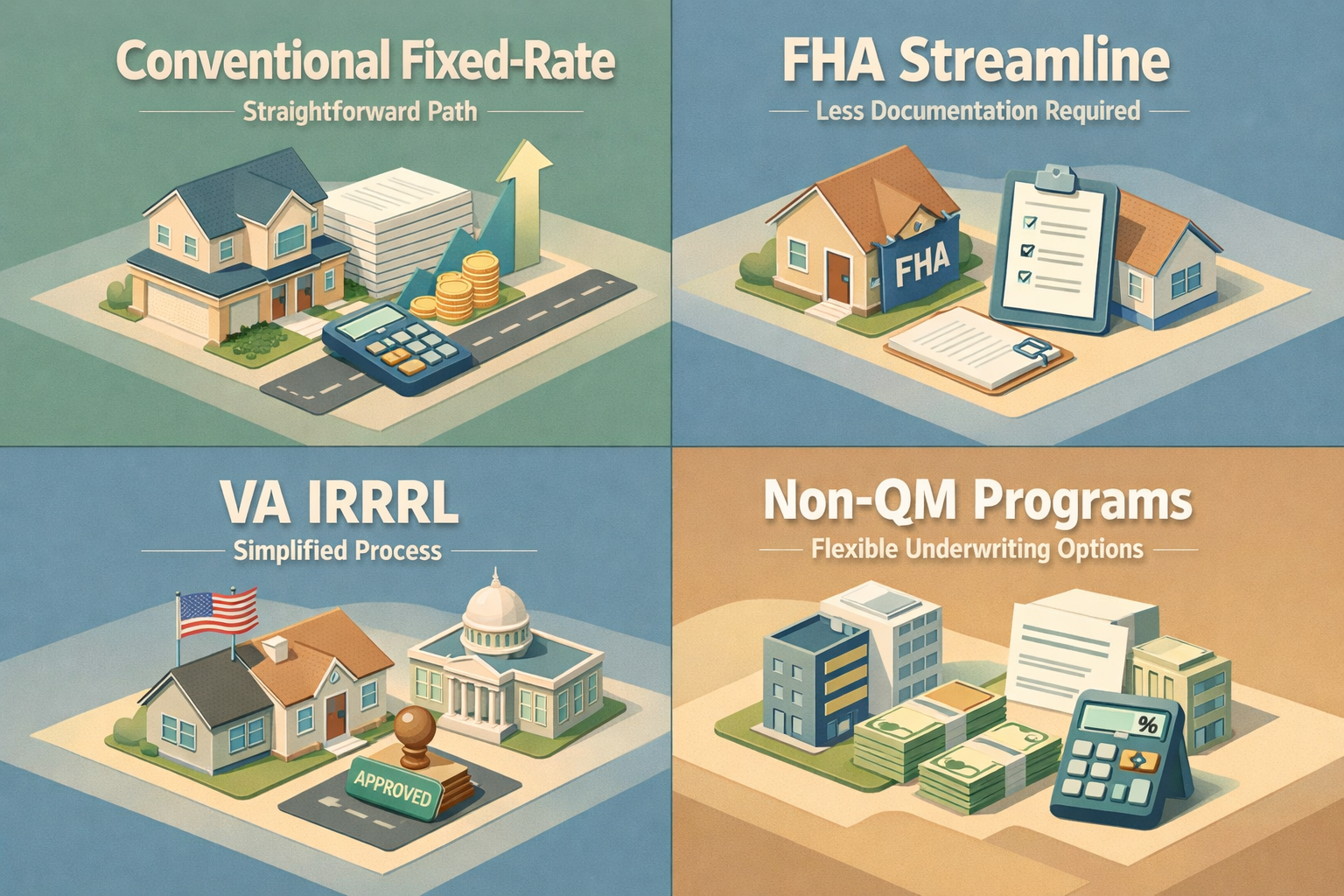
When you're ready to explore the best options for refinancing ARM mortgage with severance package funds in hand, several loan programs may be worth considering depending on your credit profile, equity position, and overall financial picture.
Conventional Fixed-Rate Refinance
A conventional refinance into a 15-year or 30-year fixed-rate mortgage is often the most straightforward path. If you have solid credit, sufficient home equity (typically at least 20% to avoid private mortgage insurance), and can document your financial situation thoroughly, conventional programs may offer competitive rates. The challenge during job loss is demonstrating income continuity, so having a signed offer letter from a new employer or a well-structured severance agreement could help bridge that gap.
FHA Streamline Refinance
If your current mortgage is FHA-insured, an FHA Streamline Refinance could be an appealing option. This program typically requires less documentation than a full refinance and may not require a new income verification in all cases, depending on the lender and the specific loan scenario. However, not all lenders apply the same flexibility, so it's important to shop around and confirm what's required.
VA Interest Rate Reduction Refinance Loan (IRRRL)
Eligible veterans, active-duty service members, and surviving spouses with VA-backed mortgages may qualify for the VA IRRRL, sometimes called a VA Streamline Refinance. Similar to the FHA Streamline, this program is designed to simplify the refinancing process and may reduce income documentation requirements. It's one of the more borrower-friendly refinance options available for those who qualify.
Non-QM and Asset-Based Refinance Programs
For homeowners who don't fit neatly into conventional or government-backed loan boxes, non-qualified mortgage (Non-QM) programs may offer more flexible underwriting. Lenders offering asset depletion or bank statement programs may be willing to qualify you based on documented assets — including your severance payout — rather than traditional employment income. These programs often come with slightly higher rates, but they can be a valuable option when standard pathways aren't available.
Building a Strong Refinance Application During a Career Transition
Even with a severance package in hand, a successful mortgage refinance application requires careful preparation. Here are key steps to strengthen your position before you apply:
- Organize your severance documentation: Gather your separation agreement, any salary continuation letters, and bank statements showing deposits. Clear, thorough documentation helps lenders assess your financial situation with confidence.
- Check your credit score: Your credit profile plays a major role in refinance approval and the interest rate you're offered. Pull your credit reports from all three bureaus and address any inaccuracies before applying.
- Calculate your home equity: Lenders typically require a minimum loan-to-value (LTV) ratio to approve a refinance. A home appraisal may be necessary to confirm your property's current market value, so understanding your equity position in advance can help you set realistic expectations.
- Minimize new debt obligations: Avoid opening new credit accounts or taking on additional debt during the refinance process, as this could negatively affect your debt-to-income (DTI) ratio.
- Demonstrate liquid reserves: Showing several months of mortgage payments in savings or accessible accounts can reassure underwriters during a period when your income may be in transition.
- Work with a knowledgeable loan officer: An experienced mortgage professional familiar with non-traditional income scenarios can help you identify the most suitable loan program and guide you through the application process efficiently.
Timing Your Refinance to Make the Most of Your Severance Funds
Timing matters a great deal when you're refinancing during a period of financial change. Ideally, you'd want to initiate the refinance process as soon as possible after receiving your severance package — while the funds are fresh, your credit is intact, and before any extended gap in employment becomes a concern for underwriters.
Some lenders may require that you have been employed within a certain window before approving a refinance. If you've already secured a new job or have a firm offer in hand, that can work significantly in your favor. A signed employment offer letter specifying your start date and compensation is often accepted by lenders as evidence of forthcoming income.
On the other hand, if your job search is still ongoing, focusing on loan programs with more flexible income documentation — such as Non-QM or streamline refinance options — may be the smarter short-term approach. Acting before your severance funds are depleted also ensures you can demonstrate meaningful financial reserves during underwriting.
It's also worth monitoring the broader interest rate environment. Refinancing ARM mortgage when rates are favorable relative to your current ARM rate could amplify the financial benefit of making the switch to a fixed-rate loan. A mortgage calculator can help you estimate potential monthly savings and break-even timelines based on current rate scenarios.
Understanding the Costs and Break-Even Point of Refinancing
Refinancing isn't free, and understanding the associated costs is essential — especially when you're managing finances during a job transition. Typical refinance closing costs may range from 2% to 5% of the loan amount, covering expenses such as origination fees, appraisal fees, title insurance, and prepaid items. While some lenders offer no-closing-cost refinance options, these often come with a slightly higher interest rate in exchange, so it's important to weigh the trade-offs carefully.
The break-even point is a critical concept here. This is the point at which your monthly savings from the lower or more stable payment outweigh the upfront costs of refinancing. For example, if your closing costs total a certain amount and you save a meaningful sum each month, you'd divide the total cost by the monthly savings to find how many months it takes to recoup the investment.
For homeowners using severance pay to cover refinancing costs, it's important to ensure that doing so doesn't eliminate the reserves you need to qualify for the loan in the first place. Some lenders allow closing costs to be rolled into the new loan balance, which can preserve your cash reserves — though it does increase your overall loan amount and potentially your monthly payment slightly.
Consulting with a mortgage advisor before committing to a refinance can help you run the numbers and determine whether the timing and structure of the transaction make financial sense given your specific situation.
●Conclusion
Navigating a refinance while relying on a severance package is certainly more complex than refinancing with stable employment income, but it's far from impossible. The best options for refinancing ARM mortgage with severance package funds will depend on your individual financial profile, the type of mortgage you currently hold, and how well you can document your financial position to a lender. Whether you pursue a conventional fixed-rate refinance, an FHA or VA streamline option, or a Non-QM program designed for non-traditional income scenarios, the key is to act thoughtfully, gather thorough documentation, and work with experienced professionals who understand your circumstances. At LoanWise, we're here to help homeowners in every season of life find the financing solutions that make the most sense. Reach out today to explore your refinance options and take a confident step toward financial stability.