
Retirement is supposed to feel like a reward — not a financial tightrope walk. But if you're carrying an adjustable-rate mortgage (ARM) into your retirement years, rising interest rates could make your monthly payments unpredictable and stressful. The good news is that refinancing is very much on the table, even when your income now comes from Social Security, pension distributions, investment accounts, or retirement savings. This article walks you through the best options for refinancing ARM mortgage with retirement income and savings, so you can make a confident, well-informed decision about your home and your financial future.
Why Retirees with ARMs Should Consider Refinancing Now
Adjustable-rate mortgages can be attractive during the initial fixed-rate period, but once that period ends, your rate adjusts periodically based on a market index. For retirees living on fixed or semi-fixed income streams, that unpredictability can be genuinely harmful. A sudden rate spike could add hundreds of dollars to your monthly payment — at exactly the time in life when your budget may be tightest.
Many homeowners originally chose ARMs when they planned to sell or refinance before the adjustment period kicked in. But life doesn't always go according to plan. If you're now in or approaching retirement and still holding an ARM, it may be worth reviewing whether refinancing into a more stable loan structure makes sense for your long-term goals.
Interest rate environments shift, and while no one can predict with certainty where rates will go, locking into a fixed-rate product could provide the payment predictability that retirees often prioritize above all else. Even if today's fixed rates are higher than your current ARM rate, the peace of mind and budgeting stability may outweigh the short-term cost.
How Lenders View Retirement Income During the Approval Process
One of the biggest concerns retirees have when exploring ARM refinance retirement income options is whether they'll qualify at all. The encouraging truth is that lenders are not permitted to discriminate based on age, and many types of retirement income are considered acceptable for mortgage qualification purposes.
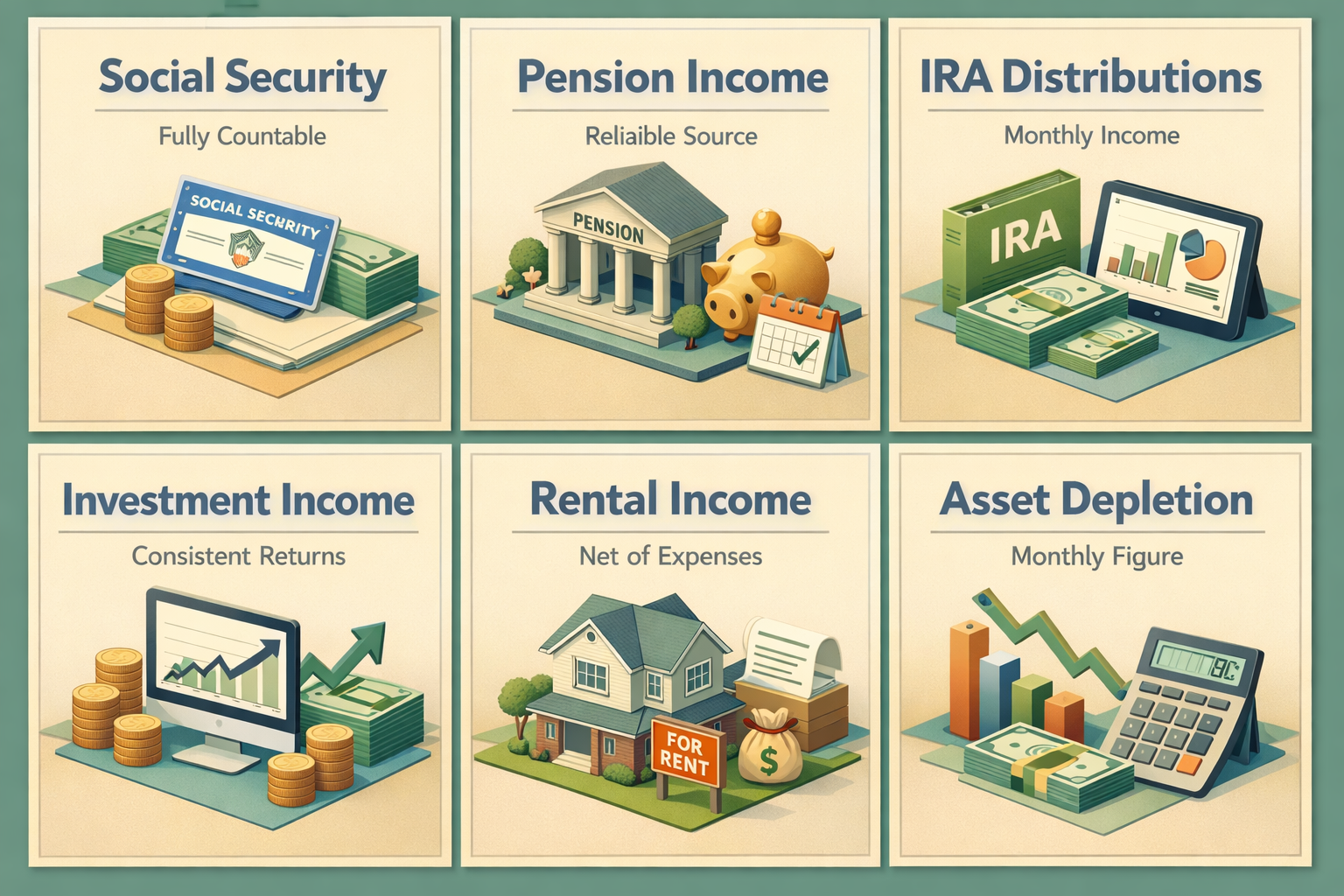
Here's what lenders may count as qualifying income:
- Social Security benefits: These are typically fully countable, and some lenders may even gross them up by 25% if they're tax-free, potentially strengthening your debt-to-income ratio.
- Pension and annuity income: Regular, documented pension distributions are generally viewed favorably since they're reliable and predictable.
- IRA and 401(k) distributions: If you're currently taking distributions, those may be counted as qualifying income. Some lenders also use an asset depletion method, which converts the total balance of your retirement accounts into a monthly income figure.
- Investment and dividend income: Documented dividend income or interest from brokerage accounts may qualify, especially if it's been consistent over a two-year period.
- Rental income: If you own rental properties, that income — net of expenses — might also be included in your qualifying profile.
It's important to work with a lender who has experience with retiree borrowers, as documentation requirements can differ from what a traditionally employed borrower provides. Gathering at least two years of tax returns, award letters, and account statements will typically support your application.
Fixed-Rate Mortgages as a Stable Alternative to ARMs
The most common path for retirees refinancing out of an ARM is moving into a fixed-rate mortgage. With a fixed-rate loan, your interest rate and principal-and-interest payment remain the same for the life of the loan — giving you a consistent, budget-friendly housing expense each month.
When considering term length, retirees often weigh shorter terms like 10, 15, or 20 years against the standard 30-year option. A shorter term typically means a higher monthly payment but significantly less interest paid over the life of the loan. If your retirement savings are healthy and your income supports the higher payment, a 15-year fixed mortgage could save you a considerable amount in interest while helping you build equity faster or pay off the home sooner.
On the other hand, if cash flow flexibility is your priority, a 30-year fixed mortgage keeps your payment lower and leaves more room in your monthly budget. This approach may make sense if you prefer to keep retirement savings invested and earning returns rather than accelerating mortgage payoff.
Either way, converting an ARM to a fixed-rate loan is often one of the most straightforward and effective strategies available when exploring the best options for refinancing ARM mortgage with retirement income and savings.
Using Retirement Savings and Assets to Strengthen Your Application
Even if your monthly income appears modest on paper, substantial retirement savings can work in your favor during the mortgage approval process. Lenders understand that retirees may have accumulated significant wealth that isn't reflected in regular monthly deposits, and several strategies exist to leverage those assets.
Asset Depletion or Asset Dissipation
Some lenders offer what's known as an asset depletion or asset dissipation calculation. This approach takes your total eligible liquid assets — such as savings accounts, brokerage accounts, and retirement funds — and divides them over a set number of months (often 360 for a 30-year loan) to derive a monthly qualifying income figure. This can be especially helpful for retirees with large portfolios but modest monthly distributions.
Making a Larger Down Payment or Reducing Loan Balance
If you're refinancing into a smaller loan balance — perhaps by bringing cash to close — you may qualify more easily, since a lower loan-to-value ratio reduces lender risk. Paying down the principal before refinancing could open up more competitive loan products and interest rate tiers.
Gift Funds and Family Assistance
In some cases, adult children or family members may contribute gift funds to help reduce the loan balance. Guidelines on this vary by loan program, so it's worth asking your lender what's permissible in your situation.
Loan Program Choices Worth Exploring for Retiree Refinancers
Not all refinance loans are the same, and the right program for a retiree will depend on their home's current value, remaining loan balance, credit profile, and income documentation. Here are a few program types commonly available:
- Conventional loans: Backed by Fannie Mae or Freddie Mac, these loans are widely available and often accept asset depletion income. They typically require a credit score of at least 620, though better scores may unlock lower rates.
- FHA loans: Insured by the Federal Housing Administration, FHA loans offer more flexible qualifying criteria and may accept lower credit scores. They do require mortgage insurance premiums, which adds to the monthly cost.
- VA loans: For veterans and eligible surviving spouses, VA loans offer strong refinance options including the Interest Rate Reduction Refinance Loan (IRRRL), which is a streamlined process requiring minimal documentation.
- Jumbo loans: If your home's value exceeds conforming loan limits, you may need a jumbo refinance. These loans typically require stronger credit, higher reserves, and more thorough documentation — but they're available to retirees who qualify.
- Non-QM loans: Non-qualified mortgage products are designed for borrowers who don't fit the standard documentation mold. Retirees with complex income streams may find these more accommodating, though rates might be somewhat higher.
Comparing multiple programs side by side — ideally with the help of an experienced mortgage professional — can help you identify the best fit for your retirement circumstances.
Understanding Closing Costs and Break-Even Timelines for Retirees
Refinancing isn't free. Closing costs typically range from 2% to 5% of the loan amount and may include origination fees, appraisal costs, title insurance, and prepaid items. For a retiree evaluating whether to refinance, understanding the break-even point is essential.
The break-even point is the number of months it takes for your monthly savings from the new loan to offset the cost of refinancing. For example, if your closing costs total $6,000 and your new payment is $200 less per month, it would take 30 months — or 2.5 years — to break even. If you expect to remain in the home for longer than that, refinancing could make financial sense.
Some lenders offer no-closing-cost refinances, where fees are rolled into the loan balance or offset by a slightly higher interest rate. This option can be appealing if you'd prefer not to spend savings upfront, though it's worth calculating the long-term cost of that trade-off carefully.
It's also worth considering whether refinancing into a new 30-year loan restarts the amortization clock — meaning more of your early payments go toward interest rather than principal. If you're already well into your current mortgage, a shorter-term refinance might preserve more of the equity you've built.
Practical Steps to Start the ARM Refinance Process in Retirement
Taking action doesn't have to be overwhelming. Here's a practical roadmap to help you move forward with confidence:
- Review your current ARM terms: Understand when your next rate adjustment is scheduled, what index your rate is tied to, and whether there are prepayment penalties that might affect your decision.
- Check your credit report: Pull your credit report from all three major bureaus and look for any errors or items worth addressing before applying. A stronger credit score typically unlocks better rates.
- Gather income documentation: Collect Social Security award letters, pension statements, tax returns from the past two years, and recent account statements for all retirement and investment accounts.
- Get a home appraisal estimate: Knowing your home's approximate current value will help you understand your loan-to-value ratio and which programs you might qualify for.
- Compare lenders and loan estimates: Don't settle for the first offer. Shopping multiple lenders — including banks, credit unions, and mortgage brokers — may surface better terms.
- Work with a HUD-approved housing counselor: If you're uncertain about any part of the process, a nonprofit housing counselor can provide free or low-cost guidance without any sales pressure.
Starting the conversation early — before your ARM adjusts again — gives you the most options and negotiating leverage.
●Conclusion
Refinancing an adjustable-rate mortgage in retirement is absolutely achievable, and for many homeowners, it's one of the smartest financial moves they can make. By converting to a stable fixed-rate loan and leveraging retirement income, savings, and assets, you may be able to lock in a predictable payment that fits comfortably within your retirement budget. The best options for refinancing ARM mortgage with retirement income and savings will vary based on your individual financial profile — but the key is to act with information, compare your choices carefully, and work with professionals who understand the unique needs of retiree borrowers. Your home should be a source of security, not stress. The right refinance strategy can help make sure it stays that way.